
A single bloom can completely change the feeling of a garden, and few flowers do that quite as effortlessly as the hibiscus flower. With its large petals, prominent central stamens, and tropical appearance, hibiscus is instantly recognizable and incredibly versatile.
It can brighten a garden, appear in artwork and tattoos, add a tropical touch to home décor, or be brewed into a deep red herbal tea. Depending on the species and cultivar, hibiscus flowers can appear in shades ranging from red and pink to white, purple, yellow, and other striking combinations.
But there is more to this flower than its appearance. In this guide, we’ll explore hibiscus flower meaning, colors, varieties, benefits, hibiscus tea, cultural associations, and creative uses such as bouquets, tattoos, drawings, wallpaper, clipart, and nail art.
What Is a Hibiscus Flower?
Hibiscus belongs to the Hibiscus genus in the mallow family, Malvaceae. The genus contains hundreds of species found mainly in tropical and subtropical regions. Its flowers are generally large and showy, with five petals in many species and a distinctive staminal column surrounding the style.
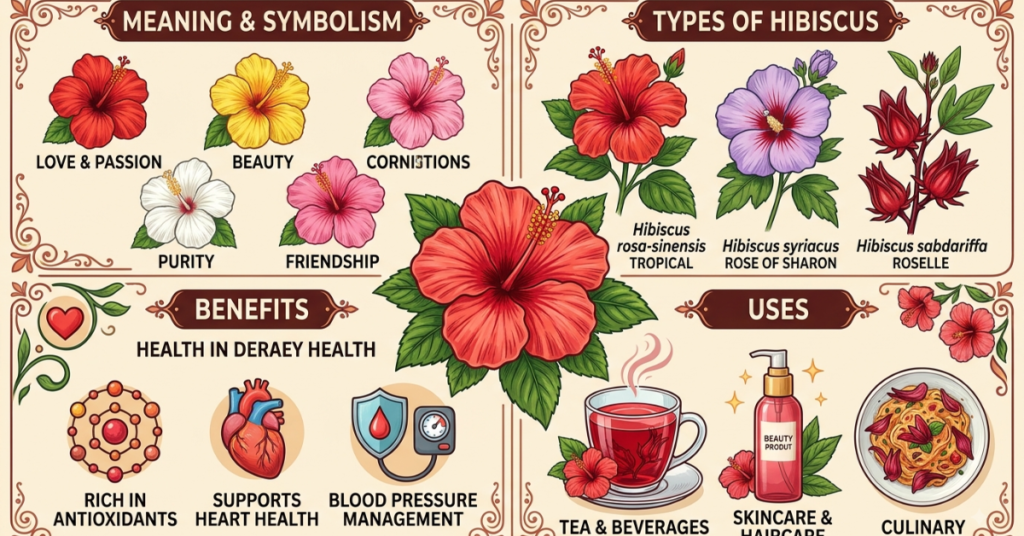
One of the best-known ornamental types is Hibiscus × rosa-sinensis, commonly called Chinese hibiscus or China rose. It is widely cultivated in tropical and subtropical climates and is available in numerous flower colors and forms.
Another important species is Hibiscus sabdariffa, commonly known as roselle. Unlike ornamental hibiscus, roselle is particularly well known for its fleshy calyces, which are used to make beverages and herbal preparations.
What Does Hibiscus Look Like?
A typical hibiscus bloom has:
- Large, delicate petals
- A prominent central staminal column
- Five-lobed floral structures in many species
- Green leaves that can vary in shape
- A wide range of flower colors
- A generally tropical or exotic appearance
The exact shape, size, color, and growth habit depend on the species or cultivar.
Hibiscus Flower Meaning
The hibiscus flower meaning varies across cultures, colors, and traditions. Because the flower is strongly associated with tropical landscapes, beauty, warmth, and femininity, it often carries a cheerful and romantic symbolism.
Hibiscus can represent:
- Beauty and femininity
- Love and affection
- Delicate beauty
- Tropical charm
- Celebration
- Hospitality
- Passion
- Youth and vitality
The meaning can also change according to the flower’s color.
For example, a red hibiscus flower is often associated with passion and love, while pink varieties may suggest affection, admiration, or gentleness. White flowers can evoke purity and elegance.
It is worth remembering that flower symbolism is not universal. Meanings can differ significantly between cultures and traditions.
Popular Hibiscus Flower Colors
One of the reasons hibiscus remains so popular is its incredible color variety. Some cultivars have single-colored petals, while others feature contrasting centers, gradients, or multiple shades.
Red Hibiscus Flower
The red hibiscus flower is probably the classic image many people have when they think of tropical hibiscus.
Its bold color gives it a dramatic appearance and makes it particularly attractive in gardens, floral photography, artwork, and tattoos. Red hibiscus is also commonly associated with passion, romance, and confidence.
Pink Hibiscus Flower
A pink hibiscus flower has a softer and more romantic appearance. Depending on the shade, pink can range from pale blush to vivid hot pink.
Pink hibiscus works beautifully in:
- Garden borders
- Tropical-themed arrangements
- Floral illustrations
- Wedding-inspired décor
- Nail art
- Wallpapers
White Hibiscus Flower
The white hibiscus flower creates a much more delicate and elegant impression. Its clean petals can look especially striking against dark green foliage.
White hibiscus is often associated with purity, grace, peace, and simplicity, although the symbolism varies by culture.
Purple Hibiscus Flower
A purple hibiscus flower can look particularly dramatic because purple shades are less commonly associated with traditional hibiscus imagery.
Purple blooms can range from lavender and violet to deep reddish-purple tones. They are a beautiful choice for gardens and floral artwork when you want something a little less conventional.
Blue Hibiscus Flower
The term blue hibiscus flower can be slightly misleading. Genuine blue flowers are uncommon in the hibiscus genus, and plants marketed or described as “blue hibiscus” may belong to other genera or have flowers that appear bluish, lavender, or blue-purple.
So, if you are shopping for a blue-flowering plant, check the botanical name rather than relying only on the common name.
Hawaiian Hibiscus Flower
The Hawaiian hibiscus flower is strongly connected with the tropical visual identity of Hawaii. Hibiscus species and hybrids are widely grown in Hawaii, where the flowers are valued for their beauty and cultural associations.
However, “Hawaiian hibiscus” does not necessarily refer to one single botanical species. Hawaii has native hibiscus species as well as cultivated and introduced varieties.
This distinction matters because common names can sometimes group several different plants under one familiar label.
Hibiscus Flower Benefits
When people search for hibiscus flower benefits, they are often referring specifically to preparations made from Hibiscus sabdariffa, particularly hibiscus tea.
Research has investigated hibiscus preparations for cardiovascular and metabolic effects. Several systematic reviews and clinical trials have reported that H. sabdariffa consumption may modestly lower blood pressure, particularly in people with elevated blood pressure.
However, this research should not be interpreted as proof that hibiscus can replace prescribed medication or medical treatment.
Potentially Studied Benefits of Hibiscus
Research has explored hibiscus in relation to:
- Blood pressure – Clinical studies have reported reductions in blood pressure, although results and study designs vary.
- Antioxidant compounds – Hibiscus preparations contain various plant compounds, including polyphenols and anthocyanins.
- Cardiometabolic health – Research has examined possible effects on cardiovascular risk markers and glucose levels.
- Traditional wellness uses – Hibiscus has a long history of use in different food and traditional medicine practices.
More research is still needed to establish the best preparation, dose, duration, and long-term effects.
Is Hibiscus a Medicine?
Not exactly.
Hibiscus tea can be part of a normal diet, but it should not be treated as a substitute for medical care. If you take medication for blood pressure, blood sugar, or another chronic condition, it is sensible to discuss regular herbal tea consumption with a healthcare professional.
Hibiscus Flower Tea
Hibiscus flower tea is usually made from Hibiscus sabdariffa, rather than the large ornamental hibiscus flowers commonly grown in gardens.
The resulting drink is naturally tart and fruity, with a deep ruby-red color. It can be enjoyed hot or cold and is often sweetened or combined with other herbs, fruit, or spices.
How Is Hibiscus Tea Made?
A simple preparation involves:
- Place dried hibiscus calyces or a suitable commercial hibiscus tea blend in a cup or teapot.
- Add hot water.
- Steep for several minutes according to the product’s instructions.
- Strain if necessary.
- Enjoy warm or chill it for iced tea.
The flavor is naturally sour, somewhat similar to cranberry.
Studies investigating hibiscus tea have used specific preparations and quantities, so drinking an ordinary cup at home should not be assumed to provide exactly the same effects observed in clinical research.
Hibiscus Flower Bouquet Ideas
A hibiscus flower bouquet gives off an instantly tropical feeling. Because the blooms are large and visually dominant, they can work especially well in arrangements where the flowers themselves are meant to be the focus.
For a balanced bouquet, consider combining hibiscus with:
- Tropical foliage
- Palm leaves
- Orchids
- Bird-of-paradise flowers
- Baby’s breath for contrast
- Smaller filler flowers
Hibiscus is particularly effective in summer-inspired arrangements, tropical events, destination weddings, and bright home décor.
Keep in mind that ornamental hibiscus flowers can be delicate and may not have the same vase life as traditional cut flowers. For a long-lasting arrangement, choose florist-approved varieties and conditioning methods.
Hibiscus Flower Drawing Ideas
The distinctive shape of hibiscus makes it an excellent subject for artists.
A hibiscus flower drawing can be as simple or detailed as you want. The flower’s large petals and central staminal column make it recognizable even in a minimalist illustration.
How to Draw a Hibiscus Flower
If you’re wondering how to draw a hibiscus flower, start with the basic structure instead of trying to copy every detail immediately.
- Draw a small circle or oval to establish the flower’s center.
- Sketch five broad petals around the center.
- Give each petal a slightly curved, natural edge.
- Add the central staminal column.
- Draw the small details around the stamens.
- Add veins to the petals using light lines.
- Refine the outline and erase unnecessary construction marks.
- Add shading or color.
Hibiscus Flower Drawing Easy
For a hibiscus flower drawing easy enough for beginners, simplify the flower into five overlapping petals.
You don’t need to capture every botanical detail. Focus on the overall silhouette, the curved petals, and the distinctive central structure. Once the basic form looks right, add details gradually.
Hibiscus Flower Outline
A hibiscus flower outline is useful for coloring pages, logo concepts, tattoos, crafts, worksheets, digital illustrations, and printable artwork.
For a clean outline:
- Keep the outer petal curves smooth.
- Avoid adding too many interior lines.
- Make the central column clearly visible.
- Use different line weights if creating a professional illustration.
- Simplify small details when the design will be printed at a small size.
A simple outline can often communicate the flower more effectively than an overly detailed drawing.
Hibiscus Flower Tattoo
The hibiscus flower tattoo is popular because the flower has a naturally recognizable shape and can be adapted to many tattoo styles.
Depending on the design, hibiscus tattoos can represent beauty, love, femininity, tropical memories, growth, or a connection to a particular place or culture.
Popular tattoo approaches include:
- Minimalist line art
- Realistic botanical tattoos
- Watercolor-inspired designs
- Black-and-grey illustrations
- Traditional floral tattoos
- Small ankle or wrist designs
- Large shoulder or back compositions
If cultural symbolism is important to you, research the specific tradition behind a design rather than assuming every hibiscus tattoo has the same meaning.
Hibiscus Flower Nails
Floral nail art is another creative way to use the hibiscus shape.
Hibiscus flower nails can be designed around almost any color palette. A simple version might feature a nude or pale base with one hibiscus bloom on each accent nail.
For a tropical look, try:
- Pink hibiscus on a white base
- Red hibiscus with green leaves
- White flowers on a bright background
- Tiny hibiscus accents on French tips
- Tropical hibiscus patterns across multiple nails
Because the petals are recognizable, even a simplified hibiscus motif can look polished.
Hibiscus Flower Clipart
Hibiscus flower clipart is commonly used for digital projects, invitations, posters, blogs, social media graphics, stickers, and educational materials.
When selecting clipart, pay attention to the licensing terms. Not every image found through a search engine is free to use commercially.
For professional projects, look for:
- Commercial-use permission
- Transparent PNG files
- SVG or vector versions when needed
- High-resolution artwork
- Clear licensing information
This is particularly important if the artwork will appear on products that you sell.
Hibiscus Flower Wallpaper
A hibiscus flower wallpaper can bring a tropical or botanical feel to a room without requiring actual plants.
Large hibiscus motifs work especially well as statement walls, while smaller repeating patterns can create a softer look.
For interiors, consider the scale carefully:
- Large blooms: dramatic and luxurious
- Small repeating flowers: lighter and more traditional
- Dark backgrounds: rich and dramatic
- Light backgrounds: airy and fresh
- Muted colors: subtle and sophisticated
- Bright tropical colors: energetic and playful
Hibiscus patterns can work particularly well in bedrooms, bathrooms, sunrooms, cafés, and tropical-inspired interiors.
Lego Hibiscus Flower
The LEGO hibiscus flower is an example of how recognizable botanical forms can be translated into brick-based design.
Building a hibiscus from LEGO elements requires thinking about the flower as a collection of simple shapes rather than as a realistic botanical structure. Petals can be built individually and arranged around a central point, while green pieces can form the stem and leaves.
This makes hibiscus an interesting subject for creative building projects, especially for children, botanical displays, and custom floral arrangements.
Hibiscus Flower Care
If you are growing ornamental hibiscus, remember that these plants generally prefer warmth, sunlight, and suitable moisture.
Basic Hibiscus Care
Light: Most tropical hibiscus varieties perform best with plenty of bright light and sunlight.
Water: Water consistently, but avoid keeping the soil constantly waterlogged.
Soil: Use fertile, well-draining soil.
Feeding: During active growth, an appropriate fertilizer can support flowering.
Pruning: Light pruning can help maintain shape and encourage branching.
Temperature: Tropical hibiscus is sensitive to cold and may need protection in cooler climates.
Because the genus includes many species, exact requirements can differ. Always check the care instructions for your particular cultivar.
Hibiscus vs. Roselle: Are They the Same?
They are related, but they are not the same plant.
The word “hibiscus” describes a broad genus containing many species. Ornamental plants such as Hibiscus × rosa-sinensis are widely grown for their flowers, while Hibiscus sabdariffa is particularly important for its edible calyces and use in beverages.
This distinction is especially important when researching hibiscus flower benefits or hibiscus flower tea. Evidence from studies on H. sabdariffa should not automatically be applied to every ornamental hibiscus species.
Why Is Hibiscus So Popular?
There is no single reason for the flower’s popularity. It brings together several qualities that people naturally appreciate.
1. It Has a Striking Shape
The large petals and prominent central structure make hibiscus easy to recognize.
2. It Comes in Many Colors
From classic red and pink to white and purple, there is a hibiscus for almost every garden palette.
3. It Works Across Different Creative Fields
Hibiscus appears in:
- Botanical art
- Fashion
- Tattoos
- Nail designs
- Home décor
- Wallpapers
- Wedding stationery
- Digital graphics
- Photography
4. It Has Cultural and Culinary Connections
Different hibiscus species have been used ornamentally, culturally, and as food or beverage ingredients in various parts of the world.
Frequently Asked Questions About Hibiscus Flower
What does the hibiscus flower symbolize?
Hibiscus can symbolize beauty, love, femininity, passion, youth, hospitality, and tropical beauty. The exact meaning depends on the color and cultural context.
What is the most common hibiscus flower color?
Red is one of the most recognizable hibiscus colors, but cultivated hibiscus varieties are available in many colors, including pink, white, yellow, orange, and purple.
Is hibiscus flower tea made from hibiscus flowers?
Hibiscus tea is commonly made from Hibiscus sabdariffa, particularly its dried calyces. It is different from simply steeping an ornamental hibiscus flower.
What are the benefits of hibiscus flower tea?
Research suggests that Hibiscus sabdariffa preparations may modestly reduce blood pressure, particularly among people with elevated blood pressure. Research into other cardiometabolic effects is ongoing.
Can you eat hibiscus flowers?
Some hibiscus species and plant parts are used as food, but not every ornamental hibiscus should automatically be considered edible. Identify the exact species and make sure the plant has been grown for culinary use before consuming it.
What is the meaning of a red hibiscus flower?
Red hibiscus is commonly associated with passion, love, beauty, and strong emotions, although flower symbolism varies across cultures.
Is there a real blue hibiscus flower?
True blue hibiscus flowers are uncommon. Plants sold under the name “blue hibiscus” may belong to another genus or have flowers that appear lavender, violet, or blue-purple.
How do you draw a hibiscus flower easily?
Start with five rounded petals around a central point, then add the staminal column and a few petal veins. Keeping the shape simple makes a hibiscus flower drawing easy for beginners.
What is a hibiscus flower tattoo supposed to mean?
A hibiscus tattoo can represent beauty, love, femininity, tropical memories, or personal connection to a place or culture. Its meaning ultimately depends on the person wearing it.
Is hibiscus good for a garden?
Yes. Many ornamental hibiscus varieties are excellent garden plants in warm climates. They produce large, colorful flowers and can make a strong visual statement when given suitable growing conditions.
Final Thoughts on the Hibiscus Flower
The hibiscus flower is much more than a pretty tropical bloom. Its distinctive shape, wide range of colors, cultural symbolism, ornamental value, and connection with hibiscus tea have made it one of the most recognizable flowers around the world.
Whether you’re interested in a pink hibiscus flower for your garden, a hibiscus flower bouquet for an event, a hibiscus flower tattoo, an easy hibiscus flower drawing, or simply want to understand hibiscus flower meaning, there is plenty to explore.
Just remember that “hibiscus” covers many different species. When researching health benefits, edible uses, or plant care, checking the botanical name is one of the easiest ways to separate reliable information from generic claims.
If you love botanical themes, hibiscus is also a great starting point for exploring other tropical flowers, floral artwork, garden design ideas, and nature-inspired décor.