
Have you ever looked at an oleander flower and wondered how something so delicate could carry such a complicated message? With its pretty clusters of pink, white, red, and other cultivated colors, oleander looks cheerful at first glance—but its symbolism has a much darker side.
The oleander meaning is closely associated with caution, danger, beauty, and hidden toxicity. In the Victorian language of flowers, oleander was famously associated with the warning “beware.” Modern interpretations also connect it with resilience, complicated love, emotional boundaries, and the contrast between outward beauty and inner danger.
But there is more to this flower than its symbolism. Let’s explore the oleander meaning flower, its colors, cultural names, spiritual interpretations, and the meanings behind references such as Mother Mother’s “Oleander” and Hannah Bahng’s song of the same name.
What Is the Oleander Flower?
Oleander is the common name for Nerium oleander, an evergreen shrub belonging to the dogbane family, Apocynaceae. Kew’s Plants of the World Online recognizes Nerium oleander L. as the accepted species. Its native range extends from the Mediterranean region eastward to Myanmar, with the plant now cultivated widely in warm climates.
The plant is particularly recognizable for:
- Narrow, leathery green leaves
- Clusters of funnel-shaped flowers
- Pink, red, white, cream, and other cultivated flower colors
- Evergreen foliage
- Strong tolerance of heat, drought, and salt spray
- Its use as an ornamental shrub, hedge, and roadside planting
Despite its attractive appearance, oleander is highly poisonous if eaten. Kew notes that all parts of the plant are extremely toxic if ingested, largely because of cardiac glycosides such as oleandrin.
That toxicity is important because it helps explain why the flower developed such strong associations with warning and danger.
Oleander Meaning in English
The oleander meaning in English simply refers to the flowering shrub Nerium oleander. The word “oleander” is the common English plant name rather than a word that literally translates into a particular emotional quality.
In everyday English, however, the flower can carry symbolic meanings such as:
- Caution
- Beware
- Hidden danger
- Beauty with a dangerous side
- Resilience
- Complicated love
- Emotional boundaries
The exact symbolism depends on the cultural or literary context.
Oleander Meaning Flower: What Does Oleander Symbolize?
So, what does an oleander flower actually symbolize?
The most historically grounded answer is caution or “beware.” Kate Greenaway’s Language of Flowers, published in the Victorian era, lists oleander as “Beware.” A Royal Horticultural Society comparison of historical flower-language sources also shows that “beware” was a recurring meaning associated with oleander in several traditional dictionaries.
This makes sense when you consider the plant itself. Oleander can look harmless and beautiful while containing potent toxins.
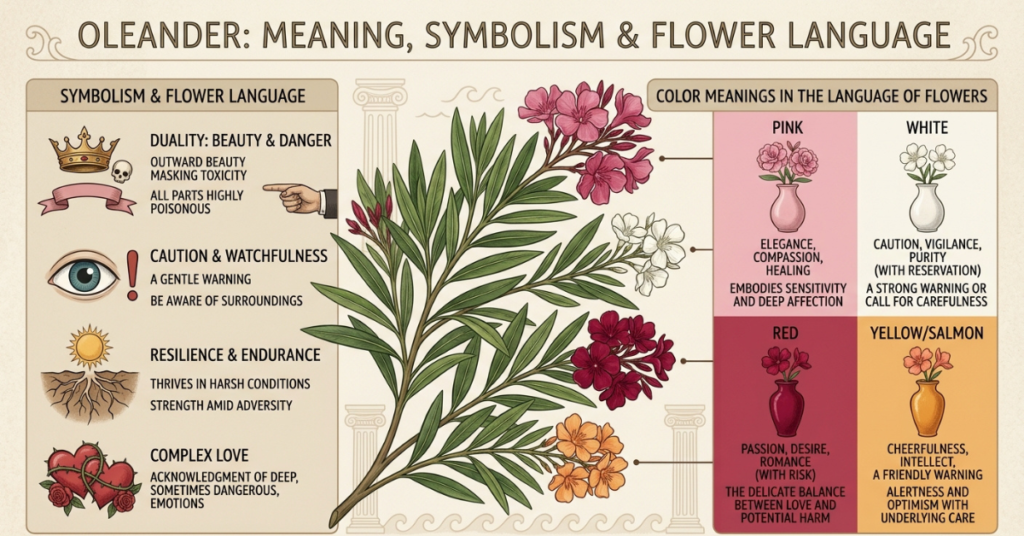
Its symbolism can therefore be understood as a contrast:
Beautiful on the outside, dangerous when approached carelessly.
That duality is one of the most fascinating parts of the oleander meaning symbolism.
Oleander Meaning Symbolism
The oleander meaning symbolism is often interpreted through several themes.
1. Caution and Warning
This is the strongest historical association. In Victorian flower language, oleander could communicate a warning without saying anything directly.
2. Beauty and Danger
Oleander represents the idea that something beautiful is not necessarily safe. Its attractive flowers and toxic nature create a natural metaphor for relationships, people, temptation, and situations that appear inviting but require caution.
3. Resilience
Oleander is remarkably adaptable. It can tolerate heat, drought, salt spray, and a range of soils, which has encouraged modern symbolic interpretations involving endurance and survival. Kew describes it as widely cultivated in warm climates and capable of tolerating drought and salt spray.
4. Complicated Love
Because oleander combines beauty with toxicity, it can symbolize love that is intense but unhealthy, attractive but painful, or difficult to leave behind.
This interpretation is especially common in contemporary poetry, music, tattoos, and visual art.
5. Boundaries
A more modern reading of oleander is emotional protection. Its symbolism can suggest knowing when to step back, recognizing danger, and protecting yourself from something that looks appealing but causes harm.
Victorian Language of Flowers: Oleander Meaning
The Victorian language of flowers oleander meaning is particularly interesting because flowers were once used as a kind of symbolic communication.
In the Victorian era, people could use flowers to express emotions that were difficult—or socially inappropriate—to say openly. Different flower dictionaries assigned different messages to individual plants, although meanings were not always completely consistent from one source to another.
For oleander, one of the clearest historical meanings was:
Oleander = “Beware.”
This makes oleander quite different from flowers such as roses, which are strongly associated with romantic love, or violets, which have traditionally carried other sentimental meanings.
Interestingly, historical flower dictionaries were not perfectly standardized. The Royal Horticultural Society’s research comparing multiple historical sources shows that flower meanings could vary considerably depending on the author and publication.
So it is better to describe “beware” as a documented traditional oleander meaning, rather than claiming it was the only meaning ever associated with the flower.
White Oleander Meaning
The white oleander meaning is especially intriguing because white flowers are often culturally associated with purity, innocence, peace, and spirituality.
When combined with oleander’s traditional symbolism, white oleander can create a more complicated message:
- Pure-looking beauty
- Innocence with a hidden danger
- Caution beneath a peaceful appearance
- Emotional distance
- Quiet strength
There is also historical evidence that different oleander colors and forms received different associations in some flower-language traditions. The Royal Horticultural Society’s historical comparison records a meaning of “candeur”—frankness or candor—for white oleander in one French-derived source.
So, rather than assigning one universal definition to white oleander, it is more accurate to view its meaning as a combination of color symbolism and the broader symbolism of oleander.
Pink Oleander Meaning
The pink oleander meaning is generally softer and more romantic than the traditional warning associated with the species as a whole.
Pink flowers commonly evoke:
- Affection
- Tenderness
- Romance
- Admiration
- Gentleness
- Emotional warmth
When these associations are combined with oleander’s traditional symbolism, pink oleander can represent beautiful but complicated affection—love that is powerful, delicate, or potentially dangerous.
It’s worth remembering that color meanings are largely interpretive. There isn’t a universally accepted historical Victorian code saying that every pink oleander must mean one specific thing.
Red Oleander Meaning
The red oleander meaning can be interpreted through the symbolism traditionally attached to red flowers: passion, intensity, desire, courage, and strong emotion.
Red oleander therefore lends itself naturally to ideas such as:
- Passionate love
- Intense attraction
- Emotional strength
- Desire
- Powerful but complicated relationships
The combination of red and oleander’s toxic nature can make the symbolism particularly dramatic: passion with a warning attached.
Historical botanical sources also distinguish red-flowered oleander varieties within traditional Indian naming systems.
Nerium Oleander Meaning
The Nerium oleander meaning refers to the botanical identity behind the common name oleander.
Nerium oleander is the accepted scientific name, and the plant belongs to the family Apocynaceae. Kew records it as an evergreen shrub or small tree that can grow to around 6 meters and notes that its flowers may be pink or red in wild forms, with cultivated varieties occurring in white, cream, yellow, purple, and double-flowered forms.
The name Nerium is commonly connected with the Greek word nerion, associated with water, reflecting the plant’s historical association with areas near water. However, the botanical name itself should not be confused with the flower’s symbolic meaning.
Oleander Meaning in Hindi
The oleander meaning in Hindi is commonly associated with कनेर (Kaner).
Oleander has several regional names across South Asia. Indian botanical references list Kaner among its Hindi names, while also recording names such as Ganneru in Telugu and Sevvarali in Tamil.
In Hindi-speaking contexts, you may therefore see oleander referred to as:
Oleander = Kaner (कनेर)
The plant is widely grown as an ornamental shrub and is also associated with gardens and places of worship in parts of India.
Oleander Meaning in Urdu
The oleander meaning in Urdu is commonly given as کنیر (Kaner).
The name refers to the same flowering shrub, Nerium oleander. Regional botanical sources list Kaner as an Urdu name for the plant.
Its symbolic meaning in Urdu would still depend on context. If someone uses the flower metaphorically, ideas such as beauty, warning, danger, or complicated affection may be intended.
Oleander Meaning in Tamil
The oleander meaning in Tamil is commonly associated with அரளி (Arali) or related forms such as Sevvarali.
Indian flora references list Arali and Sevvarali among Tamil and South Indian names associated with Nerium oleander.
As with the other regional names, this is primarily a botanical or vernacular name rather than a direct translation of the symbolic concept “beware.”
Oleander Meaning in Telugu
The oleander meaning in Telugu is commonly గన్నేరు (Ganneru).
Botanical references list Ganneru and related names among the Telugu vernacular names for Nerium oleander.
The flower is widely cultivated in India, including as an ornamental plant around homes, gardens, and roadsides.
Oleander Meaning in Marathi
The oleander meaning in Marathi is commonly कण्हेर (Kanher).
Sources documenting Indian plant names list Kanher as a Marathi name for oleander.
Again, the regional name identifies the plant; it does not necessarily mean that Marathi speakers universally attach the Victorian symbolism of “beware” to it.
Oleander Meaning Spiritual
The oleander meaning spiritual is more interpretive than botanical or historical.
From a spiritual-symbolism perspective, oleander can represent the lesson that beauty and danger can exist together. It may remind someone to look beyond appearances, trust their intuition, and recognize when something requires healthy boundaries.
Its ability to survive harsh environments can also inspire associations with:
- Resilience
- Inner strength
- Protection
- Transformation
- Survival
- Discernment
There is no single universally accepted spiritual meaning of oleander. Spiritual interpretations vary between traditions and are best presented as symbolic readings rather than established facts.
Oleander Meaning Name: What Does the Name Represent?
If you’re wondering about the oleander meaning name, it is important to distinguish the plant’s name from its symbolic meaning.
“Oleander” is primarily the English common name for Nerium oleander. It isn’t traditionally an English personal name with one fixed meaning like names such as Rose or Lily.
As a given name, however, Oleander can be chosen for its unusual floral imagery. Someone might associate it with beauty, strength, individuality, or the fascinating contrast between attractiveness and danger.
Mother Mother Oleander Meaning
One of the more popular modern searches is “mother mother oleander meaning,” referring to the song “Oleander” by Mother Mother.
The song uses oleander as a metaphor rather than simply talking about gardening or botany. Interpretations of the song commonly focus on a troubled, dependent relationship in which love and harm become intertwined. The flower’s poisonous nature makes it an effective metaphor for a relationship that can look beautiful or comforting while still being destructive.
This is where the traditional symbolism becomes especially relevant.
Oleander = beauty + toxicity + warning.
In the context of the song, the flower can therefore be read as a symbol of a person or relationship that is emotionally complicated and potentially harmful.
Mother Mother Oleander Meaning in Simple Words
In simple terms, the song can be understood as exploring:
- A relationship built around emotional dependence.
- Fear of losing someone who provides support.
- The tension between love and destructive behavior.
- The realization that closeness can become unhealthy.
- The metaphor of a beautiful but poisonous flower.
That interpretation fits naturally with the real-world characteristics of oleander, although the meaning of a song is ultimately open to personal interpretation.
Hannah Bahng Oleander Meaning
The Hannah Bahng oleander meaning is another modern interpretation of the flower’s symbolism.
Hannah Bahng’s song “Oleander” uses the flower as an emotional metaphor. Contemporary interpretations of the song focus on loneliness, emotional exhaustion, longing, and a relationship that has become painful or disconnected.
The oleander image works particularly well because the flower has a built-in contradiction: it is visually beautiful but toxic.
That makes it a fitting symbol for a relationship that may contain affection and attraction while also causing emotional pain.
Rather than saying the song has one officially confirmed meaning, it is safer to describe the flower as a metaphor for emotional toxicity, loneliness, complicated attachment, and the difficulty of letting go.
Why I’m Here Oleander Meaning: Is It About the Flower?
This search query can be confusing because there are two separate things involved.
“Why I’m Here” is a song by the band Oleander, not a song literally about the oleander flower. The band itself took its name from the poisonous flowering shrub.
The song “Why I’m Here,” released as a single from February Son in 1999, deals with emotional pain, relationship difficulties, resentment, and fear surrounding love.
So the phrase “why I’m here oleander meaning” can refer to the band’s song rather than the botanical meaning of oleander.
It’s an important distinction:
- Oleander the flower: a poisonous flowering shrub with historical symbolism of caution.
- Oleander the band: a post-grunge rock band named after the plant.
- “Why I’m Here”: a song by that band, dealing with emotional and relationship struggles.
Is Oleander a Symbol of Death?
Oleander is sometimes associated with death because the plant is genuinely poisonous and has historically been used as a source of toxic substances. Kew states that ingestion of oleander can cause serious symptoms, including cardiac arrhythmias, low blood pressure, and death.
However, saying that the universal symbolic meaning of oleander is simply “death” would be too simplistic.
Its symbolism is broader and more nuanced:
beauty → danger → caution → emotional complexity.
Death can appear in literary or artistic interpretations because of the plant’s toxicity, but it isn’t the only meaning associated with oleander.
Is Oleander a Symbol of Love?
It can be, but context matters.
Some modern flower symbolism connects oleander with romantic attraction, desire, and complicated love. However, its historical Victorian meaning of “beware” adds a darker dimension.
That’s why oleander can be an interesting symbol for love that is intense but risky.
It is less like a straightforward red rose and more like a reminder that love can be beautiful while still requiring boundaries.
Oleander Colors and Their Symbolism
Here’s a simple way to understand the most common interpretations:
| Oleander Color | Common Symbolic Interpretation |
| White | Purity, innocence, quiet beauty, caution |
| Pink | Affection, tenderness, romantic feeling |
| Red | Passion, intensity, desire |
| Purple | Mystery, individuality, emotional depth |
| Yellow/cream | Cheerfulness, warmth, brightness |
These color meanings should be treated as modern interpretive symbolism, not as a universal historical Victorian dictionary. Oleander has many cultivated forms and colors, while historical flower-language books did not always agree with one another.
Oleander as a Symbol in Art and Literature
Oleander’s symbolism works particularly well in creative writing because it contains an inherent contradiction.
Imagine a character who looks gentle but is capable of causing harm. Or a relationship that feels beautiful but gradually becomes destructive. Or a person who has survived difficult circumstances while carrying emotional scars.
Oleander can represent all of these ideas.
That is why the flower appears naturally in:
- Poetry
- Songs
- Tattoos
- Paintings
- Fiction
- Gothic aesthetics
- Romantic symbolism
- Floral photography
Its visual beauty makes it attractive to artists, while its toxicity gives it a deeper narrative layer.
Is Oleander Poisonous?
Yes. This is one point that should never be treated merely as symbolism.
All parts of Nerium oleander are extremely toxic if eaten. Kew identifies cardiac glycosides, particularly oleandrin, as major toxic compounds. Ingestion can result in nausea, vomiting, abnormal heart rhythms, low blood pressure, and potentially death.
The sap can also irritate the skin, and Kew advises avoiding smoke from burning the plant.
So although oleander is a popular ornamental plant, it should never be eaten or used casually as a home remedy.
Frequently Asked Questions About Oleander Meaning
What is the main oleander meaning?
The strongest historical oleander meaning is “beware” or “caution.” This comes from Victorian-era language-of-flowers traditions. Modern interpretations also include beauty, danger, resilience, and complicated love.
What does oleander symbolize?
Oleander symbolizes caution, hidden danger, beauty with a dangerous side, resilience, and complicated emotions. Its poisonous nature strongly influences these interpretations.
What is the Victorian language of flowers oleander meaning?
In Kate Greenaway’s Language of Flowers, oleander is associated with “Beware.” Several other historical flower-language sources also record this warning-related meaning.
What does white oleander mean?
White oleander can symbolize purity, innocence, quiet beauty, and caution. In one historical flower-language source compared by the RHS, white oleander was associated with candor or frankness.
What does pink oleander mean?
Pink oleander is commonly interpreted as affection, tenderness, romance, and emotional warmth, combined with the broader symbolism of caution and hidden danger.
What does red oleander mean?
Red oleander can symbolize passion, desire, intensity, and powerful emotion. Because oleander is also associated with caution, the combination can suggest intense but complicated love.
What is oleander called in Hindi?
Oleander is commonly called Kaner (कनेर) in Hindi.
What is oleander called in Urdu?
Oleander is commonly known as Kaner (کنیر) in Urdu.
What is oleander called in Tamil?
Oleander is commonly known as Arali (அரளி) in Tamil, with related regional forms also documented.
What is oleander called in Telugu?
Oleander is commonly known as Ganneru (గన్నేరు) in Telugu.
What is oleander called in Marathi?
Oleander is commonly called Kanher (कण्हेर) in Marathi.
What is the spiritual meaning of oleander?
There is no single universally accepted spiritual meaning. Symbolically, oleander can represent resilience, protection, discernment, boundaries, and the lesson that beauty can conceal danger.
What does Mother Mother’s “Oleander” mean?
Mother Mother’s “Oleander” uses the flower as a metaphor for a relationship involving emotional dependence, vulnerability, and destructive or toxic dynamics. The flower’s poisonous nature reinforces the song’s central metaphor.
What does Hannah Bahng’s “Oleander” mean?
Hannah Bahng’s “Oleander” has been interpreted around themes of loneliness, emotional exhaustion, longing, and a painful or disconnected relationship. The flower’s beauty-versus-toxicity contrast strengthens that emotional imagery.
Is “Why I’m Here” about oleander?
Not directly. “Why I’m Here” is a song by the band Oleander, whose name comes from the poisonous flowering shrub. The song itself focuses on emotional and relationship struggles rather than explaining the flower’s botanical symbolism.
Final Thoughts on Oleander Meaning
The oleander meaning is fascinating precisely because it isn’t one-dimensional. Historically, the flower carried the message “beware,” while modern interpretations have expanded that idea into themes of hidden danger, resilience, complicated love, emotional boundaries, and beauty that isn’t always what it seems.
Its different colors can add softer or stronger emotional associations, while its use in songs such as Mother Mother’s “Oleander” and Hannah Bahng’s “Oleander” shows how naturally the flower lends itself to stories about complicated relationships and emotional pain.
One final point is worth remembering: oleander is genuinely toxic, not merely “symbolically poisonous.” Its beauty makes it popular in landscaping, but every part of the plant should be treated with care.
If you’re exploring flower symbolism, oleander is a particularly interesting one to compare with roses, lilies, daisies, or other flowers whose meanings are shaped by color, culture, history, and literature.