
A simple palm branch can carry a surprisingly deep meaning. For centuries, people have connected palm fronds with victory, peace, honor, prosperity, hope, and renewal. Their symbolism appears in ancient cultures, religious traditions, art, and celebrations.
The palm fronds meaning becomes especially important in Christianity. Palm branches play a central role in Palm Sunday, when Christians remember Jesus’ triumphant entry into Jerusalem.
But what does a palm frond symbolize beyond this biblical story? In this guide, we’ll explore the palm fronds meaning spiritual traditions, its significance in Christianity, its connection to ancient cultures, and the ways people interpret palm imagery today.
What Is the Meaning of Palm Fronds?
Palm fronds are the large, leafy structures that grow from palm trees. Because many palm species stay green throughout the year and thrive in hot, challenging environments, people have long associated them with life, endurance, growth, and renewal.
However, their symbolism goes beyond their natural qualities. Different cultures have used palm branches to celebrate achievements, honor important people, and express religious devotion.
Common meanings include:
- Victory and triumph
- Peace and harmony
- Honor and recognition
- Life and renewal
- Prosperity and abundance
- Celebration
- Hope
- Spiritual devotion
- Strength and resilience
Historically, people in the ancient Mediterranean world used palm branches in celebrations and ceremonies. In particular, palm leaves became associated with victorious athletes and other people who had achieved distinction.
As a result, the palm branch gradually developed a broader meaning. It could represent not only victory but also the hope and confidence that come after overcoming a difficult challenge.
Palm Fronds Meaning Spiritual
The palm fronds meaning spiritual often centers on strength, hope, peace, renewal, and victory over hardship.
Palm trees provide a natural reason for this symbolism. Many species can withstand intense heat, limited water, and harsh environmental conditions. Therefore, people often see the palm as a reminder to remain strong when circumstances become difficult.
Here are some of the most common spiritual interpretations.
1. Victory Over Challenges
First, a palm branch can represent victory after a difficult struggle. It may symbolize reaching the other side of a challenging experience with greater strength and wisdom.
For this reason, someone might use palm imagery as a reminder of a personal achievement or an obstacle they successfully overcame.
2. Peace and Harmony
Palm branches can also represent peace. Their association with celebration and reconciliation gives them a gentle meaning that contrasts with their connection to victory.
In a spiritual sense, a palm frond may represent the desire to find calm after conflict, restore a relationship, or create greater harmony in life.
3. Renewal and New Beginnings
Next, palm leaves can symbolize renewal. Since many palm trees maintain their greenery throughout the year, they naturally suggest continuing life and growth.
Therefore, a palm frond can represent starting again after a difficult chapter or moving forward with a renewed sense of purpose.
4. Strength and Resilience
Palm trees often grow in demanding environments, yet they continue to survive and develop. Consequently, people may view palm fronds as symbols of endurance.
Spiritually, the image can encourage someone to stay grounded and keep moving forward, even when life feels uncertain.
5. Hope
Finally, palm fronds can represent hope. Their green appearance, connection with life, and association with celebration all contribute to this interpretation.
In other words, the palm can remind us that difficult seasons can eventually give way to better ones.
Palm Fronds Meaning in Christianity
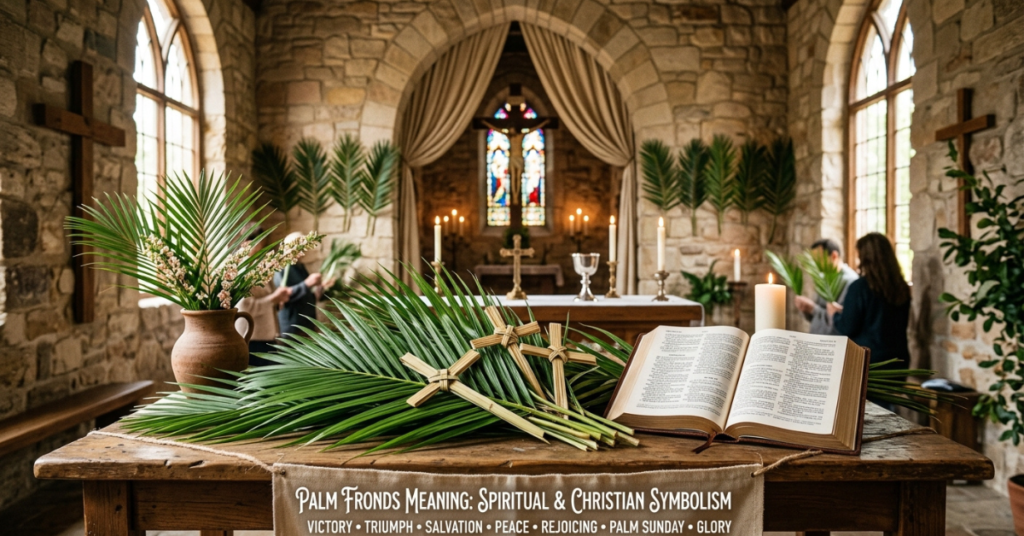
The palm fronds meaning in Christianity has a particularly strong connection with Jesus’ entry into Jerusalem.
The four canonical Gospels describe Jesus entering Jerusalem before his crucifixion. In the Gospel of John, the crowd took palm branches and went out to welcome him. The other Gospel accounts also describe the crowd using branches or leafy branches as they honored Jesus.
Christians commemorate this event on Palm Sunday, which takes place on the Sunday before Easter.
Palm Sunday begins Holy Week, the period that leads Christians through the final events of Jesus’ earthly ministry, including his crucifixion and resurrection.
For this reason, palm branches can carry several connected Christian meanings:
- Christ’s kingship
- Honor and worship
- Victory
- Faith
- Hope
- Peace
- Spiritual triumph
- The beginning of Holy Week
The story also creates an important contrast. Palm Sunday begins with celebration and public honor, but Holy Week soon turns toward suffering and sacrifice before reaching the celebration of the resurrection at Easter.
Therefore, for many Christians, the palm branch represents both Christ’s triumph and the hope of ultimate victory.
Why Are Palm Branches Used on Palm Sunday?
Christians use palm branches on Palm Sunday because of their connection with Jesus’ arrival in Jerusalem.
According to the Gospel of John, the crowd welcomed Jesus with palm branches. The gesture showed public enthusiasm and honor toward him.
Today, many churches continue this tradition. Depending on the denomination and local customs, worshippers may receive individual palm leaves, complete palm fronds, or intricately woven palm decorations during a Palm Sunday service.
The branches can then serve as physical reminders of the biblical event.
In many Christian communities, people take their palms home after the service. They may place them somewhere visible as a reminder of faith and the events of Holy Week.
What Does the Palm Branch Symbolize in the Bible?
Palm branches appear in several important biblical passages, so their meaning depends on the context.
In the Gospel accounts of Jesus’ entry into Jerusalem, the branches form part of a joyful welcome. They help communicate the crowd’s honor and celebration.
The Book of Revelation also uses palm branches in a significant scene. Revelation 7 describes a great multitude standing before God’s throne and holding palm branches in their hands.
This imagery connects palms with victory, worship, celebration, and spiritual triumph.
However, biblical symbolism does not always assign one fixed meaning to every mention of a palm. The surrounding passage and historical context matter. Therefore, it is better to understand the palm as carrying several related themes rather than one universal definition.
Palm Branch Symbolism in Ancient Cultures
Palm symbolism existed long before Christianity.
In the ancient Near East and Mediterranean regions, palm trees provided food, shade, materials, and other practical resources. Their ability to thrive in warm climates also made them valuable symbols of life and abundance.
Moreover, ancient societies connected palm branches with achievement and honor.
In ancient Greece, artists and writers associated palm branches with victory and successful competition. Roman culture also adopted similar imagery, particularly when celebrating achievement and military success.
Consequently, the palm branch became a recognizable visual symbol of triumph.
This earlier symbolism also helps explain why palm imagery carried such powerful emotional and cultural associations when Christians later used it in connection with Jesus’ entry into Jerusalem.
Palm Fronds as a Symbol of Victory
Victory remains one of the best-known meanings of a palm branch.
Historically, people associated palm leaves with victorious athletes, rulers, and other celebrated figures. As a result, the image became a visual shorthand for achievement.
Today, however, you don’t need to win a competition or lead an army to connect with this symbolism.
A palm frond can represent:
- Overcoming a difficult period
- Reaching an important goal
- Recovering after failure
- Celebrating personal growth
- Moving forward with confidence
- Successfully completing an important journey
For example, someone might choose a palm branch tattoo after overcoming a major challenge. Similarly, an artist might use palm imagery to communicate resilience and hope.
Palm Fronds and Peace
At first, victory and peace may seem like completely different ideas. However, the two concepts have often appeared together throughout history.
After conflict ends, people naturally associate victory with the possibility of peace and reconciliation. Consequently, branches and other natural imagery have frequently appeared in symbols connected with peaceful intentions.
Palm fronds can therefore communicate ideas such as:
- Calm after conflict
- Reconciliation
- Harmony
- A peaceful new beginning
- The end of a difficult struggle
In modern symbolism, a palm leaf can simply evoke a sense of tranquility. Its connection with warm landscapes, nature, and relaxation has also strengthened this interpretation.
Palm Fronds Meaning in Different Cultures
Palm symbolism appears in many cultures, although each tradition can interpret it differently.
Ancient Mediterranean Cultures
People associated palm branches with victory, achievement, honor, and celebration. Athletes and other successful individuals could receive palm imagery as a sign of distinction.
Ancient Near Eastern Cultures
Palm trees played an important practical and cultural role. Their connection with food, shade, fertility, and abundance encouraged associations with life and prosperity.
Jewish Traditions
Palm branches also appear in Jewish religious practice. During Sukkot, for example, Jews use the lulav, which includes a palm branch alongside branches from other plants. This practice has its own religious meaning and should not be confused with Christian Palm Sunday.
Christian Traditions
Christianity connects palm branches particularly strongly with Jesus’ entry into Jerusalem, worship, victory, kingship, and hope.
Modern Symbolism
Today, people often use palm imagery to represent relaxation, tropical life, nature, resilience, peace, and personal growth.
Therefore, context remains important. The same palm image can carry a religious meaning in one setting and a purely decorative or personal meaning in another.
Why Are Palm Fronds Important on Palm Sunday?
Palm Sunday holds an important place in the Christian calendar.
Churches around the world observe Palm Sunday on the Sunday before Easter. During services, many congregations distribute palm leaves or woven palm decorations to worshippers.
The tradition recalls Jesus’ arrival in Jerusalem before his crucifixion. According to the Gospel accounts, people welcomed him enthusiastically, and the Gospel of John specifically mentions palm branches.
The palms therefore connect modern worshippers with an event described in the New Testament.
At the same time, Palm Sunday prepares Christians for the more solemn events of Holy Week. The celebration of Jesus’ arrival eventually gives way to the remembrance of his suffering, death, and resurrection.
What Happens to Palm Branches After Palm Sunday?
The treatment of old palm branches depends on local church traditions.
In some Christian communities, churches collect the previous year’s palm branches, dry them, and burn them. Clergy can then use the resulting ashes during Ash Wednesday observances.
This practice creates a meaningful connection between two points in the Christian calendar.
Palm Sunday begins with the joyful imagery of palms and celebration. Ash Wednesday, by contrast, emphasizes repentance, mortality, and spiritual reflection.
As a result, the palm branch can become part of a larger yearly cycle of Christian worship.
What Does a Palm Frond Represent Spiritually Today?
Today, people can interpret palm fronds in both religious and personal ways.
For someone with a Christian background, a palm branch may immediately bring Palm Sunday, Jesus, faith, and resurrection to mind.
For someone approaching the symbol from a broader spiritual perspective, the palm may represent resilience, peace, personal growth, and hope.
Its symbolism can be summed up simply:
Strength + peace + renewal + victory + hope
Ultimately, the personal meaning depends on the person using the symbol. A palm frond might remind one individual of religious faith while reminding another of overcoming a difficult stage in life.
Palm Fronds in Art, Tattoos, and Home Decor
Palm imagery has moved well beyond religious ceremonies.
Interior designers, artists, fashion designers, and tattoo artists frequently use palm leaves because their shape creates an instantly recognizable natural aesthetic.
In home decor, palm leaves can suggest:
- Nature
- Relaxation
- Warmth
- Tropical landscapes
- Freshness
- Calmness
Meanwhile, people may choose palm branch tattoos for deeper personal reasons.
Common tattoo interpretations include:
- Surviving a difficult experience
- Personal growth
- Spiritual faith
- Victory over adversity
- Peace and tranquility
- Beginning a new chapter
- Connection with nature
Therefore, palm imagery can carry a religious message, a personal story, or simply an aesthetic appeal.
Palm Fronds vs. Palm Leaves: Is There a Difference?
People often use palm frond and palm leaf as interchangeable terms, and in everyday conversation, that usually causes no problem.
Botanically, however, a frond generally refers to the complete leaf structure of certain plants. In a palm, the frond includes the central stalk and the leaflets that extend from it.
So, when people discuss the branches used during Palm Sunday, they commonly refer to palm fronds or portions of palm leaves.
The distinction matters more in botanical discussions than in everyday conversations about symbolism.
Common Palm Frond Symbols at a Glance
| Symbol | Common Meaning |
| Palm branch | Victory and honor |
| Green palm leaf | Life and renewal |
| Palm on Palm Sunday | Christ’s triumph and kingship |
| Palm in spiritual art | Hope and resilience |
| Palm in ancient symbolism | Achievement and prosperity |
| Palm in modern decor | Nature, peace, and relaxation |
Frequently Asked Questions About Palm Fronds Meaning
What does a palm frond symbolize?
A palm frond commonly symbolizes victory, peace, honor, renewal, hope, and resilience. However, its meaning can change depending on the culture, religion, and situation.
What is the palm fronds meaning spiritually?
The palm fronds meaning spiritually often relates to overcoming challenges, inner strength, renewal, peace, and hope. In Christian contexts, palms also connect strongly with faith and Christ’s victory.
What is the palm fronds meaning in Christianity?
The palm fronds meaning in Christianity centers on Jesus’ entry into Jerusalem. Christians traditionally associate the palm branch with honor, celebration, Christ’s kingship, victory, and hope.
Why do Christians use palm leaves on Palm Sunday?
Christians use palm leaves on Palm Sunday to remember Jesus’ entry into Jerusalem. According to the Gospel of John, people welcomed him with palm branches as he entered the city.
Are palm branches a symbol of peace?
Yes, palm branches can symbolize peace as well as victory and honor. In a broader spiritual context, they may represent reconciliation, harmony, calm, and the end of conflict.
What does a palm branch mean in the Bible?
Biblical palm imagery can represent celebration, victory, worship, and spiritual triumph. However, the exact meaning depends on the specific passage and its context.
What does a palm tree symbolize spiritually?
A palm tree can symbolize resilience, growth, life, endurance, peace, and prosperity. Because many palms survive in demanding environments, people often use them as images of strength and perseverance.
Why are palm fronds important to Christians?
Palm fronds connect Christians with Jesus’ entry into Jerusalem and remain an important symbol of Palm Sunday. They also point toward themes of worship, faith, victory, hope, and Christ’s triumph.
Final Thoughts on Palm Fronds Meaning
The palm fronds meaning reaches far beyond its association with tropical landscapes. Across different cultures and historical periods, palm branches have represented victory, honor, peace, life, resilience, celebration, and hope.
Most importantly, Christianity gives the palm branch a particularly powerful meaning. On Palm Sunday, Christians use palms to remember Jesus’ entry into Jerusalem and to begin the journey through Holy Week toward Easter.
From a broader spiritual perspective, palm fronds can also remind us to remain hopeful, embrace renewal, and find strength after difficult experiences.
So, whether you’re researching the palm fronds meaning spiritual, exploring the palm fronds meaning in Christianity, or simply curious about botanical symbolism, the palm branch carries one central message again and again: strength can lead to renewal, and difficult journeys can end in hope.
If you enjoy learning about the meanings behind plants, flowers, and natural symbols, exploring their cultural and spiritual histories can reveal fascinating stories hidden within everyday things.