
Have you ever looked at an oleander and wondered how something so delicate could carry such a complicated meaning? With its clusters of pink, white, red, and other colorful blooms, oleander is one of those flowers whose beauty tells only part of the story.
The oleander flower meaning is often connected with beauty, love, desire, caution, protection, and hidden danger. Its symbolism comes from a mixture of flower language, mythology, cultural traditions, and one important botanical fact: oleander is highly poisonous.
That contrast is what makes oleander especially fascinating. It can represent something beautiful and attractive while also serving as a reminder that appearances can be deceiving.
What Is the Oleander Flower?
Oleander, scientifically known as Nerium oleander, is an evergreen flowering shrub belonging to the Apocynaceae, or dogbane, family. It is native across areas stretching from the Mediterranean region toward parts of Asia and has become widely cultivated as an ornamental plant.
Its flowers commonly appear in shades such as:
- Pink
- White
- Red
- Peach
- Purple
- Yellow in plants commonly called yellow oleander, which can refer to a different species
Oleander is popular because it produces attractive flowers while tolerating heat, drought, salt, and challenging urban conditions.
But there is an important distinction between its botanical identity and its symbolic meaning. A flower’s symbolism is cultural rather than scientific, so there is no single universal definition of what an oleander bloom “means.”
Oleander Flower Meaning and Symbolism
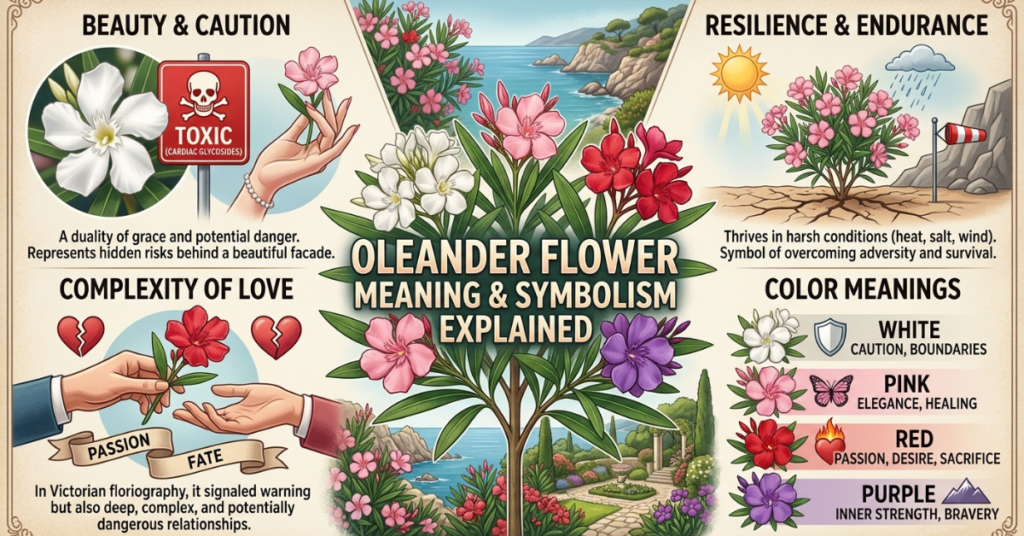
The most commonly associated themes of oleander symbolism are caution, beauty, desire, romance, destiny, and hidden danger.
The idea of caution has particularly strong historical support. In Victorian-era flower language, oleander was associated with the message “beware.” The Smithsonian’s National Museum of American History, for example, documents an oleander specimen labeled with this meaning.
A recent scholarly study of oleander’s history, names, folklore, and ethnobotanical traditions also describes the plant as having a dual cultural association with beauty and danger or evil, partly because of its toxicity.
So, depending on the context, oleander can symbolize:
- Caution — a reminder to look beyond appearances
- Hidden danger — beauty that carries an unexpected risk
- Romance and desire — particularly in modern flower symbolism
- Enduring love — associated with legends and the plant’s resilience
- Protection — in some folklore and symbolic interpretations
- Beauty and elegance — because of its striking flowers
- Complexity — the coexistence of attraction and danger
Why Does Oleander Symbolize Caution?
This meaning is easier to understand when you know the plant itself.
Oleander contains toxic cardiac glycosides, and the North Carolina Extension Gardener Plant Toolbox classifies it as highly poisonous. Its flowers, leaves, stems, roots, bark, seeds, fruits, and sap are listed as poisonous parts.
That creates a natural metaphor: something can look beautiful while still requiring caution.
This is why the oleander flower meaning negative is often connected with warnings, danger, deception, or the darker side of beauty.
Oleander Flower Meaning Negative: Is Oleander a Bad Symbol?
Not necessarily.
The negative oleander flower meaning usually refers to its associations with danger, warning, bitterness, contempt, or death, rather than suggesting that the flower itself is inherently “bad.”
Victorian floriography gave flowers different messages, including both positive and negative sentiments. However, flower language was never a completely standardized system; different books and traditions sometimes assigned different meanings.
Oleander’s negative symbolism is therefore best understood as “beware” or “there is danger beneath the beauty,” rather than simply “evil.”
In other words, oleander can symbolize a complicated truth:
Not everything beautiful is harmless.
That interpretation makes the flower particularly meaningful when discussing relationships, temptation, resilience, boundaries, or appearances.
White Oleander Flower Meaning
The white oleander flower meaning is commonly associated with purity, peace, innocence, beauty, and calmness in modern flower symbolism.
White flowers generally carry peaceful and pure associations in many cultural contexts, which is why white oleander is often interpreted through those same ideas.
At the same time, white oleander retains the broader symbolism of the species. Its pristine appearance can be contrasted with the plant’s toxicity, creating a symbolic message of pure-looking beauty with an underlying warning.
So white oleander may be interpreted as:
- Purity
- Peace
- Innocence
- Grace
- Quiet beauty
- Hidden danger
There is no universal historical rule saying that every white oleander must have these meanings. Color symbolism varies by culture and source.
Pink Oleander Flower Meaning
The pink oleander flower meaning is generally softer than the traditional warning symbolism.
Pink is commonly associated with affection, tenderness, charm, femininity, and romantic feelings. As a result, modern interpretations often connect pink oleander with love, grace, affection, beauty, and emotional warmth.
Its symbolism can be especially interesting because the gentle appearance of pink flowers contrasts with the plant’s toxicity.
A pink oleander can therefore represent:
- Affection
- Romantic interest
- Grace
- Charm
- Feminine beauty
- Emotional complexity
Red Oleander Flower Meaning
The red oleander flower meaning is commonly connected with passion, desire, romantic love, intensity, and strong emotions.
Red naturally carries powerful emotional associations, so modern flower symbolism often applies those ideas to red oleander. Some interpretations also connect red oleander with warning or danger because the species itself is poisonous.
Symbolically, red oleander can represent the idea of passion that should be approached carefully.
Its possible meanings include:
- Passion
- Deep desire
- Romantic love
- Intensity
- Courage
- Warning
- Emotional risk
This combination makes red oleander a particularly dramatic symbol: beautiful, intense, and not entirely safe.
Yellow Oleander Flower Meaning
There is an important botanical detail here.
The term “yellow oleander” is commonly used for Cascabela thevetia, also known as the be-still tree, rather than the typical Nerium oleander. It belongs to the same broader dogbane family, but it is a different plant. North Carolina Extension notes that all parts of yellow oleander are poisonous if ingested.
In modern flower symbolism, yellow is usually associated with friendship, happiness, optimism, warmth, and cheerfulness. Some symbolic interpretations of yellow oleander add an interesting layer of caution or deceptive beauty because of the plant’s toxicity.
Therefore, the yellow oleander flower meaning can be interpreted as:
- Happiness
- Friendship
- Optimism
- Warmth
- Beauty
- Caution
Again, these are symbolic interpretations rather than scientifically established meanings.
Nerium Oleander Flower Meaning
The Nerium oleander flower meaning is essentially the same broad symbolism associated with oleander: beauty, romance, caution, danger, desire, and resilience.
Nerium oleander is the accepted botanical name for the common oleander species. It is an evergreen shrub with showy, five-petaled flowers and narrow leaves.
The botanical name is useful when researching oleander because common names can be confusing. In particular, “yellow oleander” can refer to Cascabela thevetia, which is not the same species as Nerium oleander.
Oleander Flower Meaning in Telugu
In Telugu, oleander is commonly known as Ganneru (గన్నేరు). Indian botanical references also record names such as Yerra Ganneru for red-flowered forms.
The oleander flower meaning in Telugu should be understood primarily through the cultural and religious contexts in which ganneru is used rather than assuming a single universal symbolic definition.
In Telugu-speaking regions, the plant is familiar as an ornamental and culturally significant flowering plant. Its local name refers to the plant itself; it does not automatically translate into one fixed symbolic meaning such as love or danger.
Oleander Flower Meaning in Hindi
The oleander flower meaning in Hindi is associated with the flower commonly called Kaner (कनेर).
Indian botanical references list Kaner among the Hindi vernacular names for Nerium oleander.
Depending on context, Kaner may be discussed in gardening, traditional plant knowledge, religious settings, folklore, and literature. Because these contexts differ, its symbolic meaning can vary rather than having one universally accepted Hindi definition.
For an English-language symbolism article, the safest interpretation is that Kaner carries the same broader duality often associated with oleander: beauty alongside caution.
Oleander Flower Meaning in Malayalam
The oleander flower meaning in Malayalam is connected with names such as Arali (അരളി). Botanical references also record forms including Chuvanna-arali and Velutha-alari for different forms or colors.
As with Telugu and Hindi, the local name does not itself establish a universal symbolic meaning.
In Malayalam cultural contexts, Arali is a familiar flowering plant and may appear in traditional, religious, gardening, and botanical discussions. Its symbolism depends heavily on the particular cultural or literary context.
Oleander Flower Symbolism in Different Cultures
Oleander has a surprisingly rich history.
A 2026 peer-reviewed study examining oleander’s names and cultural history across 23 languages found that its many vernacular names reflect characteristics including its appearance, toxicity, habitat, traditional uses, religion, and mythology.
One Greek legend connects oleander with the story of Leander, a young man who died while attempting to cross the sea to visit his beloved. According to the tradition discussed in the study, oleander flowers were placed on his body, creating an association with endless love.
The plant also appears in traditions connected with Saint Joseph in parts of the Mediterranean world, where legends associate flowering oleander branches with the saint.
These stories show why it is difficult to reduce oleander symbolism to a single word. Its meaning has been shaped by love stories, religious traditions, folklore, plant characteristics, and its poisonous nature.
Oleander and the Victorian Language of Flowers
To understand why people search for an “oleander flower meaning,” it helps to know about floriography, or the language of flowers.
During the 19th century, flower dictionaries became popular in Britain, America, and France. People used flowers as symbolic messages, especially in romantic and social situations. The tradition became particularly fashionable from roughly the 1820s through the 1880s.
The Royal Horticultural Society notes that the first popular flower-language book, Charlotte de la Tour’s Le langage des fleurs, appeared in France in 1819 and contained hundreds of flower meanings.
Importantly, these meanings were not universal laws. Different flower dictionaries sometimes disagreed, and historians caution against treating Victorian floriography as a perfectly standardized communication system.
That distinction matters when reading modern articles that confidently claim one exact meaning for each flower color.
What Does Oleander Symbolize in Love?
In romantic symbolism, oleander can represent a relationship that is beautiful, intense, complicated, or potentially risky.
Its connection with love comes partly from folklore and partly from modern flower symbolism. The Leander legend, for example, gives the flower a connection with enduring love and grief.
At the same time, the flower’s poisonous nature introduces a darker interpretation.
Oleander can therefore symbolize:
- Enduring love
- Passion and desire
- Attraction
- Emotional intensity
- Love with complications
- A warning to protect yourself
That dual meaning is arguably what makes oleander more interesting than a flower with a purely positive symbolism.
Is Oleander a Good Flower to Give as a Gift?
Symbolically, it depends on the recipient.
If someone appreciates unusual flowers, mythology, botanical history, or complex symbolism, oleander can be an interesting choice. But it may not be the safest choice if the recipient expects traditional flower-gift meanings.
There is also a practical issue: oleander is highly poisonous. It should never be treated as an edible flower, herbal tea ingredient, or harmless decorative plant.
For households with children or pets, extra care is appropriate.
Oleander Flower Meaning at a Glance
| Oleander symbolism | Common interpretation |
| Overall meaning | Beauty, caution, desire, complexity |
| Negative meaning | Warning, danger, hidden risk |
| White oleander | Purity, peace, graceful beauty |
| Pink oleander | Affection, charm, romance |
| Red oleander | Passion, desire, intense love |
| Yellow oleander | Happiness, friendship, caution |
| Victorian symbolism | Beware |
| Love symbolism | Enduring love, desire, emotional intensity |
| Cultural symbolism | Varies by region, folklore, and tradition |
The color meanings above are modern or commonly circulated interpretations, not universally standardized historical definitions.
Is Oleander Poisonous?
Yes. This is one of the most important facts to know about the plant.
The North Carolina Extension Gardener Plant Toolbox classifies oleander as highly poisonous and warns against consuming any part of it. Toxic compounds include cardiac glycosides, and poisoning can cause gastrointestinal symptoms, dizziness, abnormal heart rhythms, and potentially death.
The plant can also be poisonous when dried, and the extension guidance specifically warns against burning oleander because the smoke can be harmful.
So while oleander is beautiful, it should be treated as an ornamental plant rather than something to experiment with medicinally or internally.
Frequently Asked Questions About Oleander Flower Meaning
What is the main oleander flower meaning?
The main oleander flower meaning is commonly associated with beauty, caution, desire, romance, and hidden danger. Historically, Victorian flower language associated oleander with the warning “beware.”
What does an oleander flower symbolize?
Oleander can symbolize romance, desire, beauty, resilience, caution, and danger. The exact interpretation depends on cultural context and the particular flower-language tradition being used.
What is the oleander flower meaning negative?
The negative side of oleander symbolism is generally warning, danger, bitterness, or hidden risk. This is strongly connected to the plant’s toxicity and its historical “beware” association.
What does a white oleander flower mean?
A white oleander is commonly interpreted as representing purity, peace, innocence, and graceful beauty, although these meanings are largely based on broader white-flower symbolism and modern interpretations rather than one universal historical code.
What does a pink oleander flower mean?
Pink oleander is commonly associated with affection, romance, charm, grace, and tenderness. Its broader oleander symbolism can still introduce the idea of caution or complexity.
What does a red oleander flower mean?
Red oleander is often interpreted as passion, romantic love, desire, and emotional intensity. Because oleander is poisonous, some modern interpretations add a warning or danger element.
What does a yellow oleander flower mean?
Yellow oleander is often associated symbolically with happiness, optimism, friendship, and warmth, sometimes combined with caution because of the plant’s toxic nature. Botanically, “yellow oleander” commonly refers to Cascabela thevetia, a different species from Nerium oleander.
What is oleander called in Telugu?
Oleander is commonly called Ganneru (గన్నేరు) in Telugu.
What is oleander called in Hindi?
Oleander is commonly called Kaner (कनेर) in Hindi.
What is oleander called in Malayalam?
Oleander is commonly called Arali (അരളി) in Malayalam. Botanical references also record names such as Chuvanna-arali and Velutha-alari.
Is oleander a symbol of love?
It can be. Some legends and modern flower-symbolism traditions connect oleander with enduring love, romance, desire, and passion. The story of Leander is one example of an association between oleander and enduring love.
Is oleander a symbol of death?
Oleander can have associations with death and danger in some folklore and modern symbolic interpretations, largely because the plant is poisonous. However, death is not its only or universal meaning.
Conclusion: The Deeper Oleander Flower Meaning
The oleander flower meaning is ultimately about contrast. It is a flower that can represent beauty and danger, love and caution, attraction and restraint at the same time.
Its pink, white, and red blooms may suggest affection, purity, or passion, while its long history and poisonous nature give the plant a darker symbolic layer. Victorian flower language famously connected oleander with “beware,” while Mediterranean folklore and modern symbolism have also associated it with romance, destiny, and enduring love.
The most useful way to understand oleander symbolism is therefore not to search for one rigid definition. Instead, think of it as a flower that asks you to look twice: beautiful on the surface, powerful underneath, and always worth approaching with respect.
If you enjoy discovering the hidden meanings behind flowers, exploring the symbolism of roses, lilies, jasmine, lavender, or other culturally significant blooms can be a natural next step.