
Have you ever seen a field of tiny blue flowers and thought it looked like a piece of the sky had fallen to the ground? That dreamy appearance is one reason the nemophila flower meaning has attracted so much attention. Commonly known as baby blue eyes, nemophila has delicate petals, a gentle appearance, and symbolism that feels just as beautiful as the flower itself.
Most flower-language references connect nemophila with ideas such as success everywhere, loveliness, and forgiveness. In addition, its blue color and spreading growth habit often inspire associations with peace, hope, connection, and new beginnings.
Japan has also given this little flower a special cultural identity. Although nemophila originally comes from western North America, huge spring displays have made it a familiar sight in Japanese gardens and parks. So, what does nemophila symbolize, and what should you know about its Hanakotoba meaning? Let’s explore it.
What Is the Nemophila Flower?
Nemophila is a genus of small flowering plants in the borage family, Boraginaceae. One of the best-known species is Nemophila menziesii, commonly called baby blue eyes. The species is native to western North America and grows naturally in areas of California and neighboring regions.
The name “baby blue eyes” comes from the flower’s appearance. Its soft blue petals and pale centers create a look that resembles bright blue eyes, giving the plant a particularly sweet and delicate character.
In Japan, nemophila is known as Rurikarakusa (瑠璃唐草). The name combines ruri, referring to a deep blue or lazuline color, with karakusa, a term associated with scrolling plant motifs.
Nemophila generally grows close to the ground and produces small, five-petaled flowers. As a result, many plants growing together can create a soft carpet of blue during the spring.
Nemophila Flower Meaning: What Does It Symbolize?
When people search for the nemophila flower meaning, they are often looking for the emotions and messages associated with this charming blue flower.
The most commonly cited meanings include:
- Success everywhere
- Loveliness
- Forgiveness
- Hope
- Peace
- Connection
- New beginnings
Among these, “success everywhere” stands out as one of the most frequently mentioned meanings in flower-language references. It makes nemophila a particularly fitting flower for someone entering a new stage of life.
At the same time, its appearance adds another layer of symbolism. The calm blue color naturally suggests peace and serenity, while the plant’s spreading growth can evoke ideas of progress, expansion, and flourishing.
Because flower meanings can differ between cultures and sources, however, it is better to treat these interpretations as symbolic associations rather than strict definitions.
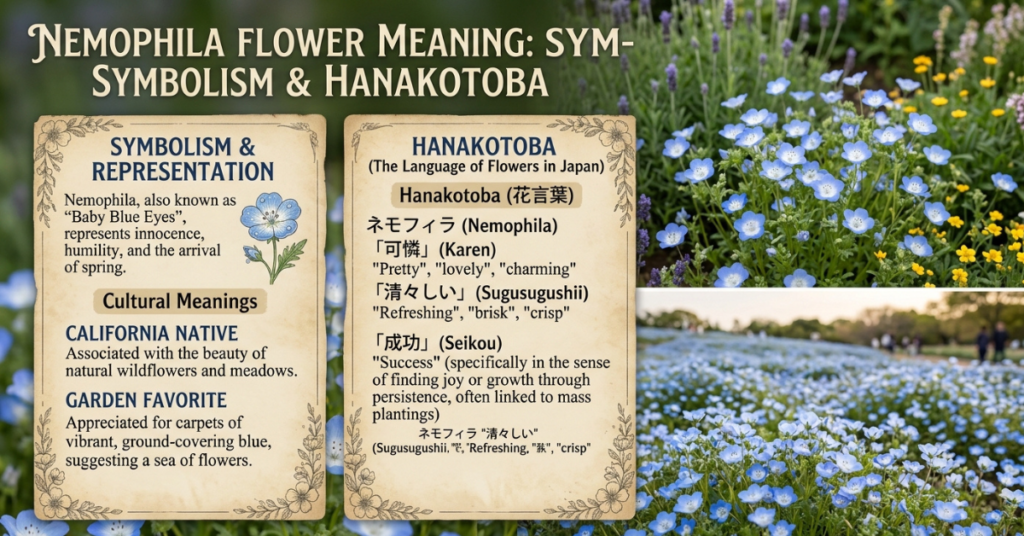
Nemophila Flower Meaning Hanakotoba
If you are searching specifically for nemophila flower meaning Hanakotoba, it helps to understand what Hanakotoba means first.
Hanakotoba (花言葉) is the Japanese language of flowers. In this tradition, flowers can communicate emotions, personality traits, wishes, or messages without words.
Unlike botanical classifications, however, flower meanings do not always have one universally accepted definition. Different Japanese references may give slightly different meanings to the same flower.
For nemophila, commonly cited associations include:
- Success everywhere
- Loveliness
- Forgiveness
- Connection
- Enmusubi, or the formation of meaningful bonds
One Japanese interpretation connects nemophila with 縁結び (enmusubi), a concept associated with bringing people or relationships together. This interpretation relates to the flower’s Japanese name and the traditional karakusa motif, which is often connected with continuous growth and vitality.
Therefore, it is more accurate to say that connection and flourishing relationships are interpretations of nemophila’s symbolism, rather than claim they represent one universally standardized Hanakotoba definition.
Common Hanakotoba Associations
Depending on the source, nemophila can communicate several positive messages:
- Success everywhere – a wish that someone succeeds wherever life takes them.
- Loveliness – a reflection of the flower’s delicate and attractive appearance.
- Forgiveness – a gentle message about letting go and moving forward.
- Connection – an interpretation linked with meaningful relationships and enmusubi.
- Hope – a modern symbolic association with its fresh spring appearance.
Together, these meanings give nemophila a warm and encouraging personality in the language of flowers.
Nemophila Flower Meaning in Japan
The nemophila flower meaning in Japan has become closely connected with spring, beautiful landscapes, and peaceful blue flower fields.
One of the best-known places associated with nemophila is Hitachi Seaside Park in Ibaraki Prefecture. During the spring blooming season, vast areas of the park turn blue as countless nemophila flowers open at the same time.
That spectacular scenery has helped make nemophila a recognizable symbol of springtime beauty in Japan. In particular, photographs of blue flower-covered hills have helped introduce the plant to audiences around the world.
There is an interesting detail behind this cultural connection, though: nemophila is not native to Japan. Nemophila menziesii originated in western North America. Japan later embraced the flower through cultivation and large-scale planting.
As a result, the flower now occupies an interesting place between botanical origin and cultural identity. It comes from North America, yet many people today immediately associate its spectacular spring displays with Japan.
Why Is Nemophila So Popular in Japan?
Part of nemophila’s appeal comes from the way it grows. Instead of producing a few tall flowers, the plant spreads close to the ground. When thousands of plants bloom together, they can create an almost continuous blue landscape.
This effect becomes especially impressive in large parks and gardens. At Hitachi Seaside Park, for example, the seasonal display has become a major attraction for visitors.
Beyond the visual appeal, the flower also fits naturally with the emotional atmosphere of spring. Its fresh color and delicate form can suggest:
- Renewal after winter
- New beginnings
- Peace and calm
- Simple natural beauty
- Hope for the future
- Togetherness and shared experiences
In other words, nemophila’s popularity comes from more than its appearance. Its seasonal setting and positive symbolism make it especially memorable.
Nemophila Flower Meaning and Prosperity
The nemophila flower meaning prosperity deserves a little clarification because “prosperity” is not always listed as its primary flower-language meaning.
Instead, the association can be understood through the symbolism surrounding karakusa, the scrolling plant motif connected with the Japanese name Rurikarakusa. Traditional plant motifs featuring continuous, winding growth can suggest vitality, continuity, and flourishing.
For that reason, some interpretations connect nemophila with ideas such as:
- Growth
- Abundance
- Flourishing relationships
- Progress
- Successful beginnings
- Continuing prosperity
This makes nemophila a lovely symbolic choice for celebrating a new job, business venture, relationship, graduation, or another important milestone.
Still, if you are writing about flower meanings, it is best to describe prosperity as a symbolic interpretation rather than present it as the flower’s official or universally accepted meaning.
Nemophila Flower Meaning Spiritual
The nemophila flower meaning spiritual does not come from one specific religious tradition. Instead, its spiritual symbolism develops from the flower’s color, appearance, growth pattern, and commonly associated meanings.
For many people, the soft blue color suggests tranquility and openness. Meanwhile, the flower’s ability to spread across a landscape can represent gradual growth and the idea that meaningful progress does not always have to be dramatic.
From a symbolic perspective, nemophila may represent:
- Peace: finding calm during a difficult period.
- Renewal: allowing yourself to begin again.
- Forgiveness: releasing anger and emotional weight.
- Hope: trusting that better days can come.
- Connection: valuing meaningful relationships.
- Gentle growth: progressing at your own pace.
These interpretations are personal and symbolic rather than formal religious meanings. Nevertheless, they explain why nemophila can feel particularly meaningful when used in gifts, artwork, gardens, or personal reflection.
Why Is Nemophila Called “Baby Blue Eyes”?
The common name baby blue eyes is a simple reference to the flower’s appearance.
Its petals are often a soft sky blue, while the center tends to be pale or nearly white. Together, these features create a look that resembles clear blue eyes.
The name also contributes to the flower’s broader associations with:
- Innocence
- Tenderness
- Youthfulness
- Gentleness
- Simplicity
That combination of color and form is one reason nemophila feels so different from more dramatic flowers such as roses or lilies.
The Meaning Behind the Name Nemophila
The scientific name Nemophila also has an interesting connection with nature.
The name comes from Greek roots traditionally explained as nemos, referring to a wooded area or grove, and phileo, meaning “to love.” In simple terms, the name can be understood as relating to a love of woodland or grove-like habitats.
Its Japanese name, Rurikarakusa, tells a different story. Ruri refers to its rich blue color, while karakusa describes a decorative, scrolling plant motif.
Therefore, both names capture an important characteristic of the flower. One reflects its connection with natural habitats, while the other highlights its distinctive blue color and plant-like form.
Nemophila Flower Colors and Their Symbolism
Blue is the color most people associate with nemophila, particularly with Nemophila menziesii. However, different cultivated forms can display variations in color and markings.
Blue Nemophila
Blue nemophila is the classic baby blue eyes flower. Its color and delicate appearance often inspire associations with:
- Success
- Loveliness
- Calmness
- Hope
- Forgiveness
Because blue traditionally evokes feelings of peace and openness, it is easy to see why this version of nemophila has such a gentle symbolic character.
White Nemophila
White nemophila can naturally suggest purity, innocence, simplicity, and freshness. Some Japanese flower-language references also associate white nemophila with success.
However, these meanings can vary between sources, so they should be treated as symbolic rather than absolute.
Purple or Dark-Marked Nemophila
Some nemophila varieties have darker or purplish markings. Their symbolism is less consistent across flower-language references.
For that reason, it is safer to focus on the overall symbolism of nemophila rather than assign a specific universal meaning to every color variation.
Is Nemophila a Good Flower to Give as a Gift?
Yes. Nemophila works especially well when you want to give someone a flower with an encouraging and gentle message.
Its association with success everywhere makes it appropriate for occasions such as:
- Starting a new job
- Beginning university
- Moving to a new home
- Starting a new relationship
- Celebrating graduation
- Marking a personal achievement
- Encouraging someone through a transition
For example, you could pair a bouquet or illustration of nemophila with a simple message:
“May you find success and happiness wherever life takes you.”
That short message captures the flower’s most recognizable symbolism while still leaving room for a personal interpretation.
Does Nemophila Have a Negative Meaning?
Generally, nemophila does not carry a strongly negative or ominous meaning.
However, some flower-language references associate it with forgiveness or a message similar to “you forgive me.” At first, that may sound connected to sadness or conflict. Yet forgiveness can also represent reconciliation, emotional healing, and moving forward.
Consequently, the meaning depends heavily on the context.
If you give nemophila to someone you care about, its message does not have to focus on an apology. It can simply express hope, kindness, encouragement, or the wish for a peaceful new beginning.
Nemophila Flower: Quick Facts
| Feature | Details |
| Scientific name | Nemophila menziesii |
| Common name | Baby blue eyes |
| Japanese name | 瑠璃唐草 (Rurikarakusa) |
| Plant type | Annual herb |
| Native range | Western North America |
| Typical color | Blue, often with a pale center |
| Blooming season | Spring |
| Family | Boraginaceae |
| Common symbolism | Success, loveliness, forgiveness |
| Japanese association | Spring scenery and blue flower fields |
Frequently Asked Questions About Nemophila Flower Meaning
What is the main nemophila flower meaning?
The most commonly cited meanings of nemophila are success everywhere, loveliness, and forgiveness. However, wording can differ between flower-language references and cultural traditions.
What is the nemophila flower meaning Hanakotoba?
In Japanese flower-language references, nemophila is commonly associated with success everywhere, loveliness, and forgiveness. Some interpretations also connect the flower with enmusubi, or meaningful bonds between people.
What does nemophila symbolize spiritually?
Symbolically, nemophila can represent peace, hope, renewal, forgiveness, connection, and gentle personal growth. These meanings are spiritual interpretations rather than formal religious definitions.
What is the nemophila flower meaning in Japan?
In Japan, nemophila is strongly associated with spring, blue flower fields, natural beauty, and renewal. Its popularity is particularly connected with spectacular spring displays such as those at Hitachi Seaside Park.
Does nemophila symbolize prosperity?
Nemophila can symbolize growth, flourishing, abundance, and prosperity in some interpretations. However, prosperity is better described as a symbolic association rather than its single official flower meaning.
Is nemophila a Japanese flower?
No. Although Japan has developed a strong cultural association with nemophila, Nemophila menziesii is native to western North America. The flower later became popular in Japan through cultivation and large-scale landscape planting.
Why is nemophila called baby blue eyes?
Nemophila gets the name baby blue eyes from its soft blue petals and pale center, which can resemble a baby’s clear blue eyes.
Final Thoughts on Nemophila Flower Meaning
The nemophila flower meaning is gentle, positive, and full of hope. Its best-known associations with success everywhere, loveliness, and forgiveness make it a meaningful flower for new beginnings, encouragement, and personal growth.
At the same time, its Japanese connection adds another fascinating dimension. Although nemophila originated in western North America, Japan has embraced it so strongly that vast spring fields of blue nemophila have become an iconic seasonal sight.
Whether you searched for the nemophila flower meaning Hanakotoba, wondered about its spiritual symbolism, or wanted to understand its connection with prosperity, one message comes through clearly: nemophila represents the beauty of moving forward.
Sometimes, growth is quiet. Sometimes, success means simply continuing to bloom wherever life takes you—and that may be the most beautiful meaning of nemophila of all.