
A new baby has a way of making an ordinary day feel extraordinary. Whether you’re celebrating a birth, visiting new parents, or simply sending congratulations from miles away, baby flowers are a thoughtful way to say, “Welcome to the world, little one.”
From delicate white bouquets and soft pastel arrangements to cheerful pink and blue designs, flowers can make a lovely gift for new parents. But choosing flowers for a newborn is a little different from choosing a bouquet for a birthday or anniversary. Hospital rules, fragrance, pollen, arrangement size, and the parents’ preferences are all worth considering.
So, what are the best new baby flowers? Which flowers work well for a baby girl or boy? And is it actually appropriate to send flowers to a hospital after birth?
Let’s take a closer look.
What Are Baby Flowers?
“Baby flowers” isn’t a formal botanical category. Instead, it is a broad phrase people use when searching for flowers associated with newborn babies, baby showers, births, and welcoming a new child.
The phrase can also refer to baby’s breath, one of the most recognizable delicate flowers used in floral arrangements. Baby’s breath belongs to the Gypsophila genus, with Gypsophila paniculata being a particularly common species. The plant produces clouds of tiny white flowers on branching stems, which explains why it is so popular in soft, romantic bouquets.
When people search for newborn flowers, they may therefore be looking for:
- Flowers to congratulate new parents
- A bouquet for a newborn baby
- Flowers for a baby shower
- Welcome baby flowers
- Flowers to send to a hospital
- White or pastel flower arrangements
- Baby’s breath arrangements
- New baby flowers delivery
- Flowers suitable for a nursery or home
In other words, baby flowers are more about the occasion, feeling, and style than one particular flower species.
Best New Baby Flowers to Give
There isn’t one flower that everyone considers the perfect newborn gift. The best choice depends on the parents’ taste, where you’re sending the flowers, and whether the bouquet is intended for the hospital or home.
Here are some popular options.
1. Roses
Roses are a classic choice because they are available in a huge range of colors and styles.
Soft pink roses can create a sweet, traditional arrangement, while white roses give a clean and elegant appearance. Peach and cream roses are also beautiful if you want something neutral.
For a newborn arrangement, consider:
- White roses
- Blush pink roses
- Peach roses
- Cream roses
- Pastel mixed roses
Roses are particularly useful when you want a bouquet that feels special without looking overly themed.
2. Tulips
Tulips have a naturally cheerful appearance and work beautifully in newborn baby flowers arrangements.
Their simple shape gives bouquets a fresh, modern look. White, pink, peach, yellow, and pastel tulips can all work well for welcoming a new baby.
They are especially nice for someone who prefers minimalist flowers rather than a heavily decorated arrangement.
3. Carnations
Carnations are often overlooked, but they’re actually very practical flowers for celebratory arrangements.
They come in many colors, have a long vase life, and can add fullness without making a bouquet extremely expensive. Pink, white, peach, and cream carnations can all work beautifully in a welcome baby flowers arrangement.
They can also be combined with roses, tulips, or baby’s breath for a fuller bouquet.
4. Baby’s Breath
If you’re looking for flowers that visually fit the occasion, baby’s breath is an obvious choice.
The tiny blooms create a soft, cloud-like effect and are commonly used as filler flowers. White baby’s breath can be used alone for a simple monochromatic bouquet or paired with roses and other pastel flowers.
However, there is an important point to remember: baby’s breath is not automatically the same thing as “baby flowers.” The latter is an occasion-based search term, while baby’s breath is an actual group of flowering plants in the genus Gypsophila.
5. Orchids
For parents who prefer something elegant and contemporary, orchids can make a sophisticated gift.
A small orchid arrangement or potted orchid can feel different from a traditional bouquet. However, if you’re sending flowers to a hospital, check the facility’s rules before choosing a potted plant.
6. Hydrangeas
Hydrangeas create large, soft clusters of flowers and can make an arrangement look abundant without requiring dozens of individual stems.
White, pale blue, blush, and lavender hydrangeas can work especially well in baby-themed arrangements.
7. Daisies
Daisies have a cheerful, innocent appearance, making them an appealing choice for a baby celebration.
That said, they aren’t always the most suitable choice for people sensitive to pollen. If allergies are a concern, ask the florist about lower-pollen alternatives rather than choosing purely based on appearance.
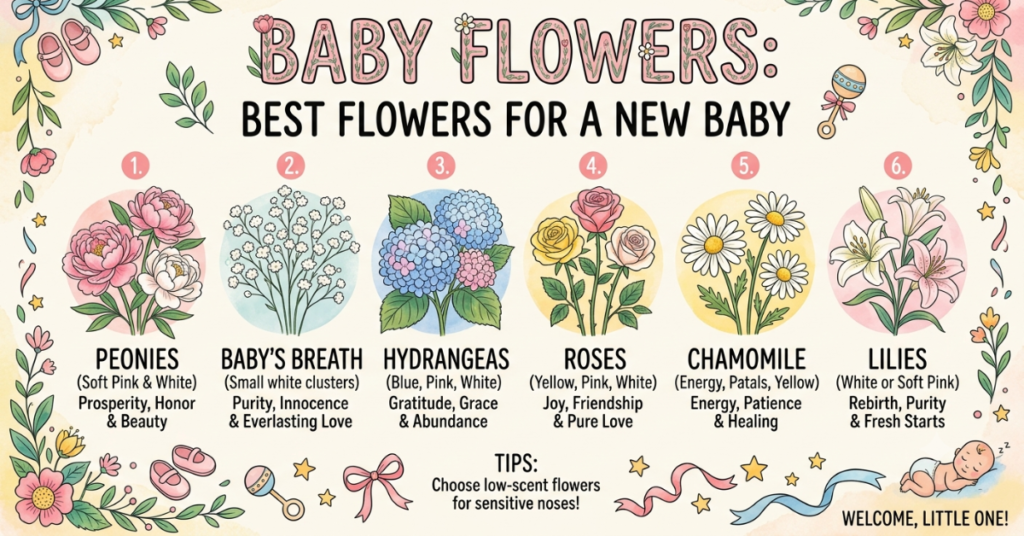
What Do Baby Flowers Symbolize?
Flowers don’t have one universal meaning, and their symbolism can vary across cultures and traditions. Still, certain flowers are commonly associated with ideas that fit a newborn celebration.
| Flower | Common association |
| White roses | Purity, innocence, new beginnings |
| Pink roses | Tenderness, affection, appreciation |
| Tulips | Cheerfulness and fresh beginnings |
| Carnations | Love, admiration, affection |
| Baby’s breath | Delicacy, innocence, everlasting affection |
| Hydrangeas | Gratitude and heartfelt emotion |
| Orchids | Elegance and beauty |
| Daisies | Cheerfulness and innocence |
These meanings are best treated as traditional floral symbolism rather than scientific facts. The message behind the gift is ultimately more important than a strict “flower language.”
White Baby Flowers: Why White Is So Popular
White baby flowers are among the most popular choices for newborn celebrations.
There is something naturally peaceful about an all-white arrangement. White roses, baby’s breath, tulips, carnations, and other pale blooms can create a soft appearance that feels appropriate for a new beginning.
A white bouquet can also be useful when you don’t know whether the parents prefer traditionally pink or blue colors.
Try combining:
- White roses + baby’s breath
- White tulips + eucalyptus
- White carnations + cream roses
- White hydrangeas + delicate greenery
- White roses + pale peach flowers
If you search for baby flowers white or “white baby flowers,” you’re likely to find arrangements ranging from completely monochromatic bouquets to white flowers accented with soft pastel shades.
Pink, Blue, or Gender-Neutral Baby Flowers?
You don’t have to match the bouquet to the baby’s gender.
For a traditional look, pink arrangements are often chosen for baby girls, while blue arrangements are commonly associated with baby boys. But modern floral designs offer plenty of alternatives.
Soft pink
Pink roses, carnations, tulips, and baby’s breath create a delicate and feminine arrangement.
Soft blue
Blue hydrangeas, white roses, and greenery can create a calm and elegant combination.
Gender-neutral
If you don’t know the baby’s gender or simply want something less traditional, try:
- White and green
- Peach and cream
- Yellow and white
- Lavender and white
- Soft pastel mixes
A gender-neutral bouquet can also be a safer choice when the parents have a minimalist aesthetic.
Newborn Baby Flowers for a Hospital
Sending newborn baby flowers to the hospital sounds simple, but there is one important step people sometimes overlook: check the hospital’s flower policy first.
Hospitals don’t all follow the same rules. Some patient-care areas allow flowers, while intensive-care and specialized units may restrict them because of infection-control concerns, allergies, or other environmental considerations.
The CDC notes that flowers and potted plants generally do not need to be restricted in areas caring for immunocompetent patients, but recommends excluding fresh or dried flowers and potted plants from areas caring for immunosuppressed patients.
For neonatal or intensive-care settings, policies can be particularly strict. The safest approach is to contact the hospital before ordering.
Before sending hospital flowers:
- Call the hospital or maternity unit.
- Ask whether flowers are permitted.
- Confirm the patient’s full name.
- Provide the room or unit information if required.
- Ask whether delivery should go to the room, reception, or another location.
- If flowers aren’t permitted, send them to the family’s home instead.
This small amount of planning can prevent a beautiful gift from being refused at the hospital.
Choosing Flowers for a New Baby at Home
Once the family is home, you generally have more flexibility.
A bouquet for the home can be slightly larger and more decorative than one intended for a hospital room. You can also consider the parents’ interior style.
For a minimalist home, choose:
- White flowers
- Neutral arrangements
- Greenery-heavy bouquets
- Simple glass-vase designs
For a colorful home, consider:
- Pastel mixed flowers
- Pink and peach arrangements
- Yellow and white flowers
- Lavender and cream bouquets
If you’re unsure, a medium-sized bouquet is usually more practical than an enormous arrangement that requires significant maintenance from exhausted new parents.
New Baby Flowers Delivery: What to Consider
Searching for new baby flowers delivery or baby flowers delivery is often the easiest way to send congratulations when you can’t visit in person.
But don’t simply choose the first bouquet you see. Look at the details of the delivery service.
Check these things before ordering:
- Delivery area
- Same-day delivery availability
- Delivery fees
- Bouquet size
- Flower substitutions
- Vase inclusion
- Delivery time
- Hospital restrictions
- Personal message options
If the baby has already arrived, make sure the delivery date is realistic. Flowers delivered several days after the family has left the hospital may need to be redirected to the home address.
How to Order New Baby Flowers Near Me
If you’re searching new baby flowers near me, start with local florists rather than automatically choosing a large national service.
A nearby florist may know local hospitals, understand their delivery policies, and be able to make seasonal substitutions while keeping the overall look of the arrangement intact.
Before ordering, ask:
“Do you deliver newborn or welcome-baby arrangements to this hospital?”
Then provide the delivery details and ask whether the florist recommends a particular bouquet for a maternity or newborn setting.
Location-Based Searches for New Baby Flowers
People often search for newborn flower delivery using a city or neighborhood name. Searches such as new baby flowers Charlotte NC, new baby flowers Monroe, new baby flowers San Diego, new baby flowers Longmont, new baby flowers Philadelphia, new baby flowers Baltimore, new baby flowers Denver CO, new baby flowers Maple Grove, and Austin new baby flowers generally indicate a desire for a florist that can deliver locally.
The same principle applies to searches like new baby flowers near me: look for a florist that actually serves the relevant hospital or residential address rather than assuming every online florist covers every location.
For hospital deliveries in particular, local knowledge can be useful because hospitals may have different receiving procedures.
What Flowers Should You Avoid for a New Baby?
The answer depends on where the flowers are going.
For a hospital delivery, avoid making assumptions about which flowers are acceptable. The hospital’s policy should come first.
For a home arrangement, you may still want to avoid extremely strong fragrances or flowers that could be problematic for someone with allergies.
Baby’s breath deserves a special mention here. Despite its delicate appearance, some baby’s breath varieties can produce pollen that may bother sensitive people. The Spruce notes that double-flowered forms generally release less pollen than single-flowered types.
It’s also wise to be cautious with:
- Very strongly scented flowers
- Loose pollen-heavy arrangements
- Flowers that shed heavily
- Large arrangements that take up too much space
- Potted plants when hospital rules prohibit them
Remember that the flowers are primarily a gift for the parents, not something that needs to be placed directly beside the baby.
How to Make Baby Flowers More Special
A bouquet doesn’t have to stand alone.
You can turn a simple flower delivery into a thoughtful welcome-baby gift by adding something useful or sentimental.
Consider pairing the flowers with:
- A handwritten congratulations card
- A soft baby blanket
- A children’s storybook
- A small keepsake
- A photo frame
- A baby-safe gift chosen by the parents
- A meal or food-delivery gift card
Keep the message simple. Something as straightforward as “Welcome to the world, little one!” can feel more genuine than a long message.
Baby Flowers Song: Is There a Song Called “Baby Flowers”?
Interestingly, “Baby Flowers” is also used as a song title, so people searching the phrase aren’t necessarily looking for floral arrangements.
There are multiple recordings titled “Baby Flowers.” For example, Spotify lists a 2024 track titled “Baby flowers” by Frankk Melodee and Charly Flames, while Apple Music lists an older recording called “Baby Flowers” by One Truth, released in 1976.
There are also tracks using “Baby Flowers” as part of sleep and lullaby music.
So, if you encountered “baby flowers” in a music search rather than a florist search, the context matters.
How to Care for New Baby Flower Bouquets
New parents already have plenty to think about, so a low-maintenance arrangement is usually appreciated.
Once the bouquet arrives:
- Remove any packaging that keeps stems tightly enclosed.
- Place the flowers in a clean vase.
- Trim the stems with a clean, sharp tool.
- Add fresh water according to the florist’s instructions.
- Keep the arrangement away from direct heat and strong sunlight.
- Remove wilted flowers as needed.
- Change the water regularly.
The CDC notes that flower vase water can contain substantial numbers of microorganisms, particularly when water is not changed regularly. In healthcare settings, the CDC recommends changing vase water every two days and cleaning and disinfecting vases after use.
At home, basic vase hygiene is simply good flower care—and especially worthwhile around a newborn.
7 Tips for Choosing the Perfect Welcome Baby Flowers
If you’re still unsure what to order, use this simple checklist.
1. Think about the parents
Choose their style rather than focusing only on stereotypical baby colors.
2. Keep the bouquet manageable
A medium-sized arrangement can be easier to place and maintain.
3. Consider fragrance
Subtle scents are generally a safer choice than intensely fragrant arrangements when you’re unsure about preferences.
4. Check hospital rules
Never assume flowers are allowed in maternity, neonatal, or intensive-care areas.
5. Choose a reliable florist
Look for clear delivery policies and good communication.
6. Add a personal note
A short handwritten message can make even a simple bouquet memorable.
7. Consider delivery timing
If the family is still in hospital, confirm the correct receiving location. If they have already gone home, arrange delivery there instead.
Frequently Asked Questions About Baby Flowers
What are the best flowers for a newborn baby?
White roses, tulips, carnations, hydrangeas, and carefully selected pastel flowers are popular choices. Baby’s breath is also widely used as a delicate filler flower.
Are flowers a good gift for a new baby?
Yes. Flowers are traditionally given to congratulate new parents, although they’re technically a gift for the parents rather than the newborn. Always check hospital policies if the family is still admitted.
What are white baby flowers?
“White baby flowers” generally refers to white floral arrangements designed for newborn celebrations. White roses, tulips, carnations, hydrangeas, and baby’s breath are common choices.
Can I send new baby flowers to a hospital?
Often, yes, but it depends on the hospital and unit. Some areas restrict flowers or plants. The CDC recommends excluding fresh and dried flowers from areas caring for immunosuppressed patients.
What flower represents a new baby?
There isn’t one universally recognized “new baby flower.” Baby’s breath is especially popular because of its delicate appearance, while white and pastel roses, tulips, carnations, and other blooms are commonly used for birth celebrations.
Are baby’s breath flowers and baby flowers the same?
Not exactly. Baby’s breath is a common name for Gypsophila, particularly Gypsophila paniculata. “Baby flowers” is a broader phrase describing flowers associated with newborns and baby celebrations.
What color flowers should I send for a new baby?
Pink, blue, white, yellow, peach, lavender, and mixed pastels can all work. If you don’t know the parents’ preferences, white or neutral flowers are an easy and elegant choice.
What should I write on a new baby flower card?
A short, warm message is usually best. For example: “Congratulations on your beautiful new arrival. Wishing your family a lifetime of love, happiness, and wonderful memories.”
Can I send new baby flowers to someone’s home?
Absolutely. In fact, home delivery can be preferable if the hospital doesn’t accept flowers or if the family has already been discharged.
What does “new baby flowers near me” mean?
It’s generally a local search for florists that offer newborn or welcome-baby flower arrangements nearby. When ordering, confirm that the florist delivers to the exact hospital or home address.
Final Thoughts
The best baby flowers don’t have to be extravagant. A thoughtfully chosen bouquet in soft colors can say everything you want it to: congratulations, welcome, love, and happiness for the growing family.
White roses, tulips, carnations, hydrangeas, and baby’s breath are all attractive options, but the most important factors are the parents’ preferences, the delivery location, and the practicalities of caring for fresh flowers.
If you’re planning new baby flowers delivery, check the hospital’s policy first, choose a trustworthy florist, and consider adding a personal note. And if you’re searching for newborn baby flowers for a home celebration, don’t be afraid to move beyond traditional pink and blue—soft whites, creams, peaches, yellows, and greens can create a beautiful modern arrangement.
Sometimes, the simplest bouquet is the one that becomes part of a family’s favorite memory.