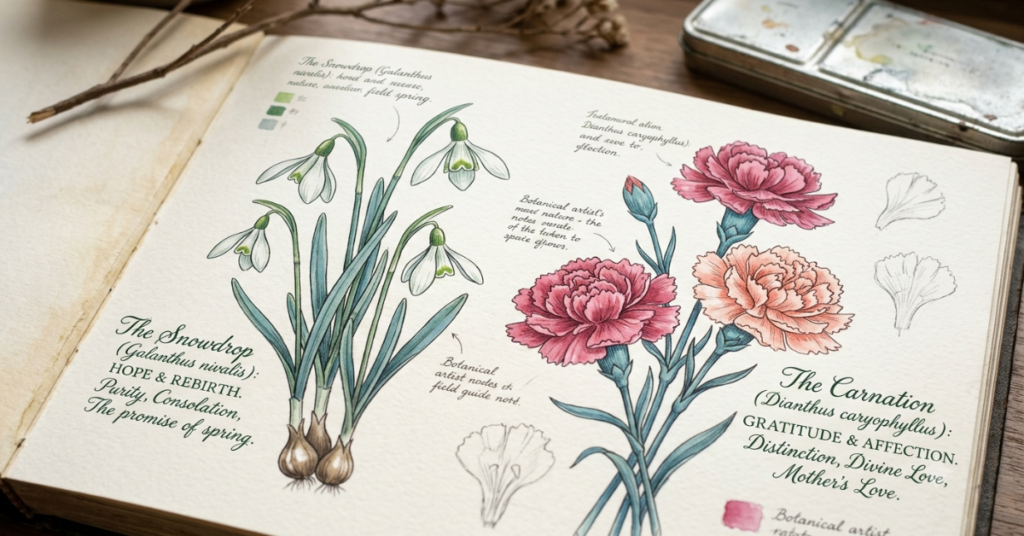

There is something beautiful about pairing flowers that seem completely different at first glance. The carnation and snowdrop flower combination brings together the warm, ruffled beauty of the carnation with the quiet, delicate charm of the snowdrop. One feels expressive and romantic, while the other suggests simplicity, hope, and the arrival of a new season.
Together, they can create a meaningful floral combination for a bouquet, tattoo, artwork, garden-inspired design, or even a personal symbol. But what exactly do these flowers represent, and why does this pairing work so well?
In this guide, we’ll explore the carnation and snowdrop flower meaning, their botanical characteristics, symbolism, bouquet ideas, tattoo inspiration, and ways to use the pairing in floral art and design.
What Is a Carnation and Snowdrop Flower?
A carnation and a snowdrop are two different types of flowering plants rather than one specific flower species.
The carnation belongs to the genus Dianthus, with Dianthus caryophyllus being the species associated with many cultivated carnations. It is known for its ruffled petals, narrow grey-green foliage, pleasant fragrance, and wide range of colors. The Royal Horticultural Society describes Dianthus caryophyllus as a perennial with fragrant flowers that can appear in shades of pink and purple.
The snowdrop belongs to the genus Galanthus. These small bulbous perennials are especially recognizable for their nodding white flowers, green markings, and early-season blooming. Some snowdrops can flower while winter is still lingering, which is one reason they have become strongly associated with the transition into spring.
Although their appearance and growing habits differ, that contrast is exactly what makes the two flowers interesting together.
Carnation and Snowdrop Flower Meaning
The carnation and snowdrop flower meaning is best understood by looking at the symbolism of each flower individually.
Carnations have a long history of symbolic associations. Depending on the color and cultural tradition, they can represent love, admiration, gratitude, purity, maternal affection, or even disappointment. The RHS’s historical overview of the Victorian language of flowers, for example, records different meanings for red, pink, striped, yellow, and white carnations.
Snowdrops have a different emotional character. Because they often appear at the end of winter or very early in spring, they are commonly viewed as symbols of hope, renewal, resilience, and new beginnings. The RHS describes snowdrops as “heralds of spring” and highlights their ability to emerge even through snow.
What Does the Combination Symbolize?
When combined, carnations and snowdrops can suggest ideas such as:
- Love and hope
- Strength through difficult seasons
- New beginnings
- Remembrance and affection
- Beauty after hardship
- Tenderness and resilience
- A balance between passion and simplicity
There isn’t one universally established historical meaning for the two flowers together. Their combined symbolism is more interpretive, which can actually make the pairing more personal.
Carnation Flower: Appearance and Characteristics
Carnations are instantly recognizable because of their layered, slightly frilled petals. Their flowers can range from soft pinks and whites to deep reds, purples, yellows, and other cultivated shades.
The plant generally prefers a sunny position and well-drained soil. According to the RHS, Dianthus caryophyllus can reach around 0.5–1 metre in height and is suitable for borders, containers, cottage gardens, and cut-flower displays.
One of the flower’s most appealing qualities is its fragrance. Some carnations have a noticeable clove-like scent, which adds another sensory layer to their visual appeal.
Carnation Color Meanings
Color can change the message of a carnation considerably.
Red carnations are often associated with love, affection, passion, and admiration.
Pink carnations are commonly connected with gratitude and maternal love. Their association with motherhood is particularly strong in modern floral traditions.
White carnations can represent purity, innocence, remembrance, and good luck, depending on the cultural context.
Yellow carnations have historically carried less positive meanings in some versions of flower symbolism, including disappointment or disdain.
Because flower meanings vary across cultures and periods, it is better to treat these interpretations as traditions rather than strict rules.
Snowdrop Flower: Appearance and Characteristics
Snowdrops have a completely different visual personality.
Their flowers are small, white, and usually hang downward from slender stems. The outer petals flare outward while the shorter inner petals often have distinctive green markings.
The common snowdrop, Galanthus nivalis, is one of the best-known species. Other species and cultivars can differ in flower size, shape, foliage, markings, and flowering time.
Snowdrops generally prefer moist but well-drained soil and often perform well in partial shade, particularly beneath deciduous trees and shrubs.
Why Are Snowdrops Associated With Hope?
Their timing has a lot to do with it.
Snowdrops can appear when gardens still look bare and winter has not completely disappeared. Seeing those small white flowers pushing through the cold naturally creates an image of persistence and renewal.
That is why snowdrops are so often used as visual symbols of:
- Hope
- Renewal
- Spring
- Resilience
- Fresh starts
- Quiet beauty
Their understated appearance makes the symbolism feel especially gentle rather than dramatic.
Why Carnations and Snowdrops Look Beautiful Together
At first, these flowers may seem like an unlikely pair.
Carnations have fuller, layered blooms, while snowdrops are small and bell-like. Carnations can provide color and visual weight, while snowdrops contribute white space and delicate movement.
That contrast can be used intentionally in floral design.
For example, a bouquet with soft pink carnations and white snowdrops can feel romantic without being overly elaborate. Deep red carnations paired with white snowdrops create a much stronger contrast and can communicate a more emotional message.
From a design perspective, the combination works because it balances:
Fullness + delicacy
Color + white
Warmth + coolness
Maturity + renewal
Drama + simplicity
Carnation and Snowdrop Flower Bouquet Ideas
A carnation and snowdrop flower bouquet can be designed in several different styles depending on the occasion.
1. Soft Pink and White Bouquet
Pair pale pink carnations with white snowdrops and delicate green foliage.
This combination works particularly well for:
- Birthdays
- Mother’s Day
- Anniversaries
- Spring celebrations
- Romantic gifts
The result is soft, feminine, and understated.
2. Red Carnation and White Snowdrop Bouquet
For a stronger visual statement, use deep red carnations with white snowdrops.
The white flowers help prevent the red carnations from becoming visually overwhelming. This arrangement can work beautifully for romantic occasions or meaningful personal gifts.
3. White-on-White Arrangement
For a minimalist look, combine white carnations with white snowdrops and different shades of green foliage.
The interest comes from texture rather than color. The fluffy carnation petals contrast with the simple bell-shaped snowdrop flowers.
4. Wild Garden Style
Instead of arranging the flowers tightly, allow the snowdrops to appear naturally between carnations, greenery, and small seasonal flowers.
This gives the bouquet a relaxed, garden-inspired appearance rather than a formal florist arrangement.
Carnation and Snowdrop Flower Tattoo Ideas
A carnation and snowdrop flower tattoo can carry a surprisingly personal message.
Because both flowers have strong symbolic associations, they can represent an experience rather than simply being decorative botanical artwork.
Popular Tattoo Concepts
1. Single Carnation With Snowdrops
A larger carnation can act as the focal point, with two or three small snowdrops surrounding it.
2. Fine-Line Botanical Design
For a minimalist tattoo, use thin outlines and subtle botanical details. This works especially well when the goal is elegance rather than a bold statement.
3. Birth Flower Combination
Carnations are widely recognized as the January birth flower. A snowdrop can be incorporated to emphasize winter, renewal, or a personal connection to the season.
4. Memorial-Inspired Design
Because both flowers can be interpreted through ideas of love, remembrance, and resilience, the pairing can be adapted into a memorial tattoo.
5. Watercolor-Inspired Tattoo
A pink or red carnation with soft white snowdrops can create a gentle contrast. The design can remain relatively simple while still having plenty of visual character.
A tattoo does not have to follow a traditional flower dictionary. The most meaningful design is often the one connected to your own story.
Carnation and Snowdrop Flower Drawing Ideas
If you’re interested in botanical illustration, a carnation and snowdrop flower drawing gives you a great opportunity to practice contrasting forms.
The carnation is useful for studying layered petals and texture, while the snowdrop is ideal for practicing clean lines and simple shapes.
Easy Drawing Approach
- Start with the stems.
Lightly sketch the direction and natural curve of each stem. - Block in the flower shapes.
Don’t begin with individual petals. First establish the overall silhouette. - Add the carnation petals.
Build the flower gradually using irregular, ruffled edges. - Draw the snowdrop.
Focus on its hanging bell-like shape and three larger outer tepals. - Add the foliage.
Use long, narrow leaves around the flowers. - Finish with details.
Add veins, petal edges, shadows, and small green markings on the snowdrop.
A Simple Composition
For a balanced botanical drawing, place one large carnation slightly off-center and add two or three snowdrops around it.
This creates a clear focal point while allowing the smaller flowers to frame the composition naturally.
Carnation and Snowdrop Flower in Floral Design
The combination isn’t limited to bouquets and tattoos. It can also work beautifully in visual design.
You can use the flowers for:
- Wedding stationery
- Greeting cards
- Wall art
- Textile patterns
- Packaging
- Scrapbooking
- Digital illustrations
- Botanical posters
- Home décor prints
For a more modern appearance, simplify the flowers into clean line art. For a traditional botanical style, include realistic stems, foliage, petal details, and natural proportions.
The contrast between the two flowers makes them especially useful for compositions that need both a strong focal flower and a delicate supporting element.
How to Grow Carnations and Snowdrops
If you’re thinking beyond artwork and want these flowers in a garden, their needs are quite different.
Growing Carnations
Carnations generally prefer:
- Full sun
- Well-drained soil
- Good air circulation
- Regular deadheading
- Moderate watering without waterlogged soil
The RHS recommends growing Dianthus caryophyllus in well-drained soil in a sunny position. Regular deadheading can help prolong flowering.
Growing Snowdrops
Snowdrops generally prefer:
- Moist but well-drained soil
- Partial shade or suitable sun
- Soil that does not become excessively dry
- Woodland-style or naturalized planting conditions
They are commonly planted beneath deciduous trees and shrubs, where they can receive light before the tree canopy fully develops.
One important point: snowdrop bulbs and plant material should not be eaten. RHS plant profiles identify Galanthus as potentially harmful if consumed.
Carnation vs. Snowdrop: What’s the Difference?
| Feature | Carnation | Snowdrop |
| Botanical genus | Dianthus | Galanthus |
| Typical appearance | Full, ruffled flower | Small, hanging bell-like flower |
| Common colors | Pink, red, white, yellow and others | Mainly white with green markings |
| Fragrance | Many varieties are fragrant | Some varieties are honey-scented |
| Growth habit | Herbaceous perennial in many forms | Bulbous perennial |
| Common symbolism | Love, admiration, gratitude | Hope, renewal, spring |
| Design personality | Romantic and expressive | Delicate and understated |
This contrast explains why the flowers can complement each other so effectively.
Is Carnation and Snowdrop a Good Flower Combination?
Yes, especially if you want a floral pairing with both visual contrast and symbolic depth.
The carnation gives the arrangement volume, color, and texture. The snowdrop adds lightness, simplicity, and a seasonal feeling.
The combination is particularly suitable when you want your floral design to communicate something along the lines of “love that survives difficult seasons” or “beauty and hope after hardship.”
That interpretation isn’t a fixed botanical definition, but it is a meaningful way to combine the established symbolism of both flowers.
Frequently Asked Questions
What does a carnation and snowdrop flower symbolize?
A carnation and snowdrop combination can symbolize love, admiration, hope, renewal, resilience, and new beginnings. The exact interpretation depends on the carnation color and the personal meaning attached to the design.
What is the meaning of a carnation and snowdrop flower tattoo?
A carnation and snowdrop flower tattoo can represent love combined with hope and resilience. It can also commemorate an important relationship, personal transformation, or a difficult period that eventually led to a new beginning.
What does a carnation flower symbolize?
Carnations have several traditional meanings, including love, admiration, gratitude, maternal affection, purity, and remembrance. Their symbolism can change depending on flower color and cultural tradition.
What does a snowdrop flower symbolize?
Snowdrops are commonly associated with hope, renewal, resilience, and the arrival of spring. Their ability to flower during the cold season contributes strongly to these associations.
Can carnations and snowdrops be used in the same bouquet?
Yes. Their contrasting shapes make them visually interesting together. Carnations provide a fuller focal flower, while snowdrops add delicate white blooms and movement.
Are snowdrops actually flowers that grow in snow?
Snowdrops can flower very early in the year and may emerge while snow or cold conditions are still present. However, they are not dependent on snow to grow. Different Galanthus species and cultivars have different flowering periods.
What is the best carnation color to pair with snowdrops?
Pink, red, and white carnations are especially attractive with white snowdrops. Pink creates a soft romantic look, red gives stronger contrast, and white produces a minimalist monochromatic arrangement.
How do I draw a carnation and snowdrop flower?
Start by sketching the stems and overall silhouettes. Build the carnation from its layered, ruffled petals and draw the snowdrop as a hanging bell-shaped flower with three prominent outer tepals and smaller inner petals.
Final Thoughts on Carnation and Snowdrop Flower
The carnation and snowdrop flower pairing is a beautiful example of how contrasting flowers can tell a bigger story together.
The carnation brings color, fragrance, fullness, and associations with love and admiration. The snowdrop brings quiet elegance and a strong connection to hope, resilience, and the beginning of spring.
Whether you’re looking for a meaningful carnation and snowdrop flower tattoo, planning a carnation and snowdrop flower bouquet, or creating a carnation and snowdrop flower drawing, the combination offers plenty of creative possibilities.
Most importantly, don’t feel restricted by traditional flower meanings. Choose the colors, arrangement, and style that connect with your own story. Sometimes the most beautiful floral symbolism is the meaning you create for yourself.