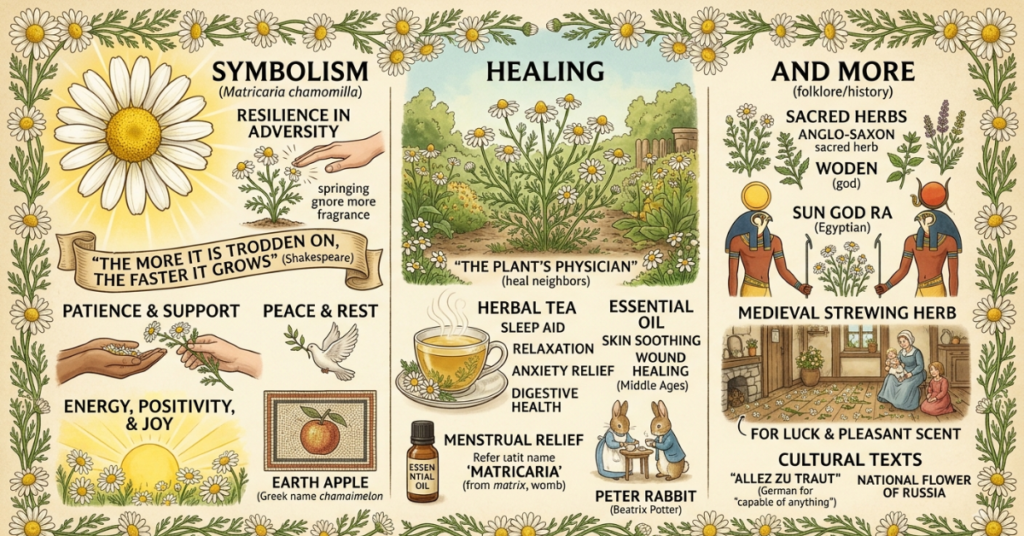

A small white flower with a sunny yellow center may not look especially powerful, but chamomile symbolism has a surprisingly rich story. For centuries, chamomile has been associated with comfort, patience, restoration, and the ability to endure difficult circumstances.
Today, chamomile is probably best known as a soothing herbal tea, but its meaning goes beyond a warm cup before bedtime. Its delicate appearance, long history as a medicinal herb, and connection with rest and renewal have all contributed to the way people interpret the flower.
In this guide, we’ll explore chamomile symbolism meaning, its connection with health and healing, spiritual associations, cultural history, and what chamomile can represent when used in gifts, gardens, tattoos, or floral arrangements.
What Does Chamomile Symbolize?
The most common symbolic meanings associated with chamomile include:
- Patience
- Comfort
- Healing and restoration
- Calmness and peace
- Resilience during difficult times
- Strength in adversity
- Rest and renewal
- Gentleness and simplicity
One of the most interesting ideas connected with chamomile is strength in adversity. The flower’s symbolism isn’t necessarily about dramatic or heroic strength. Instead, it suggests the quieter kind of strength that helps someone keep going when life becomes difficult.
That makes chamomile an especially meaningful flower for someone recovering from a challenging period, beginning a new chapter, or simply needing encouragement.
Chamomile Symbolism Meaning in Floriography
In the traditional language of flowers, or floriography, chamomile is commonly associated with patience, comfort, and resilience in adversity.
Some modern floriography references describe chamomile as representing “energy in adversity”—a fitting interpretation considering the plant’s long history as a useful medicinal herb.
It’s worth remembering that flower meanings aren’t universal scientific facts. Floriography developed through different cultures, books, traditions, and personal interpretations, so the exact meaning of a flower can vary.
Still, the recurring themes surrounding chamomile are remarkably consistent: comfort, patience, healing, and perseverance.
Why Is Chamomile Associated With Patience?
Chamomile’s association with patience can be understood symbolically rather than literally.
The plant has a gentle appearance and a long-standing reputation as a comforting herb. Rather than representing sudden transformation, it evokes the idea of allowing time, rest, and care to do their work.
In that sense, chamomile can symbolize a simple message:
Healing doesn’t always happen quickly, and that’s okay.
Chamomile Symbolism and Health
The connection between chamomile symbolism health and healing isn’t entirely accidental. Chamomile has been used as a medicinal herb for centuries.
The National Center for Complementary and Integrative Health notes that chamomile has been described in ancient medical writings and was used medicinally in cultures including ancient China, Egypt, Greece, and Rome.
Modern chamomile is available in teas, extracts, topical preparations, and other products. However, it’s important to separate the symbolic meaning of healing from proven medical effects.
Chamomile may symbolize healing because people have historically used it as part of traditional healthcare—not because the flower itself has supernatural healing powers.
Chamomile Symbolism Health Healing: What’s the Connection?
The phrase chamomile symbolism health healing brings together two sides of the plant: its cultural meaning and its traditional medicinal history.
Chamomile has been promoted for several purposes, including digestive discomfort, anxiety, insomnia, respiratory complaints, and certain skin conditions. However, according to NCCIH, research has not provided enough reliable evidence to establish chamomile as clinically effective for most of these uses.
There is some preliminary research surrounding anxiety. NCCIH notes that two studies suggested chamomile supplements might help with generalized anxiety disorder, but the evidence remains preliminary and isn’t conclusive.
So, when people call chamomile a “healing flower,” the most accurate interpretation is that healing is one of its traditional and symbolic associations, while scientific evidence for specific health benefits remains limited.
The Historical Roots of Chamomile
Chamomile has a much longer history than its modern association with bedtime tea.
The species commonly known as German chamomile is Matricaria chamomilla, an accepted botanical name according to the Royal Botanic Gardens, Kew. It belongs to the daisy family, Asteraceae.
Kew records the plant’s native range across parts of Macaronesia, North Africa, temperate Eurasia, and into Indo-China.
Historically, chamomile was valued as a useful plant rather than simply a decorative flower. Its medicinal reputation helped establish the associations with comfort, restoration, and wellness that remain popular today.
Chamomile in Ancient Traditions
NCCIH reports that chamomile appeared in ancient medical traditions and was considered an important medicinal herb in ancient China, Egypt, Greece, and Rome.
This long history helps explain why chamomile developed such strong associations with care and healing.
However, it’s important to be cautious about some popular claims circulating online. Stories sometimes describe chamomile as specifically sacred to the Egyptian sun god Ra, for example, but such claims are not well established by reliable historical evidence. A strong article about chamomile should distinguish documented medicinal history from later folklore and internet mythology.
Spiritual Meaning of Chamomile
From a spiritual or symbolic perspective, chamomile is often interpreted as a flower of peace, cleansing, comfort, and renewal.
Its soft white petals can evoke purity and simplicity, while the yellow center gives the flower a warm, sunlit appearance. Together, these qualities have encouraged interpretations involving emotional balance and positive energy.
Chamomile may therefore be used symbolically to represent:
- Peace after a difficult period
- Emotional restoration
- Patience with the healing process
- Protection and comfort
- A fresh start
- Inner resilience
These are symbolic interpretations rather than established religious meanings, so they can differ between traditions and individuals.
What Does Chamomile Mean in Love?
Chamomile isn’t usually considered one of the strongest traditional symbols of romantic passion. Instead, its meaning in relationships is softer.
It can represent gentle affection, comfort, emotional support, and peaceful companionship.
Giving someone chamomile flowers may communicate something like:
“I’m here for you.”
That makes chamomile particularly appropriate for a friend, partner, family member, or anyone going through a stressful or difficult time.
Unlike a dramatic red rose, chamomile doesn’t necessarily say “passion.” It says care, warmth, and quiet support.
Chamomile Symbolism for Healing and Recovery
Few flowers fit the idea of recovery as naturally as chamomile.
Whether someone is recovering emotionally from heartbreak, adjusting to a major life change, or simply feeling overwhelmed, chamomile can symbolize the process of slowing down and allowing yourself time to recover.
Its meaning can be summarized as:
Rest, recover, regain your strength, and keep going.
This interpretation also explains why chamomile works well in sympathy arrangements, wellness-themed gifts, self-care products, and artwork centered around emotional wellbeing.
Of course, flowers should complement—not replace—professional medical care when someone is dealing with a health condition.
Chamomile as a Symbol of Resilience
Resilience is perhaps one of the most beautiful ways to interpret chamomile.
The flower is small and delicate-looking, yet its traditional symbolism emphasizes perseverance. That contrast gives the flower a meaningful message: being gentle doesn’t mean being weak.
Chamomile can therefore symbolize someone who has experienced hardship but continues to move forward with patience and grace.
This makes it particularly meaningful for:
- Graduation gifts
- Recovery gifts
- New beginnings
- Encouragement bouquets
- Self-care themes
- Memorial or remembrance designs
- Inspirational artwork
- Personal tattoos
What Does Chamomile Represent in a Tattoo?
A chamomile tattoo can carry a very personal meaning.
Someone might choose it to represent healing after a difficult chapter, while another person may associate it with a loved one, peaceful memories, or simply a preference for delicate botanical designs.
Common chamomile tattoo meanings include:
- Healing
- Resilience
- Patience
- Peace
- Inner strength
- Recovery
- Simplicity
- Hope
- Emotional comfort
Chamomile Tattoo Ideas
If you’re considering a chamomile-inspired tattoo, you could combine the flower with:
- A crescent moon for rest and renewal
- A butterfly for transformation
- A small quote about resilience
- Other wildflowers for a meadow-inspired design
- A birth date or meaningful number
- Fine-line botanical details
- A small bouquet representing different personal qualities
The symbolism becomes even more personal when chamomile is paired with another flower whose meaning has significance to you.
Chamomile Flower Color Meaning
Chamomile is most recognizable for its white petals and yellow center. Although flower-color symbolism varies across cultures, these colors can reinforce the flower’s broader associations.
White Chamomile
White commonly evokes ideas of:
- Purity
- Peace
- Innocence
- Simplicity
- Calmness
Yellow Center
The yellow center can suggest:
- Warmth
- Happiness
- Optimism
- Sunshine
- Positive energy
Together, the white and yellow coloring gives chamomile a naturally uplifting appearance, which complements its symbolic associations with comfort and renewal.
Chamomile vs. Daisy Symbolism
Chamomile is often mistaken for an ordinary daisy because both have white petals surrounding a yellow center.
They are related botanically, but they aren’t the same plant. German chamomile, for example, is Matricaria chamomilla, a member of the Asteraceae family.
Symbolically, daisies are often connected with innocence, purity, cheerfulness, and new beginnings, while chamomile tends to have stronger associations with comfort, patience, healing, and resilience.
There can certainly be overlap, especially because flower symbolism is not a fixed scientific system.
Is Chamomile Really a Healing Flower?
In symbolic language, yes—healing is one of chamomile’s strongest modern associations.
Scientifically, however, the answer requires more nuance.
Chamomile has a long history of traditional medicinal use, but research into its effectiveness for specific health conditions is still developing. NCCIH states that there isn’t currently sufficient reliable evidence to determine its clinical usefulness for many conditions for which chamomile is promoted.
That distinction matters.
A flower can symbolize healing without being a proven treatment for an illness. Chamomile’s symbolism comes from its history, cultural associations, appearance, and traditional use—not from a guarantee that drinking chamomile tea will cure a particular condition.
Chamomile Tea and Its Symbolic Meaning
For many people, chamomile tea has become almost inseparable from the idea of relaxation.
A warm cup in the evening naturally suggests:
slow down → breathe → rest → recover.
That cultural association has strengthened chamomile’s symbolic connection with peace and emotional comfort.
Research into chamomile and anxiety has produced some promising but preliminary findings, while evidence for many other promoted uses remains insufficient.
Chamomile can also interact with some medications, and people with allergies to related plants may need to be cautious. NCCIH notes potential interactions involving warfarin, some liver-metabolized medicines, sedatives, and other drugs.
So, if you’re using chamomile medicinally rather than simply enjoying it as a beverage, it’s sensible to check with a healthcare professional—especially if you’re taking medication.
Why Chamomile Is a Meaningful Gift
Flowers are often chosen for what they say without words, and chamomile has a wonderfully gentle message.
It can be a thoughtful choice when you want to communicate:
- “Take care of yourself.”
- “I’m thinking of you.”
- “You’ve been through a lot.”
- “Give yourself time.”
- “Things can get better.”
- “I’m here for you.”
Because chamomile isn’t strongly tied to romance, it also works beautifully as a gift for friends, colleagues, parents, siblings, teachers, and people going through periods of change.
Frequently Asked Questions About Chamomile Symbolism
What is the main meaning of chamomile?
The main symbolic meanings of chamomile are patience, comfort, healing, resilience, and strength during adversity. Its gentle appearance and long history as a medicinal herb reinforce these associations.
What does chamomile symbolize spiritually?
Spiritually, chamomile is often interpreted as a symbol of peace, restoration, emotional healing, protection, and renewal. These meanings are largely symbolic and can vary depending on the tradition.
What does chamomile symbolize in love?
Chamomile usually represents gentle affection, comfort, emotional support, and peaceful companionship rather than intense romantic passion.
What does chamomile symbolize in floriography?
In modern flower-language references, chamomile is commonly associated with patience and energy in adversity, along with comfort and resilience.
Is chamomile a symbol of healing?
Yes. Healing is a common symbolic meaning of chamomile, partly because the plant has a long history of traditional medicinal use. However, symbolic healing should not be confused with scientifically proven medical treatment.
What does a chamomile tattoo symbolize?
A chamomile tattoo can symbolize healing, patience, resilience, peace, recovery, hope, or inner strength. Its meaning can also be personalized around a particular experience or person.
Is chamomile good for health?
Chamomile has been traditionally used for several health-related purposes, but scientific evidence varies by condition. NCCIH notes that there is not enough reliable evidence to establish its clinical usefulness for many of the conditions for which it is promoted.
What flower symbolizes healing and strength?
There isn’t one universal flower that exclusively represents healing and strength. Chamomile is a strong symbolic choice because it combines associations with healing, comfort, patience, and resilience.
Final Thoughts on Chamomile Symbolism
The beauty of chamomile symbolism is that it isn’t about loud or dramatic strength. Instead, chamomile represents the quieter kind: the patience to recover, the comfort of being cared for, and the resilience to keep moving forward.
Its long history as a traditional medicinal herb has helped shape its connection with health and healing, while its simple white-and-yellow appearance gives it an unmistakably peaceful character. At the same time, it’s important to distinguish traditional symbolism and historical use from modern medical evidence.
Whether you’re choosing flowers for someone who needs encouragement, researching the meaning behind a tattoo, creating botanical artwork, or simply curious about the language of flowers, chamomile carries a simple and beautiful message:
Be patient with yourself. Rest when you need to. Healing takes time, and quiet strength is still strength.
If you enjoyed exploring chamomile symbolism meaning, you may also want to explore the symbolism and cultural history of other flowers to see how their meanings developed over time.