
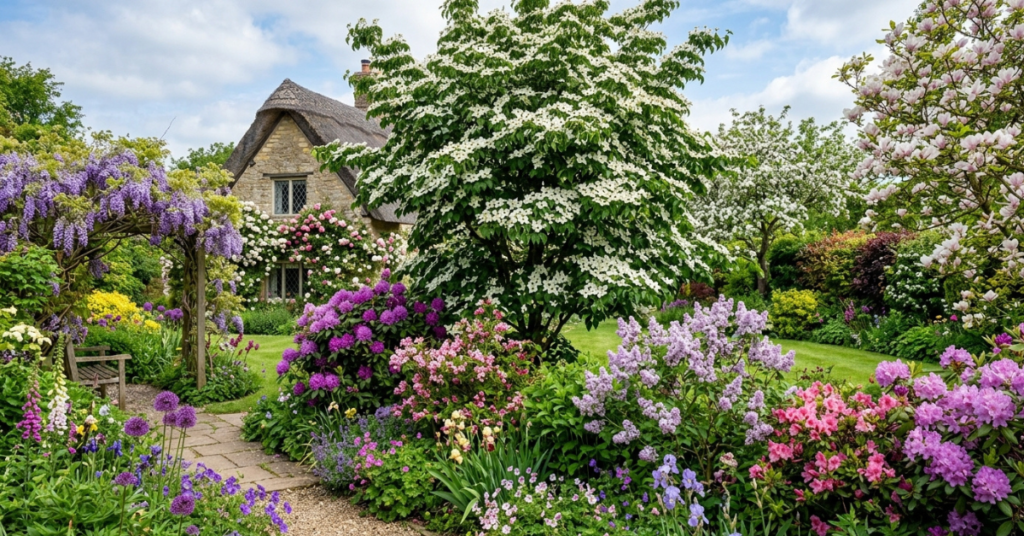

May is one of those months when a garden can suddenly feel completely transformed. Borders fill with colour, trees become covered in delicate blooms, and spring bulbs overlap with early-summer flowers. If you’re looking for May flowering plants, there are plenty of choices, from reliable perennials and flowering shrubs to tulips, clematis and late-flowering daffodils.
The exact timing varies with climate, location and plant variety, so a flower that blooms in May in one garden may appear slightly earlier or later somewhere else. In the UK, for example, May is an important transition period between spring and summer, with many spring-flowering plants still putting on a show while summer plants begin to take over.
In this guide, we’ll explore the best May flowering perennials, trees, shrubs, plants and bulbs, including popular choices for UK gardens.
What Are May Flowering Plants?
May flowering plants are plants that typically produce their main display of flowers during May. They can include annuals, perennials, bulbs, shrubs, trees and climbing plants.
May is particularly useful for gardeners because it offers a wide range of flower shapes and colours. The Royal Horticultural Society lists numerous perennials that flower in May, including geum, bergenia, brunnera, bleeding heart, euphorbia and several species of geranium.
Some plants may have a longer flowering season that begins in April and continues into May, while others begin flowering in May and continue into June or later.
Why Is May Such a Good Month for Flowers?
May sits at a sweet spot in the gardening calendar. The weather is generally becoming warmer, daylight hours are longer and many plants are actively growing.
This makes May gardens particularly useful for:
- Colourful borders
- Cottage gardens
- Wildlife-friendly planting
- Cut-flower gardens
- Containers and patios
- Flowering trees and shrubs
- Pollinator-friendly spaces
Best May Flowering Perennials
If you want flowers that return year after year, May flowering perennials are an excellent place to start.
Perennials live for several years and can provide reliable colour without needing to be replanted every season. The RHS notes that there are perennial choices for a wide variety of soil types, light conditions and garden situations.
Some excellent choices include:
1. Geum
Geums are cheerful, compact perennials that can produce warm yellow, orange, red or pink flowers. They work particularly well toward the front or middle of a flower border.
RHS lists cultivars such as Geum ‘Mrs J. Bradshaw’ and Geum ‘Lady Stratheden’ among plants suitable for May-flowering perennial borders.
2. Bergenia
Bergenia is valued for both its attractive foliage and its flowers. Depending on the variety, its flowers can appear in shades of pink, rose or purple.
It’s a useful choice if you want a relatively tough perennial that adds structure as well as seasonal colour.
3. Brunnera
Brunnera macrophylla is particularly attractive in partly shaded areas. Its small blue flowers appear above heart-shaped foliage, creating a softer woodland-garden effect.
4. Bleeding Heart
Bleeding heart, botanically known as Lamprocapnos spectabilis, is another striking May perennial. Its distinctive heart-shaped flowers make it instantly recognisable.
5. Geranium
Hardy geraniums are versatile garden plants, and several can flower around May. They are useful for filling spaces between larger plants and can work in borders, cottage gardens and informal planting schemes.
6. Euphorbia
Certain euphorbias provide unusual flowers and architectural foliage. The RHS includes several euphorbias among suitable May-flowering perennials.
Other May-flowering perennials worth considering include:
- Veronica
- Tiarella
- Pulmonaria
- Trollius
- Saponaria
- Doronicum
- Lamium
- Anchusa
May Flowering Trees for a Colourful Garden
Flowering trees can have a much bigger visual impact than small plants because their blooms are displayed above the garden.
When selecting May flowering trees, consider the mature size of the tree, available sunlight, soil conditions and the amount of maintenance it will eventually require.
Popular possibilities include:
- Hawthorn
- Laburnum
- Flowering dogwood
- Ornamental crabapple varieties
- Horse chestnut
- Catalpa
- Robinia
However, flowering time isn’t identical for every species or cultivar. Temperature and local climate can shift flowering dates considerably.
May Flowering Tree Crossword Clue
If you searched for “May flowering tree crossword clue,” you’re probably looking for a short answer rather than gardening advice.
The answer depends on the specific crossword and number of letters, so there isn’t one universally correct answer. Hawthorn is a particularly relevant possibility because it is traditionally associated with May flowering, but always check the clue’s letter count and crossing letters.
May Flowering Shrubs and Bushes
Flowering shrubs are excellent for adding height and structure without the size of a mature tree.
Some May flowering shrubs UK gardeners may consider include:
Azalea and Rhododendron
These spring-flowering shrubs can create spectacular displays in suitable acidic soil. Their flowering period varies by species and cultivar, so some bloom earlier while others continue into May.
Choisya
Choisya, sometimes called Mexican orange blossom, is an evergreen shrub valued for its glossy leaves and fragrant white flowers.
Weigela
Weigela is a popular deciduous shrub with tubular flowers that can attract pollinating insects. Depending on the variety and conditions, flowering can occur in late spring.
Viburnum
Viburnums offer considerable variety, including fragrant flowers, attractive foliage and berries in some species.
Kerria
Kerria japonica is known for its bright yellow flowers and arching stems. It is one of the shrubs that can contribute to a late-spring display.
The RHS recommends pruning several spring-flowering shrubs, including Choisya, Kerria, Spiraea and Japanese quince, after flowering rather than before it.
So, if you’re searching for May flowering shrubs UK or May flowering bushes, don’t just consider flower colour. Check when the particular cultivar flowers and when it should be pruned.
May Flowering Tulips: Do Tulips Bloom in May?
Yes, some tulips can flower in May.
Tulips generally flower during mid to late spring, and different groups have different flowering periods. The RHS describes most tulips as mid- to late-spring flowering plants.
This means May flowering tulips are absolutely possible, particularly when you choose later-flowering varieties.
Choosing May Flowering Tulip Bulbs
If your goal is a May display, don’t simply buy any tulip bulbs and expect them all to flower at the same time.
Instead:
- Check the expected flowering period.
- Look for late-flowering or suitable mid-to-late spring varieties.
- Choose bulbs that suit your local growing conditions.
- Plant them at the recommended time.
- Provide a sunny or suitably bright location with well-drained soil.
Tulips are normally planted as bulbs in autumn. The RHS recommends planting tulips in November, while spring-flowering bulbs generally need to be planted during autumn.
For the best display, planting several bulbs together rather than scattering individual bulbs can create a much stronger visual effect.
May Flowering Daffodils and Narcissus
Daffodils are one of the most familiar spring flowers, but they aren’t limited strictly to March or April.
Some May flowering daffodils can continue the display into May, depending on variety and growing conditions. The RHS states that daffodils generally flower between February and May.
Daffodils belong to the genus Narcissus, which means the terms are closely connected rather than referring to completely different types of flowers.
May Flowering Narcissus
May flowering narcissus varieties can be useful for extending a spring bulb display.
If you want daffodils that flower later, look for varieties specifically described by reputable nurseries or plant suppliers as late flowering. Blooming times can still vary depending on weather and location.
One important care tip is to resist cutting the foliage down immediately after flowering. The leaves help the bulb replenish its energy for the following season. The RHS specifically recommends deadheading tulips and daffodils while leaving their foliage and flower stems to feed the bulbs.
May Flowering Clematis
Clematis is a particularly useful choice if you’re searching for a May flowering climber.
Different clematis groups flower at different times, so choosing the right variety matters. Some clematis flower in spring, while others produce their main display during summer or even later.
A May-flowering clematis can be used to:
- Cover a wall
- Grow over a trellis
- Decorate a fence
- Climb through a shrub
- Add vertical colour to a small garden
Because clematis varieties have different pruning requirements, identify the cultivar or pruning group before cutting it back. Pruning at the wrong time can remove the stems carrying the next flowers.
May Flowering Annuals
If you want quick seasonal colour, May flowering annuals can fill gaps between permanent plants.
Annuals complete their life cycle within one growing season. They are particularly useful for containers, bedding displays and filling empty spaces in borders.
Depending on the local climate and sowing time, possibilities include:
- Calendula
- Cornflowers
- Alyssum
- Nemesia
- Marigolds
- Ammi
- Cosmos
Not every annual will naturally reach peak flowering in May. Timing depends heavily on when it was sown, whether it was started indoors and the local climate.
May Flowering Plants UK: What Grows Well?
For anyone searching specifically for May flowering plants UK, the biggest consideration is local growing conditions.
The UK isn’t one uniform gardening climate. A plant may flower earlier in a mild southern garden and later in a colder northern or high-altitude location.
The RHS even advises that some spring bedding should be delayed in colder northern areas until the danger of frost has passed.
When choosing plants, consider:
Sunlight
Some flowering plants thrive in full sun, while others are happier in partial or dappled shade.
Soil
Check whether your soil is:
- Acidic or alkaline
- Heavy clay or sandy
- Moist or dry
- Well-drained or prone to waterlogging
Space
A small perennial and a mature flowering tree have very different space requirements. Always check the eventual height and spread before planting.
Flowering Time
Don’t rely solely on the word “spring.” If May flowers are your priority, choose plants whose flowering period specifically includes May.
Best Plants for May Flowering by Garden Type
Not every garden needs the same plants. Here’s a simple way to narrow down your choices.
| Garden type | Good May flowering choices |
| Small garden | Geum, geranium, tulips, clematis |
| Cottage garden | Geum, bleeding heart, foxglove, hardy geranium |
| Shady garden | Brunnera, bergenia, pulmonaria |
| Containers | Tulips, daffodils, compact perennials |
| Large garden | Flowering trees, shrubs, clematis |
| Wildlife garden | Flowering perennials, shrubs and nectar-rich plants |
| Cut-flower garden | Tulips, daffodils, hardy perennials and annuals |
The best choice isn’t necessarily the plant with the biggest flower. A good May border usually combines different heights, textures and flowering periods.
How to Create a Garden That Flowers Throughout May
One of the easiest mistakes to make is choosing ten plants that all flower at exactly the same time.
Instead, aim for succession.
1. Start with spring bulbs
Tulips and later-flowering daffodils can provide early May colour.
2. Add reliable perennials
Geum, geranium, bergenia and other perennials can carry the display forward.
3. Add shrubs for structure
Flowering shrubs provide height and help make the garden feel established.
4. Use climbers vertically
Clematis can add flowers without taking up much ground space.
5. Fill gaps with annuals
Annuals are useful for adding seasonal colour where permanent plants haven’t filled out yet.
This layered approach can make a garden look fuller and more natural than relying on a single type of plant.
May Flowering Plant Care Tips
May isn’t just about enjoying flowers. It’s also an important month for garden maintenance.
Deadhead when appropriate
Removing faded flowers can improve the appearance of many plants and, depending on the species, may encourage further flowering.
Keep newly planted plants watered
As temperatures rise, newly planted plants can dry out quickly. Pay particular attention to containers and young plants.
Don’t cut bulb foliage too early
Allow tulip and daffodil foliage to die back naturally rather than removing it while it’s still green. This helps the bulb store energy for future growth.
Watch for weeds
May growth isn’t limited to desirable plants. Regularly removing weeds can reduce competition for water, nutrients and light.
Check before pruning trees and shrubs
Spring is also an important nesting period for birds. The RHS advises checking carefully for nesting activity before pruning trees and shrubs.
Frequently Asked Questions About May Flowering
What flowers bloom in May?
Many plants can flower in May, including geum, geranium, bergenia, brunnera, tulips, some daffodils, flowering shrubs and clematis. Exact flowering dates vary by species, cultivar, climate and growing conditions.
What are the best May flowering perennials?
Good choices include geum, bergenia, brunnera, geranium, bleeding heart, euphorbia, Veronica, tiarella and pulmonaria. The right choice depends on sunlight, soil and available space.
Do tulips flower in May?
Yes. Some tulips flower in May, particularly later-flowering varieties. Most tulips flower during mid to late spring.
Are there May flowering daffodils?
Yes. Daffodils generally flower from February through May, so some varieties can provide colour into May.
What is the May flowering tree crossword clue?
There isn’t one universal answer because crossword clues depend on the puzzle and number of letters. “Hawthorn” may be a possibility because of its traditional association with May, but the crossing letters should be used to confirm the answer.
What are good May flowering shrubs in the UK?
Choisya, weigela, viburnum, kerria, azaleas and rhododendrons can provide late-spring flowers, although flowering times vary by species and cultivar.
When should I plant May flowering tulip bulbs?
Tulips are normally planted in autumn rather than immediately before their spring flowering period. The RHS recommends planting tulips in November.
Are daffodils and narcissus the same flower?
Daffodils belong to the genus Narcissus. “Narcissus” is the botanical genus name, while “daffodil” is the common name widely used for many members of the genus.
What are the best plants for May flowering in a small garden?
Compact perennials such as geum and hardy geraniums, along with tulips, daffodils and suitable clematis, can work well. Choose plants based on their mature size rather than their size when purchased.
Conclusion: Make the Most of May Flowering
May flowering offers one of the richest opportunities to bring colour, fragrance and life into a garden. From May flowering perennials such as geum and geranium to flowering shrubs, trees, clematis, tulips and late-season daffodils, there are options for almost every type of outdoor space.
For the strongest display, don’t focus on one plant alone. Combine bulbs, perennials, shrubs, annuals and climbers with different flowering periods so that something is always coming into bloom.
And if you’re planning next year’s garden, remember that many of the most beautiful May displays need preparation months in advance. Spring-flowering bulbs such as tulips and daffodils are generally planted in autumn, so a little planning now can make a noticeable difference when May arrives.
Whether you have a large garden, a small border, a balcony or a few containers, May flowering plants can turn an ordinary space into something that feels full of life. Start with a few reliable favourites, then build your planting scheme around them for a longer and more colourful display.