
Some flowers catch your eye immediately. Others make you stop because you smell them before you even notice them. Tuberose belongs to the second group. Its rich, sweet fragrance can travel through an entire room, especially in the evening, giving this delicate-looking flower a surprisingly powerful presence.
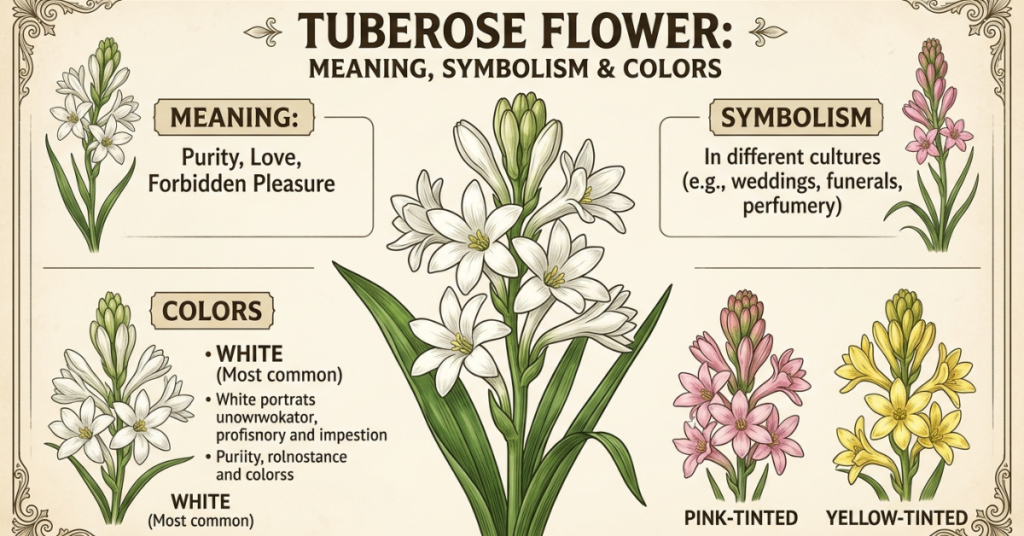
The tuberose flower meaning often centers on purity, love, passion, devotion, peace, beauty, and pleasure. However, flower symbolism changes across cultures and situations. In addition, the flower’s color, fragrance, and traditional uses can influence the meaning people associate with it.
Known scientifically as Polianthes tuberosa, tuberose originated in Mexico and now grows in many warm regions around the world. So, what does this fragrant flower really symbolize? Let’s explore its meaning, cultural significance, and the stories behind its popular associations.
What Is the Tuberose Flower?
Tuberose is a flowering plant that produces tall spikes covered with small, waxy, usually white flowers. Despite its name, tuberose is not a type of rose. Instead, it belongs to the Asparagaceae family.
The plant originated in Mexico, but growers now cultivate it in many parts of the world. People use its flowers for gardens, bouquets, garlands, decorations, and perfume.
Most importantly, tuberose stands out because of its fragrance. Its sweet, creamy, intense scent has made it a favorite ingredient in perfumery for generations.
Why Does Tuberose Have Such a Strong Connection With the Night?
The flower’s fragrance plays a major role in its identity. Tuberose becomes particularly noticeable in the evening, which helps explain its association with nighttime in several South Asian languages.
For example, Bengali uses রজনীগন্ধা (Rajanigandha) for tuberose, while Hindi commonly uses रजनीगंधा (Rajnigandha). Both names connect the flower with its fragrant, night-associated character.
As a result, tuberose carries an intriguing contrast. Its flowers look simple and elegant, yet its fragrance feels bold, memorable, and almost impossible to ignore.
Tuberose Flower Meaning and Symbolism
So, what does tuberose symbolize?
No single definition covers every culture or tradition. Instead, people have developed different interpretations through flower language, literature, customs, religious practices, and personal experiences.
Still, tuberose commonly represents:
- Purity and innocence
- Love and affection
- Passion and sensuality
- Peace and tranquility
- Devotion
- Beauty and elegance
- Pleasure and attraction
- Celebration and remembrance
However, these meanings can overlap. For example, one person may see white tuberose as a symbol of purity, while another may focus on its powerful fragrance and connect it with passion.
That contrast makes tuberose especially interesting. At first glance, it looks delicate and understated. Yet, once its fragrance fills the air, it becomes the center of attention.
Tuberose Flower Meaning: Love and Passion
One of the strongest interpretations of tuberose involves passionate love.
Its intense fragrance has encouraged associations with attraction, desire, romance, and sensuality. In some flower-language traditions, people even connect tuberose with temptation and forbidden pleasure because of its unusually strong scent.
However, you should not assume that every tuberose bouquet carries a romantic message. The occasion always matters.
For example:
- A wedding arrangement can express purity and devotion.
- A romantic bouquet can suggest passion and attraction.
- A vase of tuberose at home can represent beauty, peace, and appreciation.
- A ceremonial garland can carry cultural or spiritual meaning.
Therefore, the meaning often depends on the story behind the flowers.
Tuberose Flower Meaning: Purity and Innocence
White tuberose naturally creates associations with purity, innocence, peace, and sincerity. Its clean white petals give it an elegant appearance without making the flower look overly dramatic.
For this reason, people often choose white tuberose for weddings and other meaningful ceremonies. Its soft appearance can create a refined atmosphere while its fragrance adds another sensory dimension.
In addition, white tuberose can communicate genuine affection and devotion. So, if you want flowers that feel elegant rather than overly romantic, tuberose can make a thoughtful choice.
Tuberose Flower Meaning in Bengali
The tuberose flower meaning in Bengali connects closely with its Bengali name, রজনীগন্ধা (Rajanigandha).
In Bengali, রজনীগন্ধা refers to the fragrant tuberose flower. The name itself evokes ideas of nighttime and fragrance, which perfectly suit a flower that becomes especially noticeable through its evening scent.
In Bengali-speaking communities, people commonly use tuberose in bouquets, garlands, and decorative arrangements. Consequently, the flower can evoke feelings of:
- Fragrance and beauty
- Love and affection
- Purity
- Celebration
- Elegance
- Sweet memories
Of course, individual families and communities may attach their own meanings to the flower. Therefore, these associations work best as general cultural interpretations rather than strict definitions.
Tuberose Flower Meaning in Hindi
The tuberose flower meaning in Hindi centers on the name रजनीगंधा (Rajnigandha).
Hindi speakers commonly use this name for tuberose, and the name reflects the flower’s fragrant connection with nighttime. India Flora Online also records regional names such as Rajinighanda, Gulcheri, and Gulshabbo.
Across India, people appreciate tuberose for both its fragrance and decorative value. They often use the flowers in garlands, floral arrangements, celebrations, and other special occasions.
Tuberose Flower Meaning: Joy and Celebration
Can tuberose symbolize joy?
Yes, people can interpret tuberose as a symbol of joy, celebration, happiness, and the pleasure that comes from beauty and fragrance. However, “joy” does not represent a universally fixed botanical meaning of the flower.
Instead, context gives this interpretation its strength. For example, weddings, festivals, religious occasions, and family celebrations often feature fragrant flowers. Therefore, tuberose can naturally become associated with happy memories and joyful gatherings.
So, if you’re searching for tuberose flower meaning joy, think of it as the joy of love, celebration, beauty, fragrance, and meaningful moments rather than a strict dictionary definition.
Pink Tuberose Flower Meaning
The pink tuberose flower meaning requires a little clarification.
Traditional tuberose has a strong association with white flowers. However, you may occasionally find flowers marketed online as “pink tuberose.” These products can refer to different cultivars, related plants, hybrids, or commercial names.
Because of this variation, you should not automatically treat pink as an established traditional tuberose symbolism.
If someone uses a genuinely pink tuberose-like flower symbolically, common pink-flower associations can suggest:
- Tender affection
- Gentleness
- Admiration
- Sweetness
- Romantic feelings
- Appreciation
In other words, these meanings come mainly from pink flower symbolism, not from a universally accepted traditional meaning of Polianthes tuberosa.
Tuberose Flower Symbolism Across Cultures
Flowers rarely carry exactly the same meaning everywhere. Tuberose demonstrates this especially well.
Tuberose in South Asian Traditions
In South Asian traditions, people value tuberose for its fragrance and decorative appeal. They use its flowers in garlands, bouquets, celebrations, and other cultural settings.
Moreover, the flower’s white appearance and strong scent naturally encourage associations with purity, devotion, beauty, and celebration.
Tuberose in Western Flower Symbolism
Western flower-language traditions often emphasize another side of tuberose. Some associate the flower with passionate feelings, attraction, sensuality, and desire.
Meanwhile, contemporary floral guides may focus more strongly on the flower’s white color and connect it with innocence, purity, and peace.
Why Does Tuberose Have Different Meanings?
The reason is straightforward: flower symbolism does not follow one universal scientific system.
Instead, people develop floral meanings through culture, literature, religion, local traditions, appearance, scent, and historical customs. Consequently, it makes more sense to say that tuberose is associated with certain meanings rather than claim that it has one scientifically fixed symbolic definition.
What Does Tuberose Represent in a Bouquet?
If you’re thinking about giving someone tuberose, consider the occasion first.
For a Romantic Partner
Tuberose can communicate:
“My feelings for you are deep, intense, and unforgettable.”
Its powerful fragrance makes it especially suitable when you want a romantic gesture to feel memorable.
For a Wedding
White tuberose can represent:
- Purity
- Devotion
- New beginnings
- Lasting affection
- Elegance
For a Friend
You don’t have to give tuberose a romantic interpretation. A simple arrangement can express appreciation, affection, and gratitude.
For a Celebration
Because tuberose combines beauty with an unmistakable fragrance, it works beautifully for birthdays, engagements, weddings, and other celebrations.
Why Is Tuberose Used in Perfume?
Tuberose has one of the most recognizable floral fragrances. Its rich, creamy, sweet, and intense scent has made it valuable to perfumers.
In addition, its fragrance can become quite dominant. Therefore, perfumers often use tuberose carefully when they want to create a dramatic floral character.
The connection between fragrance and emotion also helps explain its symbolism. A flower that looks relatively understated but produces such a powerful scent naturally evokes ideas of mystery, attraction, passion, and unforgettable experiences.
Tuberose Flower Facts at a Glance
| Feature | Details |
| Common name | Tuberose |
| Scientific name | Polianthes tuberosa |
| Family | Asparagaceae |
| Native range | Mexico |
| Famous feature | Strong, sweet fragrance |
| Common flower color | White |
| Hindi name | रजनीगंधा (Rajnigandha) |
| Bengali name | রজনীগন্ধা (Rajanigandha) |
| Common symbolism | Purity, love, peace, passion, devotion |
| Major uses | Perfume, floral arrangements, garlands, gardens |
Kew identifies Polianthes tuberosa as a species native to Mexico and places it within the Asparagaceae family.
7 Occasions When Tuberose Makes a Meaningful Gift
If you want to give tuberose to someone, consider these occasions:
- Wedding celebrations — to express purity, devotion, and beauty.
- Anniversaries — to celebrate affection and romantic connection.
- Birthdays — to express joy and appreciation.
- Engagements — to represent love and new beginnings.
- Religious or cultural ceremonies — when fragrant flowers suit the tradition.
- Thank-you gestures — to show genuine appreciation.
- Home decoration — to bring beauty and fragrance into a room.
Ultimately, the best flower matches the person and the occasion. Traditional symbolism can guide your choice, but personal meaning often makes a gift even more special.
Frequently Asked Questions About Tuberose Flower Meaning
What is the main tuberose flower meaning?
The most common associations include purity, love, passion, peace, devotion, beauty, and pleasure. However, different cultures and flower traditions emphasize different meanings.
What does tuberose symbolize in love?
Tuberose can symbolize deep affection, passion, attraction, and intense romantic feelings. Its powerful fragrance plays an important role in these romantic associations.
What is tuberose flower meaning in Bengali?
In Bengali, tuberose is called রজনীগন্ধা (Rajanigandha). The name connects the flower with its fragrant and nighttime character.
What is tuberose flower meaning in Hindi?
In Hindi, tuberose is commonly called रजनीगंधा (Rajnigandha). The name reflects the flower’s fragrant association with the night.
What does a white tuberose flower symbolize?
White tuberose commonly represents purity, innocence, peace, devotion, and elegance. These qualities make it particularly suitable for weddings and meaningful ceremonies.
What is the pink tuberose flower meaning?
Pink tuberose does not have one universally recognized traditional meaning. However, when people use a pink tuberose-like flower symbolically, they may associate it with tender affection, admiration, sweetness, appreciation, and gentle romance.
Does tuberose flower meaning include joy?
Yes. Tuberose can represent joy, celebration, and happiness, particularly when people use it at weddings, festivals, and other joyful occasions. However, “joy” remains a contextual association rather than a universally standardized definition.
Why is tuberose called Rajnigandha?
The name Rajnigandha reflects the flower’s connection with nighttime and fragrance. Hindi and Bengali speakers commonly use this name for tuberose.
Is tuberose a type of rose?
No. Despite the name, tuberose is not a rose. It belongs to the Asparagaceae family and represents a completely different plant.
Final Thoughts on Tuberose Flower Meaning
The beauty of the tuberose flower meaning comes from its many layers. Its white blooms can suggest purity and peace, while its powerful fragrance can evoke passion, attraction, mystery, and pleasure.
In Bengali, people call it রজনীগন্ধা, while Hindi speakers commonly call it रजनीगंधा. Both names reflect the flower’s close connection with nighttime fragrance.
Furthermore, tuberose can represent joy when you place it in the right context. Weddings, celebrations, affection, beautiful memories, and even the simple pleasure of a fragrant room can all give the flower a joyful meaning.
Ultimately, tuberose reminds us that a flower doesn’t need dramatic colors to make an impression. Sometimes, the most memorable flowers are the ones whose fragrance stays with you long after you have stopped looking at them.