
There are flowers that look beautiful, and then there are flowers that completely change the atmosphere around them. Tuberose belongs firmly to the second category. Its small, waxy blooms may look delicate, but its rich fragrance can fill an entire room.
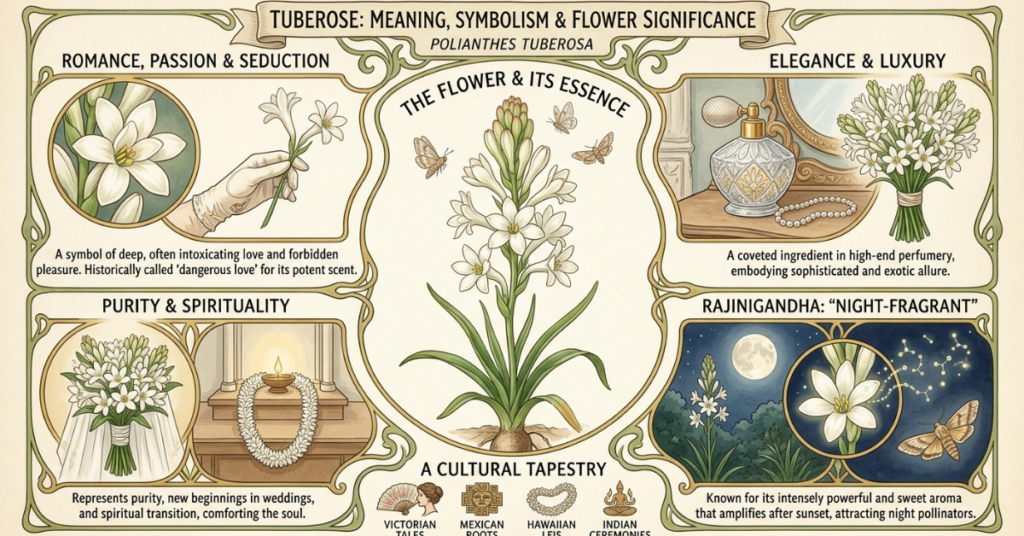
So, what is the tuberose meaning? Tuberose is commonly associated with purity, innocence, peace, sensuality, love, and intense beauty. Its symbolism can vary depending on culture and tradition, which makes this fragrant white flower especially interesting.
Known botanically today as Agave amica (formerly Polianthes tuberosa), tuberose is native to Mexico and is widely grown as an ornamental and fragrant flower. The Royal Horticultural Society describes it as a plant with white, waxy, funnel-shaped flowers and a particularly strong scent.
What Is the Tuberose Flower?
Tuberose is a perennial flowering plant that grows from underground tubers. It produces tall flower spikes covered with clusters of white, tubular blooms.
Although the name contains the word “rose,” tuberose is not a type of rose. Its botanical classification places it within the Asparagaceae family and the broader agave group.
The flower is especially famous for its fragrance. Tuberose has been valued in perfumery for centuries, and its rich scent is often described as sweet, creamy, intense, floral, and somewhat intoxicating.
Quick facts about tuberose
- Botanical name: Agave amica
- Former botanical name: Polianthes tuberosa
- Origin: Mexico
- Flower color: Most commonly white
- Flower type: Tubular, waxy blooms
- Family: Asparagaceae
- Famous for: Its powerful fragrance
- Common uses: Bouquets, garlands, gardens, floral arrangements, and perfumes
Tuberose Meaning and Symbolism
The meaning of a flower is rarely limited to one definition. Floral symbolism has developed through literature, cultural traditions, folklore, and the historical “language of flowers,” so different sources can give slightly different interpretations. The RHS notes that historical flower dictionaries themselves often assigned varying meanings to the same plants.
Still, several themes repeatedly appear when people discuss the tuberose meaning.
1. Purity and innocence
Because of its white petals, tuberose is often associated with purity, innocence, peace, and sincerity.
White tuberose is particularly popular in wedding flowers and ceremonial arrangements. Its clean appearance combined with its beautiful fragrance gives it an elegant and peaceful quality.
2. Love and romance
Tuberose is also strongly connected with romantic love. Its fragrance is rich and noticeable rather than soft or understated, which has contributed to its association with passion and romantic attraction.
This makes tuberose an interesting choice when a floral gift needs to communicate something deeper than simple admiration.
3. Sensuality and passion
One of the more intriguing aspects of tuberose symbolism is its connection with sensuality and intense passion.
Historical flower-language traditions have sometimes linked Polianthes tuberosa with voluptuousness or dangerous pleasure. These meanings are symbolic rather than universal rules, but they explain why tuberose often appears in discussions of seduction, mystery, and romantic intensity.
4. Peace and serenity
The white color of tuberose also gives it a calmer interpretation. In some floral traditions, it represents peace, tranquility, and innocence.
That combination is part of what makes the flower so versatile: it can represent both innocence and passion depending on the context.
White Tuberose Meaning
The white tuberose meaning is most closely associated with purity, peace, innocence, devotion, and beauty.
White tuberose is especially appropriate for occasions where elegance and sincerity matter, including:
- Weddings
- Religious or ceremonial gatherings
- Romantic occasions
- Sympathy and remembrance arrangements
- Elegant home décor
- Traditional garlands
Its symbolism is strengthened by its appearance: the white flowers look simple and pristine, while their powerful fragrance adds an almost luxurious quality.
For this reason, white tuberose can communicate a beautiful contrast—innocence on the outside and intensity in its fragrance.
Tuberose Meaning in English
The tuberose meaning in English is simply the name of a fragrant flowering plant known for its white, tubular flowers.
The word “tuberose” is related to the Latin tuberosa, referring to something swollen or tuberous, which relates to the plant’s underground tuberous growth.
The flower is also sometimes called:
- Tuberose
- Mexican tuberose
- Mistress of the night
- Rajnigandha
- Nishigandha
The name “mistress of the night” is particularly fitting because of the flower’s strong fragrance and its association with nighttime scent. The RHS lists “mistress of the night” among its common names.
Tuberose Meaning in Urdu
The tuberose meaning in Urdu is commonly associated with گل شبّو (Gul Shabbo) or similar regional names for the flower.
The name Rajnigandha is also widely understood in South Asian contexts. Its underlying idea is closely connected to night and fragrance—an appropriate description for a flower famous for its powerful scent.
Regional names can vary, so spelling and pronunciation may differ depending on the Urdu-speaking community or region.
Tuberose Meaning in Hindi
The tuberose meaning in Hindi is commonly expressed as रजनीगंधा (Rajnigandha). It is also known by regional names including Gulchhari/Gulcheri and Gulshabbo. India Flora Online lists Rajnigandha and other vernacular names for Polianthes tuberosa.
“Rajnigandha” is particularly meaningful because the name evokes the idea of fragrance of the night.
The word is formed from ideas associated with rajani (night) and gandha (fragrance), which perfectly captures the flower’s identity.
Tuberose Meaning in Bengali
The tuberose meaning in Bengali is রজনীগন্ধা (Rajanigandha/Rojonigondha).
The Bengali name is particularly descriptive. A botanical research publication explains that “Rajani” refers to night and “Gandha” to fragrance, reflecting the flower’s strong nighttime scent.
In Bengali culture, tuberose is also an important ornamental and floral plant, and its fragrant white blooms are used in bouquets, garlands, and decorative arrangements.
Tuberose Meaning in Marathi
The tuberose meaning in Marathi is commonly निशिगंध (Nishigandha).
Marathi-English dictionary sources identify Nishigandha as tuberose, Polianthes tuberosa.
The name carries the same night-and-fragrance idea found in other South Asian names for the flower.
Tuberose Meaning Flower: What Does It Represent?
If you’re searching specifically for the tuberose meaning flower, the simplest interpretation is:
Tuberose represents purity, peace, romantic love, sensuality, devotion, and intoxicating beauty.
However, the meaning depends on the situation.
| Tuberose symbolism | What it can represent |
| White petals | Purity and innocence |
| Strong fragrance | Passion and attraction |
| Night fragrance | Mystery and romance |
| Traditional use | Celebration and devotion |
| Elegant appearance | Grace and beauty |
This mixture of meanings is what makes tuberose different from flowers with a single, widely recognized symbolic message.
Why Is Tuberose Associated With the Night?
Tuberose has earned several night-related names because of its famously powerful fragrance and the way its scent is perceived after dark.
The Bengali name Rajanigandha, for example, combines words associated with night and fragrance.
This nighttime association has also contributed to its romantic image. A garden filled with tuberose can feel very different in the evening when its fragrance becomes particularly noticeable.
Tuberose in Weddings and Cultural Traditions
Tuberose has a long history of ornamental and ceremonial use, particularly across South Asia.
Its long flower spikes and fragrant white blooms make it suitable for:
- Bridal garlands
- Wedding decorations
- Bouquets
- Temple and ceremonial arrangements
- Floral jewelry
- Home decoration
- Cut-flower displays
Its popularity isn’t only symbolic. Tuberose is commercially important as a cut flower and as a source of fragrance used in perfumery. Research on tuberose cultivation also highlights its importance for loose flowers, cut flowers, garlands, and essential flower oil.
Tuberose Meaning in Different Cultures
There isn’t one universal flower dictionary that applies everywhere. Tuberose symbolism changes depending on cultural context.
In general:
- Western floral symbolism: It can suggest sensuality, passion, and even “dangerous pleasure.”
- Wedding traditions: Its white flowers are often associated with purity, peace, and innocence.
- South Asian traditions: It is strongly connected with fragrance, weddings, garlands, celebration, and devotion.
- Perfume culture: Its intense fragrance gives it an association with luxury, sensuality, and sophistication.
That is why a tuberose bouquet can feel simultaneously innocent, romantic, traditional, and seductive.
What Does Tuberose Smell Like?
Tuberose is famous because its fragrance is difficult to ignore.
It is generally described as a rich white-floral scent with sweet, creamy, green, and sometimes slightly animalic or indolic qualities. In perfumery, it is considered a complex and powerful floral note rather than a light, barely noticeable scent.
Depending on the person, tuberose can smell:
- Creamy
- Sweet
- Floral
- Honeyed
- Green
- Exotic
- Intense
- Slightly spicy or earthy
This strong fragrance is one reason tuberose has remained popular in fine perfumery.
Is “Solar Tuberose” a Different Flower?
The phrase “solar tuberose meaning” can be confusing because “solar tuberose” is not the standard botanical name of the plant.
In fragrance descriptions, however, solar can be used as a sensory or artistic term. A “solar tuberose” accord may suggest a brighter, warmer, sunnier interpretation of tuberose—often imagining creamy white flowers warmed by sunlight.
So, if you encountered “solar tuberose” in a perfume description, it is best understood as a fragrance concept or accord, not a separate species of tuberose.
Tuberose as a Symbolic Gift
Want to give someone tuberose but aren’t sure what message it sends?
Think about the occasion first.
For a romantic partner
Tuberose can communicate deep attraction, passion, admiration, and romance.
For a wedding
White tuberose can represent purity, peace, devotion, and new beginnings.
For a friend
A simple tuberose arrangement can express appreciation and affection, especially when the focus is on its beauty and fragrance rather than romantic symbolism.
For home décor
Tuberose works beautifully when you want an atmosphere that feels fresh, elegant, traditional, and fragrant.
Frequently Asked Questions About Tuberose Meaning
What is the main tuberose meaning?
The main tuberose meaning is associated with purity, peace, love, sensuality, passion, and beauty. The exact interpretation depends on the culture and occasion.
What does white tuberose symbolize?
White tuberose commonly symbolizes purity, innocence, peace, devotion, and beauty. It is frequently used in weddings and ceremonial floral arrangements.
What is tuberose called in Hindi?
Tuberose is commonly called रजनीगंधा (Rajnigandha) in Hindi. Other regional names are also used.
What is tuberose called in Bengali?
Tuberose is called রজনীগন্ধা (Rajanigandha/Rojonigondha) in Bengali. The name relates to night and fragrance.
What is tuberose called in Marathi?
Tuberose is commonly called निशिगंध (Nishigandha) in Marathi.
What is tuberose called in Urdu?
Tuberose is commonly known by regional Urdu names such as Gul Shabbo (گل شبّو). Naming can vary by region.
Why is tuberose called the flower of the night?
Tuberose is strongly associated with nighttime because of its powerful fragrance and names such as Rajnigandha, which connect the flower with night and scent.
Is tuberose a rose?
No. Despite its name, tuberose is not a rose. It is botanically classified as Agave amica and belongs to the Asparagaceae family.
What does tuberose symbolize in love?
In romantic symbolism, tuberose can represent passion, sensuality, attraction, deep affection, and intoxicating beauty. Historical flower-language traditions have particularly emphasized its sensual side.
Final Thoughts on Tuberose Meaning
The tuberose meaning is much more layered than its delicate white flowers might suggest. It can symbolize purity and innocence, but its intense fragrance also gives it associations with passion, romance, sensuality, and mystery.
Its names across languages tell an equally beautiful story. From Rajnigandha in Hindi and Bengali to Nishigandha in Marathi and regional Urdu names such as Gul Shabbo, the flower is repeatedly connected with fragrance and the night.
Whether you’re choosing flowers for a wedding, looking for a meaningful gift, decorating your home, or simply curious about floral symbolism, tuberose is a fascinating choice. Its beauty may catch your eye first—but its unforgettable fragrance is what makes it memorable.