
Some wildflowers have a way of making a garden feel effortlessly natural. With slender stems, delicate foliage, and rounded clusters of blue flowers, globe gilia is a beautiful example of a plant that doesn’t need to be flashy to stand out.
Scientifically known as Gilia capitata, this North American native belongs to the phlox family, Polemoniaceae. It is appreciated for its blue-to-violet blooms, relatively easy cultivation, drought tolerance, and value to pollinators such as bees and butterflies.
Whether you’re interested in identifying this wildflower, collecting globe gilia seeds, or learning how to grow it at home, this guide covers its appearance, native range, growing requirements, life cycle, and common questions.
What Is Gilia capitata?
Gilia capitata is an herbaceous wildflower native to western North America. It is commonly known as globe gilia, bluehead gilia, blue field gilia, and blue gilia.
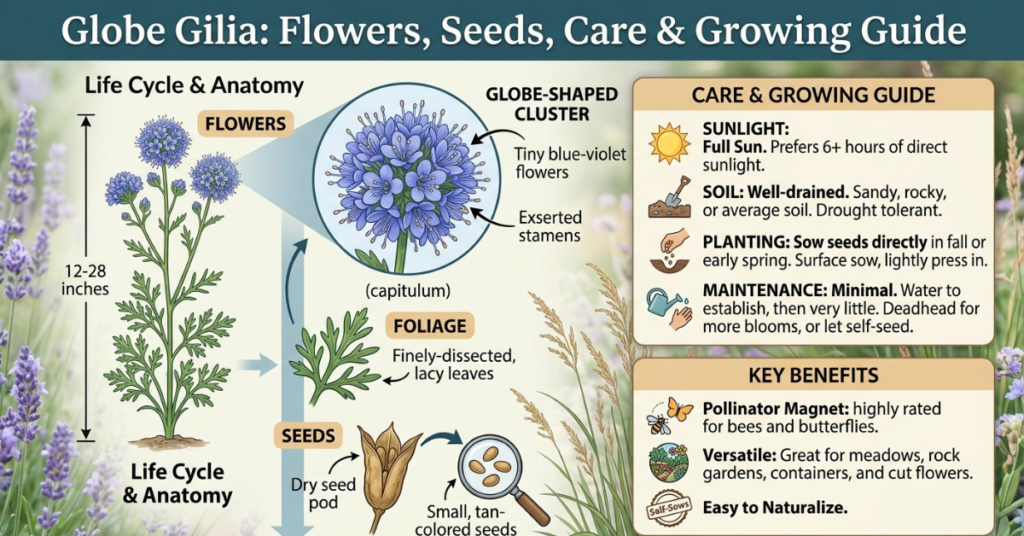
Its most recognizable feature is the rounded flower head. Rather than producing one large bloom, each flower head contains many tiny individual flowers packed closely together. This gives the plant its characteristic globe or pincushion-like appearance.
The species belongs to the Polemoniaceae family, which also includes phlox. Depending on the population or subspecies, its flowers can range from pale blue and lavender to violet, pink, or white.
Globe Gilia Quick Facts
| Feature | Details |
| Scientific name | Gilia capitata |
| Family | Polemoniaceae |
| Common names | Globe gilia, bluehead gilia, blue field gilia |
| Plant type | Usually grown as an annual |
| Flower colors | Blue, violet, lavender, pink, white |
| Typical height | About 6 inches to 2 feet |
| Light | Full sun to partial shade |
| Soil | Well-drained soil |
| Water | Moderate during establishment; relatively drought tolerant afterward |
| Propagation | Seeds |
| Wildlife value | Attracts bees, butterflies, and other pollinators |
The exact appearance and mature size can vary because several subspecies occur across its broad natural range.
Globe Gilia Flower: Appearance and Characteristics
The globe gilia flower is what makes this wildflower particularly easy to recognize.
Each rounded flower head consists of numerous tiny, five-petaled flowers. The clusters sit at the ends of thin stems, creating an interesting contrast between the compact blooms and airy foliage.
Most commonly, the flowers are blue or blue-violet. However, natural variation means that some plants can produce flowers with lavender, pink, or whitish tones.
Why Are the Flower Heads Round?
What looks like a single flower is actually an inflorescence, or a cluster of individual flowers.
The flowers are packed together into a rounded structure. This distinctive shape gives the species its common name and creates the small, globe-like appearance that makes it popular in wildflower gardens.
Globe Gilia Leaves and Plant Structure
The globe gilia leaves have a finely divided or dissected appearance. Instead of broad, solid leaves, the foliage looks somewhat feathery and delicate.
Lower leaves are generally more noticeable, while the upper portions of the plant become increasingly open as the stems branch toward the flower clusters.
This airy structure allows the plant to blend naturally into meadow plantings and mixed wildflower borders.
How Tall Does Gilia capitata Grow?
The globe gilia height depends on growing conditions, geographic location, and subspecies.
Many references describe mature plants as roughly 6 inches to 2 feet tall, although some individuals can grow taller under favorable conditions.
Plants growing in rich soil with sufficient moisture may become taller and more vigorous, while those growing in dry, exposed locations can remain smaller.
Is Globe Gilia Annual or Perennial?
One of the most searched questions about this wildflower is “globe gilia annual or perennial?”
For most gardeners, it is best treated as an annual. The plant grows, flowers, produces seeds, and completes its life cycle within a single growing season.
However, botanical databases can differ in how they describe the species because Gilia capitata includes geographically distinct subspecies. Some references list it as annual or perennial.
The important gardening point is that plants can readily reproduce from seed. If mature flowers are allowed to form and release seeds, new plants may appear in subsequent seasons.
Globe Gilia Native Range and Habitat
The globe gilia native range covers a large portion of western North America.
The species occurs across areas of the western United States and extends northward into Alaska and southward toward northern Mexico. It is particularly associated with regions of California, Oregon, Washington, Idaho, Utah, Arizona, and other western states.
Its natural habitats include:
- Open grasslands
- Meadows
- Rocky slopes
- Sandy areas
- Coastal environments
- Chaparral
- Open woodland
- Disturbed areas
This broad habitat range helps explain why the plant can adapt to different garden conditions when given adequate sunlight and drainage.
Globe Gilia in California
Globe gilia California populations are particularly noteworthy because the species occurs throughout a variety of habitats in the state.
Several subspecies are recognized, including forms associated with particular ecological regions. One example is dune gilia, Gilia capitata ssp. chamissonis, which is associated with coastal sand-dune environments.
This regional diversity also means that plants found in different parts of California may not look exactly alike.
How to Grow Globe Gilia From Seed
For gardeners interested in growing globe gilia from seed, direct sowing is generally the simplest approach.
The seeds are small, and the plants don’t usually require complicated propagation techniques. Depending on the climate, fall or early spring can be suitable times for sowing.
1. Pick a Sunny Location
Choose a location that receives plenty of sunlight.
Full sun encourages strong stems and good flowering. Although the plant may tolerate some partial shade, a bright location is generally preferable.
2. Use Well-Drained Soil
Good drainage is essential.
The species naturally occurs in sandy, rocky, and other freely draining environments. Heavy, constantly wet soil can create unfavorable conditions for the roots.
You don’t necessarily need highly fertile soil. Ordinary garden soil can work if excess water drains away efficiently.
3. Sow the Seeds
Scatter the globe gilia seed over prepared soil and gently press it into the surface.
Avoid covering small seeds with a thick layer of soil. Follow the planting depth and seasonal recommendations on your particular seed packet because seed suppliers may provide instructions suited to specific climates.
4. Maintain Moisture During Germination
Newly planted seeds need enough moisture to begin germinating.
Keep the soil lightly moist rather than constantly saturated. Once the young plants become established, watering can gradually be reduced.
5. Thin Crowded Plants
When several seedlings emerge close together, thin them if necessary.
Giving each plant enough space improves airflow and reduces competition for sunlight, moisture, and nutrients.
Globe Gilia Seedlings: Early Growth
Globe gilia seedlings are initially small and can be easy to confuse with other young plants.
As they develop, their finely divided foliage becomes more noticeable. Providing adequate sunlight at this stage helps prevent weak or excessively stretched growth.
A simple routine is enough:
- Keep newly germinated plants lightly moist.
- Provide plenty of light.
- Remove excessively crowded seedlings.
- Avoid overwatering.
- Gradually reduce irrigation as plants mature.
Once established, these wildflowers are considerably less demanding than many traditional ornamental plants.
Globe Gilia Plant Care
One of the biggest advantages of Gilia capitata is its relatively low-maintenance nature.
Sunlight
Full sun is ideal. A location receiving several hours of direct sunlight each day will generally produce better flowering.
Soil
Use well-drained soil. Sandy, rocky, loamy, or average garden soil can be suitable when water doesn’t remain around the roots.
Water
Young plants need regular moisture while they establish themselves. Mature plants are relatively drought tolerant and normally need much less supplemental irrigation.
Fertilizer
Heavy feeding isn’t usually necessary. Excessively fertile conditions can encourage leafy growth rather than the naturally delicate structure associated with this wildflower.
Maintenance
There is little pruning involved. Once flowering finishes, you can allow some plants to produce seed if you want natural reseeding.
Do the Flowers Attract Pollinators?
Yes. The small blooms are useful to a range of insects.
The plant provides nectar and pollen and can attract bees, bumblebees, butterflies, and other beneficial insects. This makes it a practical choice for people who want to add more wildlife value to a garden.
It works particularly well in:
- Pollinator gardens
- Native plant landscapes
- Wildflower meadows
- Cottage gardens
- Rock gardens
- Low-water landscapes
Combining it with other native flowering species can create a more diverse habitat for local pollinators.
Globe Gilia Seeds and Natural Reseeding
One reason gardeners enjoy this species is its ability to reproduce through seed.
After flowering, mature plants can produce seeds. If some spent flower heads are left on the plant, those seeds may fall into the surrounding soil and germinate during a suitable season.
Natural reseeding doesn’t guarantee that plants will return in precisely the same location. Instead, seedlings may appear wherever the conditions are favorable.
For informal meadow gardens, this natural variation can actually make the planting look more authentic.
Is This Wildflower Good for Gardens?
For the right type of garden, it can be an excellent choice.
This isn’t a plant to choose if you want a large, permanent perennial with dramatic foliage. Instead, it is ideal for gardeners who appreciate seasonal flowers, naturalistic planting, and relatively low-maintenance species.
It is particularly suitable for:
- Native gardens
- Drought-tolerant landscapes
- Wildflower mixes
- Pollinator borders
- Meadow-style gardens
- Rock gardens
- Informal flower beds
The blue flower clusters also pair nicely with other spring and early-summer wildflowers.
Common Growing Problems
Although this species is generally easy to grow, a few problems can occur.
Overwatering
Constantly wet soil is one of the easiest mistakes to make. Choose a well-drained location and avoid keeping established plants excessively wet.
Too Little Sun
Plants growing in deep shade may become weak and produce fewer flowers.
Crowded Seedlings
Seedlings growing too closely together may compete for light and nutrients. Thin them when necessary.
Excess Fertilizer
Rich soil and heavy fertilizer aren’t usually needed. A moderately fertile, well-drained site is often sufficient.
How to Identify Gilia capitata
If you encounter this wildflower outdoors, several features can help with identification.
Look for:
- Rounded clusters of tiny flowers
- Blue or blue-violet blooms
- Thin, branching stems
- Finely divided foliage
- A relatively delicate growth habit
- Preference for sunny, open locations
- Seasonal flowering in spring or summer
Because the species varies geographically, flower color alone shouldn’t be used as the only identification feature.
Frequently Asked Questions
What is globe gilia?
It is a North American wildflower scientifically known as Gilia capitata. It is recognized for its rounded clusters of small blue or violet flowers and finely divided foliage.
Is Gilia capitata an annual?
It is generally treated as an annual in gardening. The plant completes its life cycle within a growing season but can reseed itself.
How tall does it grow?
Most plants reach approximately 6 inches to 2 feet, although height can vary according to the subspecies and growing conditions.
What color are the flowers?
Blue and blue-violet are the most familiar colors. Lavender, pink, and white forms can also occur.
Can I grow it from seed?
Yes. Directly sowing seeds into well-drained soil is generally the easiest propagation method.
When should I sow the seeds?
Fall and early spring are commonly recommended, but the best timing depends on your local climate and the instructions supplied with the seed.
Does it need full sun?
Full sun is preferred for strong growth and flowering, although the plant may tolerate some partial shade.
Is it drought tolerant?
Once established, it can tolerate relatively dry conditions, particularly in well-drained soil.
Does it attract bees and butterflies?
Yes. Its flowers can provide nectar and pollen for bees, butterflies, bumblebees, and other beneficial insects.
Can it reseed itself?
Yes. Allowing some flowers to mature and release seed can encourage new plants to appear naturally in future seasons.
Where is it native?
Its natural distribution covers much of western North America, including broad areas of the western United States and parts of Canada and northern Mexico.
Does it grow in California?
Yes. The species is widespread in California and occurs across several different habitats, with multiple recognized subspecies.
Conclusion
With its delicate foliage, rounded blue flower clusters, and impressive adaptability, globe gilia is a wonderful choice for anyone interested in native wildflowers or natural-looking gardens.
It is generally grown as an annual, but its ability to produce seed means it can return naturally when conditions are right. Give it plenty of sunlight, well-drained soil, and reasonable moisture during establishment, and it can reward you with a beautiful seasonal display.
If you’re planning a pollinator garden or simply want to experiment with native wildflowers, starting with Gilia capitata seeds is an easy way to bring a touch of western North America’s natural beauty into your landscape.