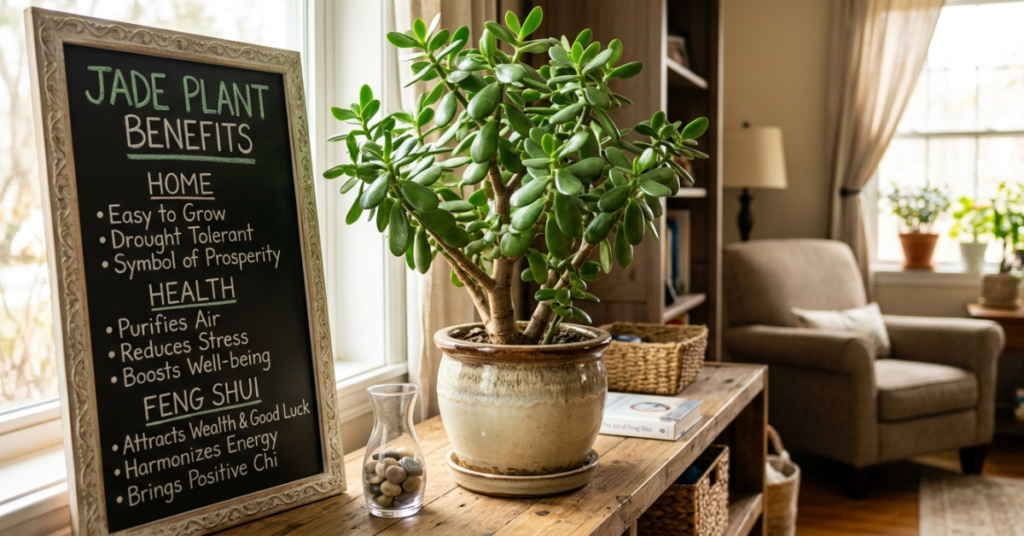

A small jade plant can make a room feel instantly fresher and more inviting, but its appeal goes beyond its glossy green leaves. Often associated with prosperity, good fortune, and positive energy, the jade plant has become a favorite houseplant around the world.
But how many of the commonly discussed jade plant benefits are actually supported by evidence, and which ones come from cultural traditions such as feng shui and Vastu?
In this guide, we’ll explore jade plant benefits and uses, its traditional symbolism, possible household advantages, skin-related claims, different jade varieties, and important safety considerations. We’ll also separate established facts from beliefs so you can enjoy the plant without unrealistic expectations.
What Is a Jade Plant?
The jade plant (Crassula ovata) is a succulent native to southern Africa. It has thick, fleshy leaves that store water, allowing the plant to tolerate periods of dryness better than many common houseplants.
It is also known by several popular names, including:
- Money plant or money tree
- Lucky plant
- Friendship tree
- Money jade plant
- Lucky jade plant
Its compact growth and relatively easy care make it especially popular as an indoor plant.
Jade Plant Benefits and Properties
The jade plant is best known as an ornamental succulent, rather than a medicinal plant. Its thick leaves, branching stems, and ability to store water are adaptations that help it survive in relatively dry conditions.
Some commonly discussed jade plant benefits and properties include:
- Attractive year-round greenery
- Low-maintenance indoor gardening
- Long lifespan with appropriate care
- Traditional association with prosperity and good fortune
- Potential contribution to a more pleasant indoor environment
- Educational value for learning about succulent plants
One important distinction is worth making: a plant being associated with health, prosperity, or positive energy does not automatically mean it has clinically proven effects in those areas.
Jade Plant Benefits at Home
One of the biggest practical advantages of a jade plant is how easily it fits into a home environment. Its compact appearance works well on desks, shelves, windowsills, balconies, and other bright spaces.
1. Adds Natural Beauty
The thick green leaves provide a simple way to introduce nature indoors. Jade plants can complement modern, minimalist, rustic, and traditional interiors.
2. Relatively Easy to Maintain
Because jade plants are succulents, they generally prefer drying out between waterings rather than staying constantly wet. This makes them a convenient choice for people who occasionally forget to water their plants.
3. Can Live for Many Years
With suitable light, well-draining soil, careful watering, and appropriate temperatures, jade plants can remain part of a home for many years.
4. Encourages Indoor Gardening
Even a small plant can make someone more interested in caring for greenery. For beginners, jade plants can be a rewarding introduction to succulent care.
Jade Plant Benefits in Bedroom
Can you keep a jade plant in the bedroom? Yes. There is no general horticultural reason that prevents you from keeping a healthy jade plant indoors, including in a bedroom.
However, some online claims about jade plant benefits in bedroom go much further than the evidence supports.
A jade plant should not be considered a treatment for insomnia, anxiety, breathing problems, or other health conditions. Like most plants, it also does not produce enough oxygen at night to create a meaningful medical benefit in an ordinary bedroom.
If you enjoy having plants around while sleeping, focus on practical factors such as:
- Adequate sunlight during the day
- Good air circulation
- Proper drainage
- Avoiding overwatering
- Keeping soil and leaves free from pests
Jade Plant Benefits for Home and Interior Spaces
For interior design lovers, the jade plant can be useful for more than its traditional symbolism. Its structured branches and rounded leaves create visual softness without taking up much space.
Try placing a jade plant:
- On a bright living-room shelf
- Beside a sunny desk
- On a console table
- Near a well-lit kitchen window
- On a balcony with suitable conditions
- In a decorative ceramic planter
A mature jade plant can also become an attractive focal point because its stems develop a miniature tree-like appearance.
Jade Plant Benefits Feng Shui
The jade plant has a particularly strong reputation in feng shui. It is traditionally associated with wealth, prosperity, growth, and good fortune.
Its rounded leaves are sometimes interpreted as resembling coins, which contributes to its symbolic connection with financial abundance.
Feng Shui Jade Plant Benefits
Traditional feng shui interpretations commonly associate jade plants with:
- Prosperity
- Wealth
- Growth
- Good fortune
- Positive energy
- Business success
These are cultural and symbolic beliefs rather than scientifically established effects.
In other words, placing a jade plant in a particular location cannot be expected to directly create wealth. However, people may use the plant as a meaningful visual reminder of their financial goals, growth, or aspirations.
Jade Plant Benefits Vastu’s Direction
In Vastu Shastra, plants may be placed according to traditional beliefs about direction and energy. Jade plants are sometimes recommended for areas associated with prosperity and positive growth.
You may find recommendations for placing a jade plant in areas such as the southeast or other directions depending on the particular Vastu tradition being followed.
However, there is no scientific evidence that a jade plant in a specific compass direction changes financial circumstances or health.
If you follow Vastu, treat placement as a cultural or spiritual practice rather than a scientifically proven method of attracting wealth.
Money Jade Plant Benefits
The term “money jade plant” usually refers to the jade plant because its coin-like leaves have become associated with wealth and abundance.
The commonly mentioned money jade plant benefits include symbolic ideas such as:
- Attracting prosperity
- Encouraging financial growth
- Representing stability
- Bringing good fortune
- Creating a positive atmosphere
These meanings explain why jade plants are frequently given as housewarming, business-opening, or celebratory gifts.
Lucky Jade Plant Benefits
The jade plant’s reputation as a lucky plant is closely connected to its longevity, vigorous growth, and rounded leaves.
Giving someone a jade plant can therefore carry a thoughtful message: May your home, relationships, or business continue to grow.
That symbolism is one of the reasons jade plants remain popular gifts even when the recipient is not particularly interested in gardening.
Jade Plant Benefits Spiritual
Some people assign spiritual meanings to jade plants based on their appearance, growth habits, and cultural traditions.
A jade plant may symbolize:
- Growth
- Renewal
- Abundance
- Stability
- Resilience
- Good fortune
These meanings can make the plant personally meaningful, but they should not be confused with scientifically demonstrated spiritual or supernatural effects.
Jade Plant Benefits in Islam
Questions about jade plant benefits in Islam often arise because people want to know whether the plant has a special religious meaning.
There is no well-established Islamic teaching that gives the jade plant a specific spiritual power, guaranteed blessing, or special status. Claims that keeping a jade plant automatically attracts wealth or blessings should therefore not be presented as Islamic doctrine.
A Muslim can certainly keep a jade plant as an ordinary ornamental plant and appreciate its beauty. The important distinction is between enjoying a plant and attributing supernatural powers to it without reliable religious evidence.
Jade Plant Benefits for Skin
Jade plants are sometimes promoted online for jade plant benefits for skin, including claims involving acne, irritation, hydration, or wound care.
These claims should be approached carefully.
Although plants contain various natural compounds, that does not mean applying raw jade plant material to the skin is safe or effective. There is not enough reliable clinical evidence to recommend jade plant leaves as a standard skin treatment.
If you have acne, eczema, wounds, rashes, or another skin concern, evidence-based skincare products and professional medical advice are safer options than experimenting with crushed plant leaves.
Jade Plant Benefits and Uses
The most sensible uses of a jade plant are ornamental, educational, and symbolic.
Common Uses
Home decoration: Its sculptural appearance makes it a natural addition to interiors.
Gifts: Jade plants are popular housewarming and business gifts because of their prosperity symbolism.
Indoor gardening: They are useful for people learning how to care for succulents.
Workspace decoration: A small jade plant can add greenery to a desk without requiring constant attention.
Cultural symbolism: The plant is often used to represent luck, abundance, friendship, and growth.
Gollum Jade Plant Benefits
The Gollum jade is a cultivar of Crassula ovata recognized by its unusual tubular leaves, which often have reddish tips under suitable growing conditions.
Its benefits are largely the same as those of other jade cultivars:
- Attractive ornamental appearance
- Relatively manageable care requirements
- Long-term indoor gardening potential
- Strong symbolic association with prosperity
- Compact, distinctive form
Its unusual shape makes it particularly interesting for decorative plant collections.
Dwarf Jade Plant Benefits
The name “dwarf jade” can refer to smaller-growing jade-like plants and is sometimes used for Portulacaria afra, commonly called elephant bush or dwarf jade.
This is important because Portulacaria afra is botanically different from the common jade plant, Crassula ovata.
Both can be attractive succulents, but they have different characteristics and care requirements. Always check the botanical name when buying a plant rather than relying only on a common name.
Mini Jade Plant Benefits
A mini jade plant offers many of the same ornamental and symbolic advantages as a larger plant while taking up less room.
It can work especially well for:
- Small apartments
- Office desks
- Bedrooms
- Bookshelves
- Window ledges
- Small decorative corners
Because of its size, it can also be easier to incorporate into minimalist interior designs.
Trailing Jade Plant Benefits
“Trailing jade” can refer to different succulent plants sold under similar common names, so identification matters.
Unlike the classic upright jade plant, trailing varieties are valued for their cascading growth. They can be attractive in hanging planters or elevated containers where their stems can spill naturally over the edges.
Their main benefits are decorative rather than medicinal.
Jade Plant Health Uses: What Does Science Say?
This is where it is important to separate popular plant claims from evidence.
Indoor plants can make spaces feel more pleasant, and interacting with plants may support enjoyment and connection with nature. However, it would be misleading to describe a jade plant as a medicine or treatment.
There is currently no good basis for claiming that keeping a jade plant cures diseases, treats chronic conditions, or replaces medical care.
What About Air Purification?
Houseplants are often advertised as powerful natural air purifiers. While plants can participate in gas exchange and laboratory research has explored their effects on indoor pollutants, ordinary homes are much more complicated environments.
Ventilation, filtration, cooking, cleaning products, outdoor pollution, and building materials can have much larger effects on indoor air quality.
So, keep a jade plant because you enjoy it—not because you expect one small pot to purify an entire home.
Jade Plant Benefits and Side Effects
A healthy jade plant is generally grown as an ornamental plant, but that does not mean every part of it should be consumed or used as a home remedy.
Potential concerns include:
- Pets may become sick if they eat jade plant material.
- Raw plant material should not be casually applied to broken or irritated skin.
- Overwatering can encourage root problems and mold in the growing medium.
- Plant soil can harbor microorganisms if it is poorly maintained.
- Some people may experience irritation from contact with plant material.
Are Jade Plants Toxic to Pets?
Jade plants are considered potentially toxic to dogs and cats. If a pet chews or eats the plant and develops symptoms such as vomiting, weakness, lack of coordination, or unusual behavior, contact a veterinarian or an appropriate animal poison service.
For homes with curious pets, keeping the plant somewhere inaccessible is the safest approach.
How to Care for a Jade Plant
Good care is the best way to enjoy the practical benefits of a jade plant.
1. Give It Bright Light
Jade plants generally do best in bright light. A location with several hours of suitable sunlight can support compact, healthy growth.
2. Avoid Constantly Wet Soil
Allow the growing medium to dry between waterings. The exact watering schedule depends on light, temperature, pot size, soil, and season.
3. Use Well-Draining Soil
Succulent or cactus soil can help prevent excess moisture around the roots.
4. Choose a Pot With Drainage
A drainage hole allows excess water to escape and is especially important for succulent plants.
5. Don’t Overwater
One of the most common mistakes with jade plants is watering too frequently. Yellowing leaves, soft stems, or root problems can occur when the plant remains excessively wet.
Frequently Asked Questions About Jade Plant Benefits
What are the main jade plant benefits?
The main practical benefits are ornamental beauty, relatively easy care, longevity, and suitability for indoor gardening. Cultural traditions also associate jade plants with prosperity and good fortune.
Is a jade plant good for the bedroom?
Yes, you can keep a jade plant in a bedroom if it receives appropriate light and is properly cared for. However, claims that it provides major health or oxygen benefits during sleep are not well supported.
Does a jade plant bring money?
In feng shui and other traditions, jade plants symbolize wealth and prosperity. There is no scientific evidence that a plant directly attracts money.
Which direction is best for a jade plant according to Vastu?
Vastu recommendations vary by tradition. Some commonly recommend prosperity-associated areas such as the southeast, but these are traditional beliefs rather than scientifically established effects.
Is jade plant good for skin?
There is insufficient clinical evidence to recommend jade plant leaves as a skin treatment. Avoid applying raw plant material to acne, wounds, or irritated skin without professional guidance.
Is jade plant good for health?
A jade plant can contribute to a pleasant indoor environment and provide the everyday benefits of caring for plants. However, it should not be considered a medicinal treatment.
What are jade plant benefits in feng shui?
Feng shui traditionally connects jade plants with wealth, prosperity, growth, abundance, and good fortune.
Are jade plants poisonous?
Jade plants can be harmful if eaten, particularly by pets. Keep them away from dogs, cats, and children who may chew on plants.
What is the difference between a Gollum jade and a regular jade plant?
Gollum jade is a cultivar with distinctive tubular leaves, while the common jade plant has broader, flatter oval leaves. Both are varieties of Crassula ovata.
Can a jade plant be kept inside the house?
Yes. Jade plants can be grown indoors when they receive sufficient light and are planted in well-draining soil with adequate drainage.
Conclusion
The most valuable jade plant benefits are a combination of practical and symbolic ones. It is an attractive, long-lived succulent that can bring greenery into your home without demanding complicated care. Its reputation for luck, wealth, prosperity, and positive energy also gives it cultural meaning in feng shui and other traditions.
At the same time, it’s important to distinguish tradition from science. A jade plant can symbolize prosperity, but it cannot guarantee financial success; similarly, it should not be treated as a medicine for skin or health problems.
If you’re thinking about adding one to your home, choose a healthy plant, give it plenty of appropriate light, use well-draining soil, and water carefully. Whether you love it for its beauty, symbolism, or easy-care nature, a jade plant can be a charming addition to your indoor garden.