
A simple palm leaf can carry a surprisingly deep message. Across religious traditions and ancient cultures, palm fronds meaning has been connected with victory, peace, celebration, hope, and spiritual renewal. But their symbolism becomes especially important in Christianity, where palm branches are closely associated with Jesus’ triumphal entry into Jerusalem.
If you’ve ever wondered why churches use palm branches on Palm Sunday or what these leaves represent spiritually, you’re in the right place. Let’s explore the history, symbolism, and palm fronds meaning in Christianity, while also looking at what these graceful leaves can represent on a more personal level.
What Are Palm Fronds?
Palm fronds are the long, leafy branches that grow from palm trees. Depending on the species, they can be broad and fan-shaped or long and feather-like.
Palm trees have been important in warm regions of the world for thousands of years. Beyond their practical uses, their evergreen appearance and ability to thrive in difficult climates helped give them symbolic importance in many cultures.
In religious and historical settings, palm branches have often represented:
- Victory and triumph
- Peace and prosperity
- Celebration and welcome
- Life and endurance
- Hope and renewal
- Honor and recognition
Their meaning can change depending on the culture or tradition, so it is useful to look at the symbolism in context.
Palm Fronds Meaning: What Do They Symbolize?
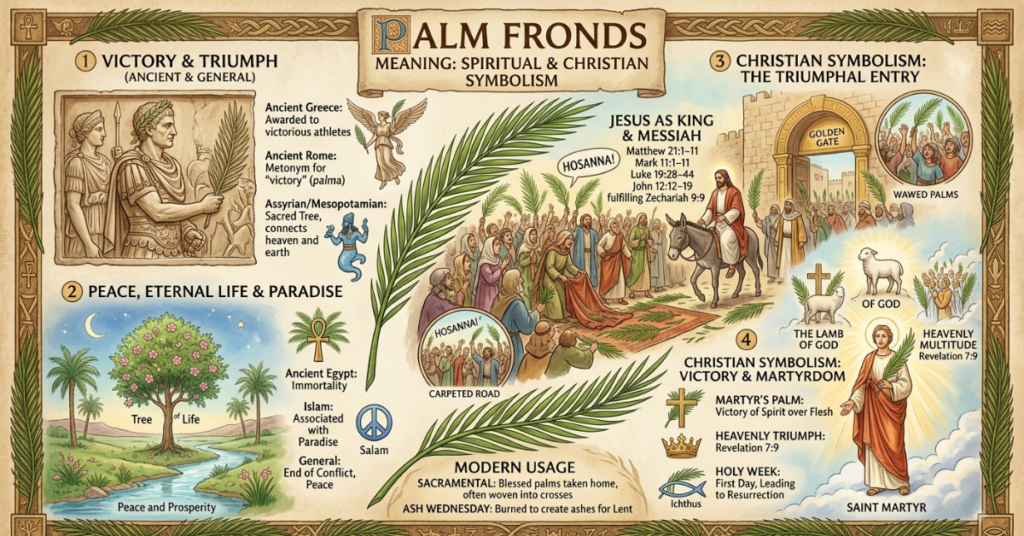
At its simplest, the palm fronds meaning is often associated with victory and triumph. Palm branches were used as symbols of celebration and honor in the ancient Mediterranean and Near Eastern world.
The symbolism makes intuitive sense, too. Palm trees remain green in hot, dry environments and can survive conditions that many other plants cannot. Their resilience naturally lends itself to ideas of endurance, life, and hope.
1. Victory and Triumph
One of the oldest associations of palm branches is victory.
Palm branches were used in celebrations honoring victorious rulers and important figures. In the biblical account of Jesus entering Jerusalem, the crowd’s use of palm branches carries this sense of public honor and triumph. John 12:13 specifically describes people taking palm branches to welcome Jesus while proclaiming him as king.
This is why a palm frond can symbolize overcoming difficulties and reaching a long-awaited victory.
2. Peace and Welcome
Palm branches can also communicate welcome and peace.
A person carrying or presenting a palm branch may be expressing respect rather than hostility. In the Christian story, the crowd’s actions during Jesus’ entry into Jerusalem were a public expression of honor and expectation.
The image of a green palm branch therefore combines celebration with a sense of peaceful welcome.
3. Hope and Renewal
Because palm trees can remain green in challenging environments, palm fronds are sometimes interpreted as symbols of endurance and continuing life.
This makes them especially meaningful in spiritual contexts. A palm leaf can serve as a reminder that difficult seasons do not necessarily last forever and that renewal can follow hardship.
4. Honor and Recognition
Palm branches have also been associated with honoring someone important.
In the Gospel of John, the crowd does not simply carry palm branches casually. Their actions accompany words identifying Jesus as the King of Israel.
In this setting, the palm branch becomes part of a public display of recognition.
Palm Fronds Meaning Spiritual: What Do They Represent?
When people search for palm fronds meaning spiritual, they are often looking for a broader interpretation beyond their biblical use.
Spiritually, palm fronds can represent the idea of remaining strong while moving through difficult circumstances. Their association with life, victory, and renewal makes them a natural symbol for personal growth and perseverance.
Some common spiritual interpretations include:
- Resilience: staying strong during difficult periods.
- Victory: moving beyond obstacles or challenges.
- Peace: finding calm after conflict or uncertainty.
- Renewal: entering a new stage of life.
- Hope: believing that better circumstances can come.
- Protection: in some spiritual interpretations, the palm is viewed as a comforting symbol of divine care.
It is important to distinguish these broader spiritual interpretations from specific biblical teachings. Not every modern symbolic meaning is explicitly stated in Scripture.
Palm Fronds Meaning in Christianity
The palm fronds meaning in Christianity is most strongly connected with Jesus’ triumphal entry into Jerusalem, an event commemorated by Christians as Palm Sunday.
According to John 12:12–13, a crowd welcomed Jesus as he entered Jerusalem and carried palm branches while shouting “Hosanna” and proclaiming him King of Israel.
The account is significant because the palm branches were not merely decorative. They formed part of the crowd’s public welcome and reflected themes of kingship, celebration, and hope.
Why Did People Use Palm Branches for Jesus?
Palm branches already had cultural associations with victory and the honoring of important people. Biblical study notes also connect their use in John with earlier Jewish traditions and historical celebrations of victory.
At the same time, the Gospel writers connect Jesus’ entry with Scripture. Matthew describes the king coming humbly, riding on a donkey, echoing the imagery of Zechariah 9:9.
So the palm branches communicate an important message: the crowd was welcoming Jesus with the kind of honor associated with a king.
What Does Palm Sunday Have to Do With Palm Fronds?
Palm Sunday is the Christian observance that remembers Jesus’ entry into Jerusalem before his crucifixion.
Churches in many Christian traditions distribute or display palm branches during Palm Sunday services. Worshippers may carry them during processions, hold them during services, or take them home afterward.
The palm therefore becomes a physical reminder of the biblical event and the themes surrounding it.
Why Is It Called Palm Sunday?
The name comes from the Gospel accounts describing palm branches being used as Jesus entered Jerusalem. John gives the clearest direct reference, saying that people took palm branches and went out to meet him.
The day is also important because Palm Sunday begins Holy Week, leading Christians toward the events of Jesus’ crucifixion and resurrection.
What Does “Hosanna” Mean With Palm Branches?
“Hosanna” is closely connected with the Palm Sunday story.
The word comes from a Hebrew expression associated with a plea for salvation, but in Christian worship it also became an expression of praise. John 12:13 connects the crowd’s cry with Psalm 118:25–26, a passage that includes a plea for salvation and a blessing on the one who comes in the Lord’s name.
This gives the scene a deeper meaning. The crowd’s celebration was not simply about welcoming a famous person; it was connected with expectations of salvation and kingship.
Palm Branches in the Bible
Palm trees and branches appear in several biblical contexts, although their meanings are not identical in every passage.
Some notable references include:
- John 12:13 — Palm branches are carried during Jesus’ entry into Jerusalem.
- Leviticus 23:40 — Palm branches are included among branches used during the Feast of Tabernacles.
- Psalm 118:25–26 — The words associated with “Hosanna” and “Blessed is he who comes in the name of the Lord” appear here.
- Revelation 7:9 — A great multitude is pictured standing before the throne with palm branches in their hands.
These references help explain why palm imagery became so meaningful in Christian symbolism.
Palm Fronds and the Symbolism of Victory
The connection between palms and victory did not begin with Christianity.
Historical and biblical reference material notes that palm branches were used in celebrations of victory, including among Judeans. This background helps explain why the crowd’s use of palms during Jesus’ arrival carried such a powerful message.
In Christian symbolism, however, the idea of victory eventually takes on an even deeper meaning. Palm imagery can point beyond earthly success toward spiritual victory and hope.
This is particularly visible in Revelation, where a multitude stands before God holding palm branches.
Are Palm Fronds a Symbol of Peace?
Yes, palm branches can symbolize peace, although victory and triumph are particularly prominent associations in the biblical Palm Sunday context.
The broader symbolism of a palm can include:
- Peace after conflict
- A respectful welcome
- Celebration
- Spiritual hope
- Endurance
- Victory over hardship
Because symbolism varies between cultures and traditions, it is best not to assume that every palm branch always means exactly the same thing.
What Do Palm Fronds Mean Spiritually Today?
Today, someone might interpret a palm frond as a personal reminder of strength, faith, hope, or a new beginning.
For a Christian, its meaning may be specifically tied to Jesus, Palm Sunday, salvation, and the events of Holy Week. For someone using palm imagery outside Christianity, it might simply represent resilience, tropical life, peace, or victory.
The meaning ultimately depends on the context in which the palm is being used.
Palm Fronds as a Symbol of Resilience
There is something naturally inspiring about a palm tree.
Palm trees grow in environments characterized by heat, strong sunlight, limited rainfall, and other challenging conditions. That makes the palm an easy metaphor for resilience: bending through difficult circumstances without losing its ability to grow.
For this reason, palm imagery can work beautifully in:
- Artwork
- Tattoos
- Jewelry
- Home décor
- Religious decorations
- Memorial designs
- Inspirational graphics
- Wedding and event décor
A palm frond does not have to represent one single idea. Its symbolism can be personal while still carrying centuries of cultural and religious history.
Palm Fronds vs. Palm Leaves: Is There a Difference?
The terms are often used interchangeably in everyday conversation.
Technically, a palm frond refers to the entire leaf structure of a palm tree, including its central stem and attached leaflets or segments. So when someone talks about waving a palm frond on Palm Sunday, they are referring to a palm leaf or branch-like leaf structure.
In everyday writing, “palm leaf” and “palm frond” are both commonly understood.
Palm Fronds Meaning: A Quick Summary
If you want the meaning in a nutshell, here are the most important associations:
| Symbolism | Meaning |
| Victory | Triumph and overcoming obstacles |
| Peace | Welcome and peaceful intentions |
| Hope | Looking toward a better future |
| Renewal | New beginnings and spiritual restoration |
| Resilience | Strength through difficult circumstances |
| Honor | Respect for an important person |
| Christianity | Jesus’ triumphal entry and Palm Sunday |
| Eternal hope | Spiritual victory and life |
Frequently Asked Questions About Palm Fronds Meaning
What is the main palm fronds meaning?
The main symbolism associated with palm fronds is victory, triumph, honor, peace, and hope. In Christianity, they are especially associated with Jesus’ entry into Jerusalem and Palm Sunday.
What is the palm fronds meaning spiritual?
Spiritually, palm fronds can represent resilience, victory, renewal, hope, peace, and the ability to endure difficult circumstances. These broader interpretations vary depending on the spiritual or cultural context.
What is the palm fronds meaning in Christianity?
The palm fronds meaning in Christianity is strongly connected with Jesus’ triumphal entry into Jerusalem. In John 12:13, people carried palm branches while welcoming Jesus and proclaiming him King of Israel.
Why do Christians use palm leaves on Palm Sunday?
Christians use palm leaves on Palm Sunday to remember the crowd welcoming Jesus into Jerusalem. The practice reflects the biblical account in which people carried palm branches as they greeted him.
What does a palm branch symbolize in the Bible?
A palm branch can symbolize victory, celebration, honor, and welcome. In Christian interpretation, palm imagery can also point toward spiritual victory and hope.
Does the Bible say palm branches symbolize victory?
The Bible does not provide one simple statement saying “palm branches mean victory” in every context. However, historical and biblical references indicate that palms were associated with victory celebrations, which helps explain their significance in the Gospel accounts.
What does a palm leaf symbolize spiritually?
A palm leaf may symbolize endurance, hope, peace, renewal, and victory. In Christian settings, its meaning is more specifically connected to Jesus, Palm Sunday, and spiritual hope.
What does “Hosanna” mean on Palm Sunday?
“Hosanna” is traditionally understood as an appeal meaning “save” or “save us,” and it also became a joyful expression of praise. Its use during Jesus’ entry into Jerusalem is connected with Psalm 118:25–26.
Are palm branches only a Christian symbol?
No. Palm branches had symbolic and cultural importance before and outside Christianity. Their association with victory and honor helps explain why they became especially meaningful in the Christian story of Palm Sunday.
Conclusion: The Deeper Meaning Behind Palm Fronds
The palm fronds meaning goes far beyond a beautiful tropical leaf. Across history, palm branches have represented victory, honor, celebration, peace, resilience, and hope.
For Christians, their meaning is particularly significant. Palm branches recall Jesus’ entry into Jerusalem, the crowd’s declaration of him as king, and the beginning of Holy Week.
Spiritually, the palm can also serve as a simple reminder to remain hopeful and resilient through challenging seasons. Whether you encounter palm fronds in a church, artwork, décor, or nature, knowing their history gives this familiar leaf a much richer meaning.