
May is when gardens, woodlands, roadsides, and parks really begin to wake up. One week you may see a few scattered spring flowers, and the next, everything seems to be covered in colour.
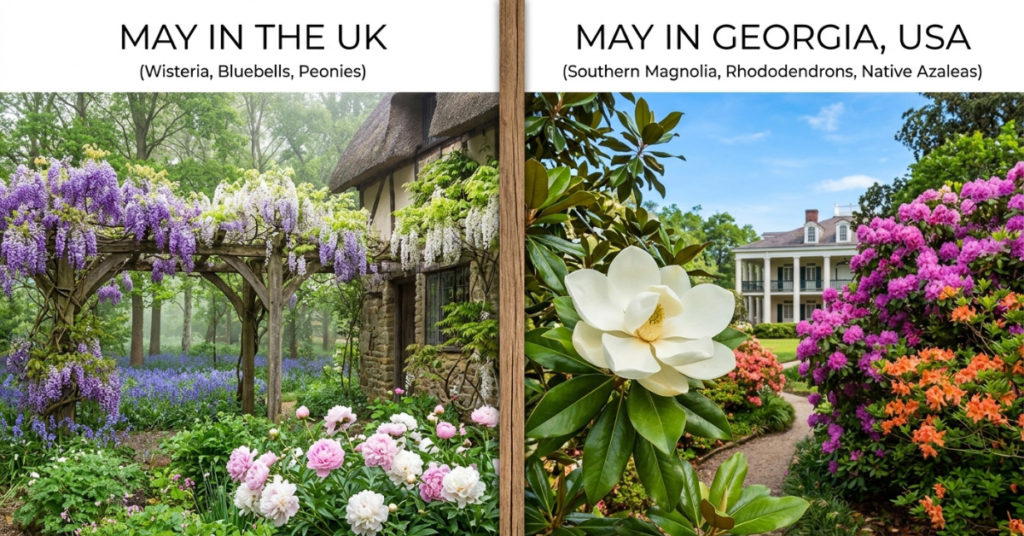
If you are wondering what blooms in May, the answer depends heavily on where you live. In the UK, May can bring bluebells, hawthorn, lilacs, peonies, and the beginning of the summer flower season. In Georgia, the warmer climate means azaleas, roses, daylilies, and other flowering plants can make a strong appearance around the same time.
May is also an important month for allergy sufferers because tree pollen can still be present while grass pollen begins to become more significant. So, whether you’re planning a garden, looking for flowers to photograph, or trying to understand why your allergies suddenly appear, May has plenty to offer.
What blooms in May?
May sits between spring and summer, making it one of the most varied flowering months of the year. Some early spring flowers are still finishing their display, while summer-flowering plants are beginning to take over.
Common flowers and flowering plants that can bloom in May include:
- Bluebells
- Hawthorn
- Lilac
- Peonies
- Roses
- Clematis
- Lupins
- Columbines
- Irises
- Azaleas
- Rhododendrons
- Daylilies
- Sweet peas
The exact flowering time isn’t fixed. Temperature, rainfall, soil, elevation, and the local climate can all move flowering dates forward or backward by several weeks.
The Royal Horticultural Society’s May gardening guidance, for example, notes that spring-flowering plants may be finishing while gardeners begin preparing summer bedding and supporting heavy-flowering plants such as peonies.
What flowers bloom in May in the UK?
The UK is particularly beautiful in May because spring woodland flowers overlap with early summer garden blooms.
1. Bluebells
Bluebells are among the flowers most strongly associated with a British spring. Their violet-blue, bell-shaped flowers can create spectacular carpets beneath trees and across woodland floors.
The native English bluebell, Hyacinthoides non-scripta, is a bulbous perennial that flowers in late spring. The RHS describes bluebells as a quintessential British wildflower and notes that they can form extensive carpets.
Depending on the region and weather, bluebells can begin flowering in April and continue into May. A cool spring can delay their peak, while warmer conditions may bring them forward.
2. Hawthorn
Hawthorn is another classic May bloomer. Common hawthorn produces clusters of small white flowers, while cultivated varieties can have pink or double blooms.
There is even a long-standing connection between hawthorn and May in British tradition. The RHS notes that the old saying “Ne’er cast a clout till May be out” is associated with hawthorn flowering, although the meaning of “May” in the saying has been debated.
Beyond its flowers, hawthorn is valuable to wildlife, providing food and habitat for numerous insects and birds.
3. Lilac
If you love strongly scented flowers, lilac is one of the May plants worth looking for.
Its clusters of purple, lavender, pink, or white flowers can fill a garden with fragrance. In many parts of the UK, lilacs flower around late spring, although the exact timing varies with cultivar and weather.
Lilac works particularly well as a specimen shrub because its flowers are both visually striking and fragrant.
4. Peonies
Peonies are one of those flowers that seem almost designed for late spring.
Their large, rounded blooms can be white, pink, coral, red, or deep burgundy depending on the variety. Many herbaceous peonies begin flowering in late May, although some bloom later.
Because the flowers can become quite heavy, the RHS recommends putting supports in place before herbaceous plants grow too tall or produce heavy blooms such as peonies.
5. Clematis
Clematis is another plant that can add height and drama to a May garden.
Different clematis groups flower at different times, so not every variety blooms in May. Some cultivars produce flowers in May and June, making them useful for covering walls, fences, arches, and trellises. The RHS, for example, lists Clematis ‘Wedding Day’ as flowering in May and June.
6. Early roses
Roses are generally associated with summer, but some varieties can begin flowering toward the end of May, particularly in warmer parts of the UK.
The RHS describes roses as early-summer flowering plants, with many varieties continuing to flower into autumn.
So if you visit a well-established garden toward the end of May, you may already see the first roses opening.
What blooms in May in Georgia?
If you’re asking what blooms in May in Georgia, the answer is quite different from the UK.
Georgia’s warmer climate allows many plants to flower earlier and gives gardeners a longer growing season. May can be a particularly colourful month, with late spring flowers overlapping with plants that continue into summer.
1. Azaleas
Azaleas are among Georgia’s signature spring flowering shrubs.
They are especially well known across the state for their spectacular displays of pink, red, white, purple, and other colours. UGA Cooperative Extension describes azaleas as one of the most popular flowering shrubs in Georgia and notes that while many are associated with spring, some cultivars flower during summer and fall as well.
In Northeast Georgia, azaleas are strongly associated with the arrival of spring. UGA Extension recently highlighted their peak displays around Augusta and described them as a staple of Southern gardens.
2. Roses
Roses are also well suited to Georgia gardens.
UGA’s landscape plant guidance includes floribunda roses among plants suitable throughout the state, particularly in sunny locations.
By May, many roses can provide a strong burst of colour, especially where plants receive adequate sunlight and care.
3. Daylilies
Daylilies are extremely popular in Georgia because they tolerate the state’s growing conditions well.
UGA Cooperative Extension notes that daylilies are among the most widely grown perennials in Georgia. While peak flowering is usually in June or July, some varieties begin flowering as early as May and can continue into October.
That makes daylilies a particularly useful choice if you want flowers that bridge late spring and summer.
4. Coral bells
Coral bells produce airy flower spikes above attractive foliage.
According to UGA Cooperative Extension, they generally flower from late spring into early summer, with blooms ranging from coral and pink to white.
They are especially useful in borders and partly shaded areas where their foliage can provide interest even when the plant isn’t flowering.
5. Azaleas and rhododendrons
Georgia’s mild climate also supports a wide range of azaleas and rhododendrons.
Their flowering periods vary considerably by species and cultivar, which is why you can see some finishing their spring display while others are still preparing to bloom.
For gardeners, choosing several cultivars with different flowering periods can extend the overall season.
What blooms in May that causes allergies?
Flowers themselves often get blamed when seasonal allergies appear, but there is an important distinction to understand.
The colourful flowers you notice in a garden aren’t necessarily the biggest allergy triggers.
Many showy garden flowers are pollinated by insects. Their pollen tends to be heavier and is less likely to become widely airborne. By contrast, wind-pollinated plants can release large quantities of pollen into the air.
In the UK, tree pollen is typically present from late March to mid-May, while grass pollen begins around mid-May and continues into July. The Met Office identifies grass pollen as the most common pollen allergen for hay fever sufferers.
May allergy triggers can include:
- Grass pollen
- Oak pollen
- Birch pollen in some areas
- Ash pollen
- Other tree pollen
- Emerging weed pollen depending on location and weather
This means that a person experiencing sneezing, itchy eyes, congestion, or a runny nose in May shouldn’t automatically assume that a nearby rose or peony is responsible.
Weather matters, too. Warm, dry and breezy conditions can help pollen become airborne and spread, while rain can temporarily reduce airborne pollen levels.
Are May flowers bad for hay fever?
Not necessarily.
A garden full of roses, peonies, or other colourful flowers doesn’t automatically mean that your hay fever will become worse. The more important question is what type of pollen is circulating in the air and whether you’re sensitive to it.
If you know you have seasonal allergies, a few simple habits can reduce exposure:
- Check the local pollen forecast before spending long periods outdoors.
- Keep windows closed when pollen levels are particularly high.
- Change clothes after spending a long time outside.
- Shower or wash your hair after heavy pollen exposure.
- Avoid mowing grass yourself when grass pollen is a major trigger.
- Follow advice from your doctor or pharmacist about allergy medication.
The Met Office recommends monitoring pollen forecasts and notes that antihistamines, corticosteroid treatments, and eye drops can help manage hay fever symptoms; people with more severe symptoms should speak with their GP.
Why do May blooms vary from year to year?
One of the easiest mistakes is treating a flowering calendar as an exact schedule.
Plants respond to their environment, not the date on a calendar.
Several factors can change when a flower appears:
Temperature
A warmer-than-usual spring can speed up plant development and bring flowering forward. A cold spring can delay it.
Rainfall
Adequate moisture can support vigorous growth, while dry conditions can stress plants. Heavy rain can also affect flowers that are already open.
Sunlight
Longer days and increased sunlight influence plant growth and flowering, although different species respond differently.
Location
A flower blooming in southern England may not bloom at exactly the same time in Scotland. The same principle applies within Georgia, where elevation and local conditions can affect flowering.
The Met Office specifically notes that UK pollen seasons can start earlier or later depending on location and weather conditions.
A quick May bloom calendar
Here’s a simple guide to help you know what to look for.
| Flower or plant | UK in May | Georgia in May |
| Bluebells | Often flowering | Not a typical May highlight |
| Hawthorn | Common late-spring bloom | Less characteristic |
| Lilac | Often late spring | Can bloom, depending on variety |
| Peonies | Late May in many areas | Possible, depending on variety and climate |
| Roses | Beginning in warmer areas | Common |
| Clematis | Several varieties | Several varieties |
| Azaleas | Some varieties | Major spring highlight |
| Daylilies | Later varieties possible | Early varieties can begin in May |
| Coral bells | Late spring | Late spring to early summer |
| Grass | Growing and beginning pollen season | Active pollen season can occur |
This table is a general guide rather than a fixed flowering timetable. Individual cultivars and local weather can shift flowering dates.
How to enjoy May blooms without missing the best display
If you’re planning a garden visit or simply want to see as many flowers as possible, timing matters.
For woodland flowers: Look earlier in May, particularly for bluebells and other spring wildflowers.
For flowering shrubs: Mid-to-late May can be a good time to look for hawthorn, lilac, and later spring shrubs.
For garden borders: Late May is when the transition toward summer becomes more obvious, with peonies, clematis, early roses, and other perennials beginning to make an appearance.
For Georgia gardens: Spring displays such as azaleas can be particularly impressive, while May also marks the beginning of a transition toward summer-flowering plants.
Frequently Asked Questions
What flowers are in bloom in May?
Common May flowers include bluebells, hawthorn, lilac, peonies, clematis, irises, roses, azaleas, and various spring perennials. The exact flowering period depends on climate, location, and variety.
What blooms in May UK?
In the UK, May commonly brings bluebells, hawthorn, lilac, peonies, clematis, late spring perennials, and the first flowers on some roses. Warmer southern areas may see flowers earlier than northern regions.
What blooms in May that causes allergies?
Grass pollen is an important May allergy trigger, particularly as the UK grass-pollen season begins around mid-May. Tree pollen, including pollen from species such as oak, birch, and ash, can also still be present.
What blooms in May in Georgia?
Georgia can have a wide range of May blooms, including azaleas, roses, daylilies, coral bells, and other late-spring and early-summer plants. UGA Extension identifies azaleas as particularly important flowering shrubs in Georgia and notes that some daylily varieties begin blooming in May.
Are roses allergy-friendly?
Roses are generally insect-pollinated rather than major wind-pollinated allergy sources. However, individual sensitivities vary, and being around flowers can still expose someone to pollen from other nearby plants.
Do flowers bloom earlier in warmer weather?
Often, yes. Warmer conditions can speed up plant development and flowering, although the response differs between species. Weather can also influence pollen release, so an unusually warm spring may change both the appearance of gardens and the timing of allergy season.
Final Thoughts
So, what blooms in May? Quite a lot.
In the UK, May is a beautiful transition period filled with bluebells, hawthorn, lilac, peonies, clematis, and the beginnings of the summer rose season. In Georgia, the warmer climate brings spectacular azaleas alongside roses, early daylilies, coral bells, and other flowering plants.
May is also a month when seasonal allergies can become noticeable, particularly as grass pollen begins to join the tree pollen already present in the air. Understanding both the flowers and the pollen season can make it much easier to plan garden visits and outdoor activities.
If you’re building a garden, planning a May flower walk, or simply wondering what you should expect to see outside, May is one of the most rewarding months to explore. Keep an eye on local flowering conditions rather than relying solely on a calendar—the garden often has its own timetable.