
Have you ever seen a white flower blooming in a landscape that looks almost too dry to support life? That striking contrast is part of what makes the desert lily so fascinating. Known scientifically as Hesperocallis undulata, this bulb-forming perennial is adapted to some of the harshest environments of the American Southwest.
This unusual desert wildflower is more than just a beautiful plant. Its deeply buried bulb, wavy-edged leaves, seasonal growth cycle, and large fragrant flowers all reveal clever strategies for surviving heat, drought, and unpredictable rainfall.
In this guide, we’ll explore the desert lily flower, its natural habitat, adaptations, appearance, cultural associations, blooming season, and some of the other popular searches connected with its name.
What Is the Desert Lily?
The desert lily, scientifically known as Hesperocallis undulata, is a perennial herb belonging to the family Asparagaceae. It is the only accepted species in the genus Hesperocallis. Although its flowers resemble those of true lilies, modern botanical classification places it within the order Asparagales.
The plant is also known as the ajo lily. The Spanish word “ajo” means garlic and refers to the garlic-like association of its bulb. Historical botanical references describe the bulbs as having been used as food by Indigenous peoples.
One of the most interesting things about this species is that much of its survival strategy happens underground. Rather than remaining visibly active throughout the hottest and driest periods, it can retreat into dormancy and wait for more favorable conditions.
Desert Lily Flower: What Does It Look Like?
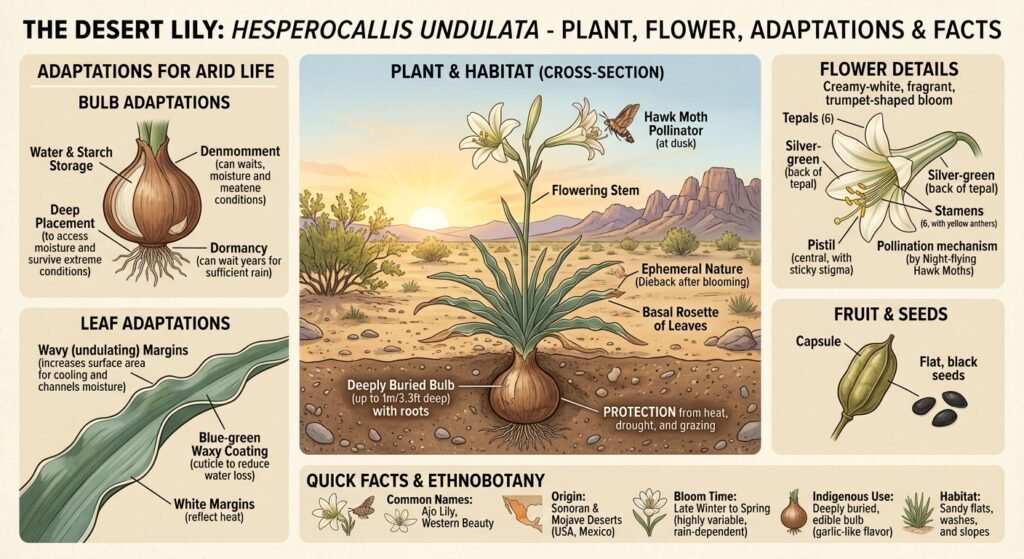
The desert lily flower is one of the most striking sights in a desert landscape.
Its blooms are typically:
- White to snowy white
- Funnel- or trumpet-shaped
- Approximately 5–6 cm long
- Fragrant
- Carried on a flowering stalk above the leaves
- Sometimes marked with subtle bluish-green coloring on the underside of the tepals
The flowers can appear surprisingly large compared with the rest of the plant. Against sandy or rocky surroundings, their bright color makes them particularly noticeable.
Flowering generally occurs from late winter into spring, although the exact timing depends heavily on local rainfall and environmental conditions.
Is Desert Lily Pink?
Despite searches for desert lily pink, the true Hesperocallis undulata is best known for its white flowers.
A pink flower described online as a “desert lily” may belong to another species, be a cultivar, or simply be a stylized image or commercial product using the common name.
This is a useful reminder that common plant names can be confusing. When botanical accuracy matters, the scientific name is much more reliable than a common name alone.
Where Does This Desert Flower Grow?
The natural range of Hesperocallis undulata extends across parts of the southwestern United States and northwestern Mexico.
Its range includes:
- Arizona
- California
- Nevada
- Northwestern Mexico
The species is associated with dry environments including parts of the Mojave and Sonoran deserts. It can occur in sandy flats, rocky areas, and creosote-bush scrub.
Desert Lily Arizona
Desert lily Arizona is a popular search term because the species occurs in western parts of the state. Suitable desert habitats can produce impressive displays when rainfall creates favorable growing conditions.
However, flowering isn’t guaranteed every year. The amount and timing of rainfall have a major influence on when plants emerge and bloom.
That is one reason desert wildflower displays can seem so sudden. A seemingly barren landscape may change dramatically after sufficient rain.
Desert Lily Adaptations: How Does It Survive?
The most fascinating aspect of Hesperocallis undulata may be its adaptations rather than its flowers.
1. A Deeply Buried Bulb
One of its most important survival features is the underground bulb. The bulb can remain protected beneath the soil during periods when surface conditions become extremely hot and dry.
This provides several advantages:
- Protection from extreme surface temperatures
- Reduced exposure to drought
- Storage of resources
- Protection during unfavorable seasons
Instead of relying on leaves and flowers throughout the year, the plant can remain dormant until conditions improve.
2. Seasonal Growth
Its life cycle is closely connected with rainfall. Following sufficient moisture, leaves emerge and the plant can eventually produce its flowering stalk.
This strategy can be viewed as a form of drought evasion. Rather than remaining actively exposed to harsh conditions, the plant spends unfavorable periods underground and takes advantage of relatively short periods when water is available.
3. Wavy, Blue-Green Leaves
The leaves form a basal rosette and are long, narrow, blue-green, and noticeably wavy along their margins.
The species name undulata refers to this undulating or wavy characteristic. These distinctive leaves make the plant easier to recognize even when it isn’t flowering.
4. A Rapid Response to Rain
Rain is an important environmental signal for many desert plants. When enough moisture becomes available, the dormant bulb can produce visible growth relatively quickly.
This ability helps explain why desert landscapes can transform so dramatically after periods of favorable rainfall.
Habitat and Ecology
This native wildflower generally occurs in open desert landscapes rather than lush forests or permanently moist environments.
Its habitats include:
- Sandy flats
- Rocky slopes
- Creosote-bush scrub
- Dry desert valleys
- Other suitable Mojave and Sonoran desert environments
It is also documented in protected landscapes such as Mojave National Preserve.
Like other flowering plants, it contributes to desert biodiversity and can provide seasonal resources for pollinators. Its presence is another reminder that apparently barren landscapes can support highly specialized ecosystems.
When Does It Bloom?
The main flowering period generally falls between late February and May, although the timing varies with rainfall and local conditions.
A simplified view of its seasonal cycle looks like this:
- Rain provides sufficient moisture.
- The dormant bulb responds to favorable conditions.
- Leaves emerge from the soil.
- A flowering stalk develops.
- Large white flowers open.
- The plant eventually returns to dormancy as conditions become less favorable.
Because rainfall varies from one year to another, the same location may look dramatically different during different seasons.
Can You Grow This Plant?
The desert lily plant is attractive, but it isn’t necessarily an easy addition to a home garden.
Its specialized life cycle and underground bulb make it different from many familiar ornamental bulbs. Cultivation can be difficult because reproducing the environmental conditions of its natural habitat isn’t always straightforward.
For those interested in growing native desert plants, general considerations include:
- Use extremely well-drained soil.
- Avoid constantly wet conditions.
- Respect the plant’s natural seasonal cycle.
- Avoid disturbing the bulb unnecessarily.
- Don’t assume frequent watering will improve growth.
Responsible sourcing is particularly important with native wild plants. Removing specimens from natural populations can damage local ecosystems and may be prohibited in protected areas.
Desert Lily Meaning and Symbolism
There isn’t one universally recognized symbolic meaning for Hesperocallis undulata. However, its unusual life cycle naturally lends itself to several symbolic interpretations.
The flower can represent:
- Resilience
- Hope
- Renewal
- Patience
- Adaptation
- Beauty in unexpected places
The symbolism comes from the plant’s ability to remain hidden during difficult conditions and emerge when the environment becomes favorable again.
For this reason, the flower can make a meaningful subject for artwork, photography, jewelry, or tattoo designs.
Desert Lily Tattoo Ideas
A desert lily tattoo can work particularly well as a minimalist botanical design or as part of a larger desert-inspired composition.
Some possible approaches include:
- A simple flower outline
- A detailed botanical illustration
- The flower combined with sand dunes or mountains
- A bloom paired with a crescent moon
- A fine-line design featuring Hesperocallis undulata
- A small botanical tattoo representing resilience and renewal
If botanical accuracy is important, use photographs or reputable botanical references rather than generic illustrations labeled simply “desert lily.”
Desert Lily Sanctuary and Conservation
The phrase desert lily sanctuary may be used when people are searching for protected areas or special locations where this wildflower can be observed.
One relevant conservation site is the Desert Lily Preserve near Desert Center, California, which is associated with habitat for the species.
The larger conservation lesson is important. Desert wildflowers may appear plentiful during a spectacular bloom, but their populations still depend on fragile environmental conditions.
If you visit a natural habitat, follow local regulations, remain on designated routes where required, and avoid digging up plants or collecting flowers.
Desert Lily Academy: Is It a Flower Organization?
Interestingly, Desert Lily Academy has nothing to do with botany. It is the name of a residential treatment and educational program for young women in Queen Creek, Arizona.
The organization describes its programming as trauma-informed and includes education, vocational opportunities, extracurricular activities, and individualized support.
Therefore, searches such as desert lily academy photos or desert lily academy reviews are generally about the organization rather than the wildflower.
This is a useful example of why search context matters. A phrase that looks botanical at first glance may actually refer to an entirely different subject.
The Desert Lily Vacation Home
Another unrelated use of the name is The Desert Lily Vacation Home, a high-desert accommodation marketed as a renovated home with desert views and outdoor amenities.
In this case, “Desert Lily” is simply a property name inspired by the surrounding landscape. It isn’t referring to the botanical species.
Desert Lily Gardens
Desert Lily Gardens is another example of the phrase being used as a business or venue name rather than a plant reference.
One example is Desert Lily Gardens Event Center in Smithfield, Utah, which is promoted as a venue for weddings, meetings, celebrations, and other events.
Again, the name alone doesn’t necessarily indicate a botanical connection.
What About Desert Lily Aloe Vera Gel?
You may also encounter searches such as aloe vera gel desert lily or desert lily aloe vera gel.
These phrases should not be confused with Hesperocallis undulata. Aloe vera and this desert bulb are completely different plants.
If a skincare product uses “Desert Lily” in its name, check the ingredient list and manufacturer’s information rather than assuming that it contains an extract from the wildflower.
What Is the High Desert Lily?
The phrase high desert lily can be confusing because it may be used descriptively for different lily-like plants associated with high-desert environments.
However, Hesperocallis undulata is the species commonly identified as the desert lily or ajo lily. Its natural range includes dry desert and shrubland environments in the southwestern United States and northwestern Mexico.
Whenever two plants have similar common names, checking the scientific name is the safest way to avoid confusion.
The SPELL Desert Lily Skirt
If your search for SPELL desert lily skirt brought you to this article, you’re looking at something completely unrelated to botany.
SPELL is an Australian fashion brand, and the Desert Lily Skirt is a clothing product associated with the brand’s bohemian-inspired style.
In this context, “Desert Lily” is a fashion name rather than the name of a flower.
Serta Classic Desert Lily Plush Euro-Top Mattress
The Serta Classic Desert Lily Plush Euro-Top Mattress is another completely unrelated search result.
It refers to a Serta mattress collection rather than a botanical product. Retail listings have included multiple mattress sizes and plush Euro-top construction.
If someone searches this exact phrase, their intent is clearly related to mattresses rather than desert plants.
Desert Lily vs. Similar-Looking Plants
Common names can create considerable confusion when identifying wildflowers.
For example, some plants with small white or pinkish flowers may be mistaken for this species. The actual Hesperocallis undulata is distinguished by its much larger funnel-shaped flowers, basal leaves, wavy margins, and underground bulb.
| Feature | Desert Lily |
| Scientific name | Hesperocallis undulata |
| Flower color | Usually white |
| Flower shape | Funnel or trumpet-shaped |
| Leaves | Basal, linear and wavy-edged |
| Underground structure | Deep bulb |
| Habitat | Mojave and Sonoran desert environments |
| Bloom period | Generally late winter to spring |
| Family | Asparagaceae |
| Common name | Ajo lily |
When identifying a plant in the wild, photographs can help, but a reliable botanical reference is preferable to relying solely on common names.
Frequently Asked Questions
Is the desert lily a real flower?
Yes. Hesperocallis undulata is a real native desert wildflower found in parts of the southwestern United States and northwestern Mexico. It produces large, fragrant white flowers and grows from an underground bulb.
Is it the same as aloe vera?
No. Aloe vera and Hesperocallis undulata are entirely different plants. A skincare product may use “Desert Lily” as a product or brand name, but that doesn’t mean it contains the botanical species.
Where does it grow?
The species occurs in Arizona, California, Nevada, and northwestern Mexico, particularly in dry desert and shrubland habitats.
What color are the flowers?
The species is best known for large white flowers. Searches for pink varieties may refer to another species, artwork, products, or an incorrect identification.
Why is it called an ajo lily?
The name comes from the Spanish word “ajo,” meaning garlic. The term is associated with the garlic-like characteristics of the bulb and its historical use as food.
Is it easy to grow?
Not necessarily. Its specialized desert life cycle and underground bulb can make cultivation challenging, especially outside its natural environment.
What are its main adaptations?
Important adaptations include its deeply buried bulb, seasonal dormancy, ability to respond to favorable rainfall, and specialized basal leaves. Together, these features help it survive prolonged periods of harsh desert conditions.
When does it flower?
The main flowering period is generally from late winter through spring, often between late February and May. Rainfall can significantly influence the timing.
Can it be used as a tattoo design?
Yes. Its distinctive white flower and desert origins make it an appealing botanical tattoo subject. It can also symbolize resilience, renewal, patience, and hope.
Final Thoughts
The desert lily is a fascinating example of how plants can survive in environments that appear almost impossible for life. Its underground bulb allows it to wait through difficult conditions, while seasonal rainfall triggers the growth and flowering that make it so remarkable.
With its white trumpet-shaped blooms, wavy blue-green leaves, and specialized desert lifestyle, Hesperocallis undulata has a distinctive identity that sets it apart from many other lily-like plants.
The phrase “Desert Lily” can also refer to an academy, vacation property, garden venue, fashion item, or mattress, so context matters when researching the term. When you want information about the actual plant, looking for the scientific name Hesperocallis undulata is the best way to make sure you’re researching the right species.
For anyone fascinated by unusual plants, this wildflower offers a fascinating introduction to desert ecology, seasonal adaptation, native flora, and the remarkable ways plants respond to extreme environments.