
Have you ever seen a hillside covered in tiny sky-blue flowers and wondered what could possibly make a landscape look so dreamlike? The nemophila flower is one of those blooms that almost seems painted onto the landscape. Its delicate blue petals, low-growing habit, and distinctive markings have made it especially famous in Japan, where enormous spring flower fields attract visitors from around the world.
Known commonly as baby blue eyes or five spot, nemophila is actually native to the western United States and northwestern Mexico rather than Japan. Botanically, Nemophila menziesii is an annual species in the Boraginaceae family.
Today, the flower is particularly associated with Japan because of spectacular displays such as the famous nemophila flower field at Hitachi Seaside Park in Ibaraki. But there is much more to this little blue flower than its Instagram-famous appearance.
What Is the Nemophila Flower?
The nemophila flower is a small annual flowering plant belonging to the genus Nemophila. The best-known species, Nemophila menziesii, is commonly called baby blue eyes because of its soft blue coloring.
The flowers are typically cup-shaped and have five lobes. The familiar blue form has pale or white centers and can reach roughly 1.5 inches across, while the plant itself stays relatively low to the ground.
Quick facts about nemophila
- Scientific name: Nemophila menziesii
- Common name: Baby blue eyes
- Another common name: Five spot
- Family: Boraginaceae
- Plant type: Annual
- Native range: Western United States to Baja California, Mexico
- Typical flower color: Sky blue, with white markings
- Blooming preference: Cool weather
- Growth habit: Low and spreading
- Popular use: Borders, rock gardens, containers and mass plantings
The name Nemophila comes from Greek roots associated with a wooded pasture or glade and “loving,” referring to the habitat of some members of the genus. The species name menziesii honors Scottish botanist Archibald Menzies.
Nemophila Flower Meaning
The nemophila flower meaning is often connected with success wherever you go, delicacy, and forgiveness in Japanese flower-language sources.
Japanese flower-language references commonly give nemophila the meaning “success anywhere” or “success wherever you go.” Some Japanese sources also associate it with ideas such as delicacy and forgiveness.
Because flower meanings can vary between cultures and references, it is worth being careful with claims that present one interpretation as universally established.
Nemophila flower language meaning
In the context of Japanese hanakotoba, nemophila is often presented with meanings related to:
- Success wherever you go
- Delicacy or gentleness
- Forgiveness
This gives the flower a particularly positive emotional character. A small blue flower representing the hope of doing well wherever life takes you makes a surprisingly thoughtful gift.
Nemophila Flower Symbolism
The nemophila flower symbolism is strongly influenced by its appearance. Its pale blue color naturally evokes the sky, openness, calmness, and peaceful landscapes.
Its low-growing form also gives it a quiet, understated beauty. Unlike large roses or dramatic lilies, nemophila does not demand attention. Instead, thousands of tiny flowers create their impact together.
That is part of what makes the flower so appealing in gardens and landscapes: one flower is delicate, but a field of them can feel enormous.
It is important, however, to distinguish modern interpretations from documented traditional symbolism. Hanakotoba is a Japanese system of flower meanings, but not every meaning circulating online has the same historical or cultural authority.
Nemophila Flower in Japanese
The nemophila flower in Japanese is written as ネモフィラ (nemofira).
Nemophila flower Japanese name
The Japanese name commonly used today is ネモフィラ, a katakana rendering of “Nemophila.” You may also see the flower referred to as baby blue eyes in English-language travel and gardening material.
This is a useful distinction because nemophila is not originally a Japanese native flower. Its native range is in western North America, while its enormous popularity as a landscape flower has grown significantly in Japan. Kew lists Nemophila menziesii as native from the western United States to Baja California, Mexico.
Nemophila Flower Meaning Hanakotoba
If you’re specifically searching for the nemophila flower meaning hanakotoba, the most frequently cited Japanese meaning is “success wherever you go.” Japanese flower-language sources list nemophila under this positive expression, while some also include meanings such as “delicate” and “I forgive you.”
Hanakotoba, literally understood as “flower words,” refers to Japanese flower symbolism and the meanings associated with particular blooms.
For this reason, nemophila can work beautifully as a symbolic flower for:
- A new beginning
- Graduation
- Starting a new job
- Moving somewhere new
- Wishing someone success
- A gentle message of forgiveness
What Does the Nemophila Flower Look Like?
The classic nemophila flower blue variety has a remarkably soft appearance.
The petals are usually a light sky blue, sometimes almost powder blue, with a pale center. The flowers have five rounded lobes, giving them a simple, almost childlike appearance.
This is where the name baby blue eyes becomes easy to understand. The color is unusually gentle rather than intensely saturated.
Nemophila flower five spot
Another familiar type is called five spot, referring to the dark spots found near the tips of its five petals.
The contrast between the pale petals and darker markings gives five-spot nemophila a completely different personality from the classic blue form. Instead of looking like a miniature blue sky, it has a more graphic, patterned appearance.
Why Is the Nemophila Flower So Famous in Japan?
Search for nemophila flower Japan, and one place appears again and again: Hitachi Seaside Park in Ibaraki Prefecture.
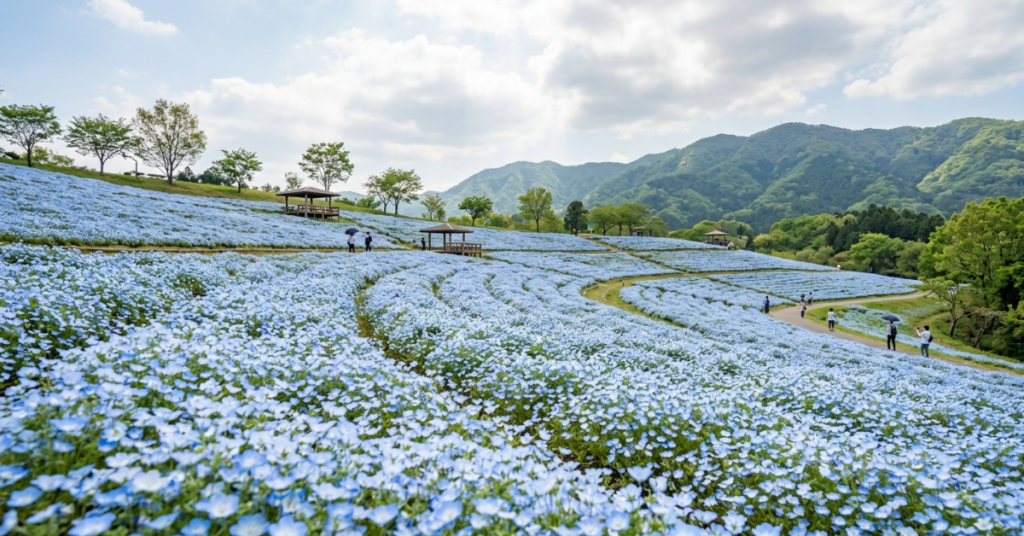
The park’s Miharashi Hill becomes covered with millions of blue nemophila during spring. Japan’s official tourism organization describes approximately 4.2 hectares of nemophila at the park, creating a striking visual connection between the flowers, sky and sea.
More recent information from NEXCO EAST reports that around 5.3 million nemophila flowers bloom on Miharashi Hill each year around mid-April through the Golden Week period.
The scale is what makes the experience extraordinary. A single baby blue eyes flower is tiny; millions of them together can transform an entire hill.
Nemophila Flower Field Japan: Hitachi Seaside Park
If you’re looking for a famous nemophila flower field Japan destination, Hitachi Seaside Park is the standout location.
Located in Hitachinaka, Ibaraki Prefecture, the park is known for seasonal flower displays throughout the year. In spring, Miharashi Hill becomes the main attraction as the blue flowers cover the landscape.
The effect is especially striking because the hill sits close to the Pacific coast. From certain viewpoints, the blue flowers visually blend with the sky and ocean.
That unusual combination is one reason photographs from the park have become so recognizable.
Nemophila Flower Season in Japan
The nemophila flower season in Japan generally falls in spring, with the most famous displays at Hitachi Seaside Park occurring around mid-April to early May, although exact bloom dates change with weather and growing conditions.
Japan’s official tourism information describes spring as the season when the park’s famous sky-blue nemophila appear on Miharashi Hill.
Past and recent travel information similarly places the best viewing period around late April and early May, while noting that the precise peak can shift from year to year.
Best time to see nemophila in Japan
For travelers, the practical takeaway is:
- Plan for mid-April through early May.
- Check the official bloom forecast before traveling.
- Expect the peak to vary depending on temperature, wind and rain.
- Be prepared for crowds during peak flowering and Golden Week.
The flowers are delicate, and weather can quickly affect the appearance of a large field.
Nemophila Flower Festival
The popularity of the flower has also led to seasonal celebrations and events around major nemophila displays.
At Hitachi Seaside Park, the spring nemophila period is a major seasonal attraction, with visitors coming specifically to see Miharashi Hill covered in blue. The park itself hosts a range of seasonal activities and attractions alongside its flower displays.
If you’re searching for a nemophila flower festival, it is best to check the official park schedule for the specific year because event dates, admission arrangements and peak-bloom timing can change.
Blue Nemophila Flower Field Locations
Although Hitachi Seaside Park is probably the most internationally recognizable destination, it isn’t the only place where nemophila can be grown or displayed.
Large-scale plantings can appear in gardens, parks and seasonal flower attractions in Japan and elsewhere. However, Hitachi Seaside Park remains the defining destination for the iconic blue hillside experience. Japan’s tourism organization specifically highlights the park’s extensive nemophila landscape.
For anyone planning a photography-focused trip, searching for current bloom reports is more useful than relying on a fixed calendar alone.
How to Grow Nemophila Flower From Seeds
Interested in growing your own little blue field? Nemophila flower seeds are one of the easiest ways to start.
Nemophila is a cool-weather annual. It generally performs best in loose, well-drained soil that stays evenly moist, with full sun to partial shade depending on the climate.
Growing nemophila from seeds
- Choose a cool growing period.
Nemophila prefers cooler conditions and can struggle when exposed to prolonged heat and humidity. - Prepare well-drained soil.
Avoid soil that stays constantly waterlogged. - Sow the seeds according to your climate.
In cooler climates, direct spring sowing can work. In warmer climates, growers may sow during a cooler season instead. - Keep the soil evenly moist.
Do not allow newly sown seeds to dry out completely. - Give plants adequate light.
Full sun to partial shade can work, although some afternoon protection may be helpful in hot climates. - Enjoy the flowers before summer heat arrives.
Nemophila can decline quickly when consistently exposed to hot, humid conditions.
One useful feature is that plants can self-seed under suitable conditions, potentially giving you another generation of flowers the following season.
Can You Grow Nemophila in a Hot Climate?
This is where gardeners need to be realistic.
Nemophila is a cool-weather annual, so extremely hot summers are not ideal. Missouri Botanical Garden notes that plants can decline rapidly under consistently hot and humid conditions.
If you live in a warm climate, the trick is to grow nemophila during the coolest suitable part of the year rather than trying to keep it flowering through intense summer heat.
This makes timing more important than simply choosing a sunny location.
Nemophila Flower Bouquet Ideas
A nemophila flower bouquet has a naturally soft and romantic appearance.
Because the flowers are small and delicate, they work particularly well when combined with other flowers that have complementary shapes and colors.
Try pairing blue nemophila with:
- White daisies
- Baby’s breath
- White roses
- Pale pink flowers
- Soft greenery
- Other small spring flowers
For a minimalist arrangement, you can also let the blue flowers stand alone. A simple glass vase filled with delicate blue blooms can look surprisingly elegant.
Nemophila Flower Logo and Design Inspiration
The simple shape of the nemophila flower also makes it attractive for visual branding.
A nemophila-inspired flower logo can communicate ideas such as:
- Softness
- Nature
- Freshness
- Calm
- Youthfulness
- Simplicity
- Spring
- Natural beauty
The five-petal structure is especially useful in graphic design because it can be simplified into a clean icon.
For an interior, lifestyle, stationery or beauty brand, the muted baby-blue color can also create a calm visual identity without feeling overly formal.
Nemophila Flower Wallpaper
The soft blue color of the flower makes it a natural choice for nemophila flower wallpaper and digital backgrounds.
A field of baby blue eyes can create a dreamy visual effect, especially when photographed from a distance. For interiors, a subtle botanical print can work well in bedrooms, reading corners, nurseries and other relaxing spaces.
If you’re designing a room around the flower, consider pairing its pale blue tones with:
- Warm white
- Cream
- Light oak
- Soft beige
- Natural linen
- Muted sage green
The result is usually much calmer than combining the flower with highly saturated blues.
Why Is Nemophila Blue So Popular?
There is something particularly unusual about the color of baby blue nemophila flower.
Its blue is light, airy and slightly muted rather than dark or jewel-toned. In a large planting, this creates the illusion of a second sky on the ground.
That visual quality explains why Japanese nemophila fields have become such popular photography locations. At Hitachi Seaside Park, the flowers merge visually with the blue sky and nearby sea, producing the famous “sea of blue” effect.
Frequently Asked Questions About Nemophila Flower
What is the nemophila flower meaning?
The most commonly cited nemophila flower meaning is “success wherever you go.” Japanese flower-language sources also associate it with delicacy and forgiveness.
What is nemophila called in Japanese?
Nemophila is commonly written ネモフィラ (nemofira) in Japanese. The name is essentially the Japanese rendering of “Nemophila.”
Why is nemophila famous in Japan?
Nemophila became especially famous in Japan because of enormous spring plantings, particularly the blue fields at Hitachi Seaside Park in Ibaraki.
When is nemophila flower season in Japan?
At the famous Hitachi Seaside Park display, nemophila generally blooms during spring, with viewing often centered around mid-April through early May. Exact timing changes from year to year.
Where can I see a nemophila flower field in Japan?
Hitachi Seaside Park’s Miharashi Hill in Ibaraki is the best-known destination for a large-scale nemophila flower field.
What does “baby blue eyes” mean?
“Baby blue eyes” is a common name for Nemophila menziesii, referring to its delicate blue flowers.
Is nemophila easy to grow from seeds?
Generally, yes. Nemophila can be grown from seed and is considered a relatively low-maintenance annual when grown under suitable cool-weather conditions. It prefers well-drained, evenly moist soil and can be grown in full sun to partial shade.
Is nemophila a perennial?
No. Nemophila menziesii is an annual, meaning its natural life cycle is completed within one growing season.
Why is nemophila called five spot?
The name five spot refers to the dark markings near the edges or tips of the five petals on certain nemophila forms.
Can nemophila grow in hot weather?
Nemophila prefers cool conditions and may decline rapidly in consistently hot and humid weather. In warm climates, it is better to grow it during a cooler season.
Final Thoughts on the Nemophila Flower
The nemophila flower may be small, but its visual impact is anything but. From its delicate baby-blue petals to the enormous fields that have made it famous in Japan, this flower has a special ability to turn an ordinary landscape into something almost dreamlike.
Its commonly cited meaning of success wherever you go makes it even more appealing as a symbolic flower, while its Japanese association with spring has helped make it a favorite subject for travel photography, gardens, bouquets and design.
Whether you’re researching nemophila flower meaning, planning to visit a nemophila flower field in Japan, looking for nemophila flower seeds, or simply searching for a beautiful blue flower for your garden or design project, this little annual is worth getting to know.
And if you ever find yourself in Ibaraki during peak spring bloom, seeing millions of nemophila stretching across Miharashi Hill is one experience that photographs can only partially capture.
Sources: Kew Science, Missouri Botanical Garden, Japan National Tourism Organization, Hitachi Seaside Park-related tourism information, and Japanese flower-language references.