
Have you ever noticed a small primrose blooming while the weather still feels like winter? There is something especially charming about a flower that appears so early in the season. That early arrival is also the key to understanding the primrose meaning: the flower is commonly associated with youth, new beginnings, young love, and enduring affection.
The primrose belongs to the genus Primula, and its name is ultimately connected to the Latin prima rosa, meaning “first rose.” The name reflects the plant’s early flowering habit and helps explain why primroses have long been connected with spring, renewal, and first experiences.
But there is more to the primrose meaning flower symbolism than simply “spring.” Depending on the tradition, the flower can represent young love, eternal love, protection, hope, or even the feeling that someone is indispensable to you.
What Is the Primrose Meaning?
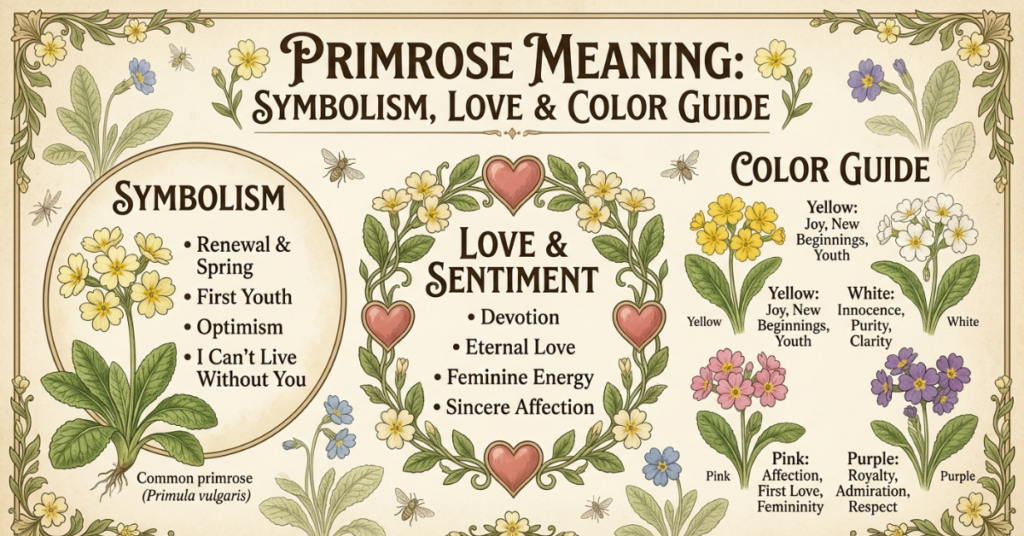
The most widely associated meanings of primrose include:
- Young love
- Youth and innocence
- New beginnings
- Hope and renewal
- Enduring or eternal love
- Devotion and affection
- Beauty that arrives early in the season
In Victorian flower language, primrose was particularly associated with young love, while some traditional flower dictionaries gave it the much stronger message, “I can’t live without you.” The Old Farmer’s Almanac also notes these two traditional associations.
This gives the flower an interesting emotional range. A primrose can suggest the sweetness of a new relationship, but it can also express deep attachment.
Primrose Meaning Flower: Why Does It Symbolize New Beginnings?
The symbolism makes more sense when you look at the plant itself.
Common primrose (Primula vulgaris) is one of the flowers associated with early spring. In Britain, for example, it can flower from late December through spring, depending on conditions.
That seasonal behavior naturally lends itself to ideas such as:
- The end of winter — the flower signals a change in the landscape.
- The beginning of spring — its appearance suggests renewal.
- Youth — its delicate appearance and early blooming became linked with freshness and innocence.
- New love — its arrival at the beginning of the growing season made it a fitting symbol for first romantic feelings.
So, when someone searches for the primrose meaning flower, the simplest answer is: primrose traditionally represents young love, youth, renewal, and enduring affection.
Primrose Meaning in Love
The primrose meaning in love is one of the most interesting parts of its symbolism.
In traditional Victorian flower language, giving someone primroses could communicate young love. Some historical sources go further, associating the flower with the message “I can’t live without you.”
That makes primrose a particularly thoughtful flower for someone who wants to express affection without choosing the more obvious red rose.
What Does Primrose Say in a Relationship?
A primrose can communicate ideas such as:
- “My feelings for you are growing.”
- “You are very important to me.”
- “This love feels new and special.”
- “I care deeply about you.”
- “I want this affection to last.”
The exact interpretation depends on the cultural or historical flower-language tradition being used. Flower meanings are symbolic rather than universal rules, so it is better to treat them as a guide to a flower’s emotional associations rather than a fixed dictionary.
Primrose Meaning Flower Language
The primrose meaning flower language has changed somewhat depending on the source and period.
Victorian floriography—the practice of assigning messages to flowers—gave plants specific emotional meanings. Primrose is commonly listed in this tradition with meanings connected to young love and intense attachment.
Interestingly, not every “primrose” meaning applies to every plant called primrose. This becomes especially important when discussing evening primrose, which belongs to a different genus.
Primrose vs. Evening Primrose
This is an easy botanical mix-up.
Primrose (Primula) belongs to the family Primulaceae. Evening primrose (Oenothera) belongs to the family Onagraceae. Despite sharing the common name “primrose,” they are not the same plant.
The common evening primrose, Oenothera biennis, has pale yellow flowers that open in the evening, which explains its common name.
That difference also matters when interpreting flower symbolism.
Evening Primrose Meaning
The evening primrose meaning is quite different from the symbolism usually associated with garden primrose.
Historical flower-language sources have associated evening primrose with inconstancy, partly because its flowers open in the evening and fade relatively quickly. A historical flower-language text specifically lists Oenothera biennis as representing “inconstancy.”
Other traditions give evening primrose more positive associations, including waiting, quiet affection, freedom, and wishes. These interpretations are particularly noticeable in Japanese and Korean-language flower lore, although they should not be treated as universal cultural definitions.
Evening Primrose Meaning Flower Language
The evening primrose meaning flower language can therefore include:
- Inconstancy
- Fleeting feelings
- Quiet or unspoken love
- Waiting
- Nighttime beauty
- Hope and wishes
The darker meaning comes largely from the flower’s short-lived blooming pattern.
Yellow Primrose Meaning
The yellow primrose meaning is closely connected with the traditional appearance of the common primrose.
Yellow flowers generally evoke warmth, happiness, friendship, and optimism in modern floral symbolism. Yellow primrose can therefore be interpreted as representing:
- Cheerfulness
- Friendship
- Fresh beginnings
- Warm affection
- Hope
- Youthful happiness
However, color symbolism isn’t standardized across all flower dictionaries. In other words, there is no single official “yellow primrose code.”
Red Primrose Meaning
The red primrose meaning is less consistently documented than the general symbolism of primrose.
Red flowers are commonly associated with passion, strong emotion, courage, and romantic love. As a result, a red primrose can reasonably be interpreted as strong affection or passionate love.
It is worth noting, though, that color-specific meanings for primrose are largely modern or informal compared with the better-documented general Victorian meanings of the flower. So if you’re looking for historically established flower language, the general primrose symbolism is more reliable than a strict red-primrose definition.
White Primrose Meaning
The white primrose meaning is usually associated with:
- Purity
- Innocence
- Peace
- Fresh beginnings
- Sincerity
White flowers have long been used symbolically to communicate innocence and purity, making white primroses a natural choice for spring arrangements, weddings, and occasions marking a new chapter.
Pink Primrose Meaning
The pink primrose meaning is generally softer and more romantic than the symbolism associated with stronger colors.
Pink primroses are commonly interpreted as representing:
- Gentle affection
- Young love
- Tenderness
- Admiration
- Sweet romantic feelings
This makes pink primrose especially appropriate when the relationship is new or when you want to communicate affection without the intensity traditionally associated with deep red flowers.
Pink Evening Primrose Meaning
Don’t confuse pink primrose with pink evening primrose.
Pink evening primrose commonly refers to species such as Oenothera speciosa, a North American plant that produces pink or sometimes white flowers.
Its symbolism is not as firmly established in traditional Western flower language as that of ordinary primrose. Modern interpretations often connect its delicate appearance and evening blooming with:
- Gentle love
- Beauty
- Freedom
- Adaptability
- Fleeting moments
So the pink evening primrose meaning is best understood as an interpretive association rather than a universally recognized historical flower-language definition.
Blue Primrose Meaning
A blue primrose meaning is also not firmly standardized in traditional Western floriography.
Blue flowers are often associated with:
- Calmness
- Trust
- Loyalty
- Serenity
- Mystery
Therefore, a blue primrose can symbolically suggest peaceful affection, trust, and emotional depth.
One important detail: naturally blue primroses are not the standard form of common primrose, and many garden varieties have been bred in a wide range of colors. The symbolic meaning should therefore be separated from the botanical identity of the plant.
Purple Primrose Meaning
The purple primrose meaning is commonly interpreted through broader purple-flower symbolism.
Purple is traditionally associated with:
- Dignity
- Admiration
- Elegance
- Mystery
- Respect
A purple primrose can therefore make a thoughtful flower for expressing admiration or appreciation. Some modern flower-meaning sources specifically associate purple primrose with respect and dignity, although this is not as historically consistent as the broader symbolism of primrose itself.
Violet Primrose Meaning
The violet primrose meaning can be confusing because “violet” may describe either a flower color or the separate violet plant (Viola).
If you mean a violet-colored primrose, its symbolism generally draws from purple and violet color associations: admiration, dignity, spirituality, and mystery.
If you mean the violet flower, that is a different plant altogether. Violet has its own established symbolism, including faithfulness, modesty, humility, and devotion.
Japanese Primrose Meaning
The Japanese primrose is a real botanical species, Primula japonica. Kew recognizes it as an accepted species native to Japan and the Kuril Islands.
It is sometimes associated with ideas such as beauty, youth, spring, and renewal because of its appearance and seasonal flowering. However, there isn’t one universally established English-language flower meaning specifically assigned to Primula japonica.
This is an important distinction: Japanese primrose meaning should not automatically be presented as a fixed traditional Japanese flower-language definition.
Evening Primrose Meaning Korean
If you’re searching for the evening primrose meaning Korean, the Korean name commonly used for evening primrose is 달맞이꽃 (dalmajikkot). It literally evokes the idea of a flower that “greets” or meets the moon.
The name is connected to the plant’s distinctive habit of opening around evening. Korean sources describe evening primrose as a flower that opens around sunset and closes after the morning arrives.
In Korean flower-language discussions, evening primrose can be associated with ideas such as waiting, silent love, wishes, and freedom. These are cultural or popular interpretations rather than a single official definition.
Primrose Meaning in English
The primrose meaning in English is straightforward botanically: it refers to flowering plants of the genus Primula, particularly the common primrose in ordinary usage.
The word itself comes through Old French from Medieval Latin and is connected with “first rose.” The name reflects the flower’s early appearance in spring.
Primrose is also used as a color term for a pale yellow shade.
Primrose Meaning in Urdu
The primrose meaning in Urdu is commonly given as پرائمروز. Some English-Urdu dictionaries also describe it as a pale-yellow flower or give terms such as بسنتی گلاب.
Because common names do not always translate perfectly between languages, “پرائمروز” is often the clearest way to identify the flower in Urdu.
In simple terms:
Primrose = پرائمروز / ہلکے پیلے رنگ کا پھول
It should also be noted that “جنگلی گلاب” appears in some online dictionaries, but this can be misleading because primrose is botanically not a true rose.
Primrose Meaning Spiritual
The primrose meaning spiritual is often connected with renewal, hope, protection, and the beginning of a new phase.
Its symbolism makes sense from a seasonal perspective. A flower appearing near the beginning of spring can represent the idea that difficult periods eventually give way to growth.
Some traditional folklore also gives primrose protective associations. The Old Farmer’s Almanac notes beliefs that primroses could protect against evil spirits and that Celtic traditions connected patches of primroses with the fairy realm.
Spiritually, you might therefore interpret primrose as a reminder of:
- New beginnings
- Resilience
- Hope after hardship
- Emotional renewal
- Protection
- The return of light and growth
These are symbolic interpretations rather than religious doctrines.
Primrose as a February Birth Flower
Primrose is commonly recognized as a February birth flower, alongside violet in many Western traditions.
That makes sense symbolically. February sits close to the transition from winter toward spring in the Northern Hemisphere, and primrose’s early flowering fits beautifully with themes of hope, youth, and new beginnings.
A February birthday bouquet featuring primrose can therefore carry a message of:
“A beautiful new beginning is ahead.”
Primrose Symbolism at a Glance
| Primrose type or color | Common symbolic interpretation |
| Primrose | Young love, youth, renewal, enduring affection |
| Yellow primrose | Happiness, friendship, warmth |
| Red primrose | Strong affection, passion |
| White primrose | Innocence, purity, peace |
| Pink primrose | Gentle affection, young love |
| Purple primrose | Respect, admiration, dignity |
| Blue primrose | Trust, calmness, serenity |
| Violet primrose | Admiration, dignity, spiritual depth |
| Evening primrose | Inconstancy, waiting, fleeting feelings |
| Pink evening primrose | Gentle beauty, freedom, fleeting moments |
| Japanese primrose | Spring, beauty, renewal; no single universal flower-language meaning |
Note: Color meanings are mostly symbolic interpretations and can vary between cultures and flower-language traditions. The general historical symbolism of primrose is better documented than many of the color-specific meanings.
Primrose Meaning Name: What Does the Name Primrose Mean?
The primrose meaning name comes directly from the flower.
As a personal name, Primrose is an English flower name traditionally interpreted as “first rose.” The underlying expression comes from Medieval Latin prima rosa.
The name has a delicate, vintage quality and fits the long tradition of using flowers as personal names.
In modern English-speaking countries, Primrose is particularly associated with femininity, nature, spring, and classic floral names.
Why Is Primrose Associated With Love?
There are two major reasons.
First, its early appearance connects it with first love and youthful feelings. Second, Victorian flower language gave primrose a particularly intense romantic message: “I can’t live without you.”
That combination gives primrose a surprisingly deep emotional character. It looks delicate, but its symbolism can be remarkably strong.
When Should You Give Someone Primroses?
Primroses can be a lovely choice when you want something softer and less predictable than roses.
Consider giving them for:
- A new relationship — to represent young love.
- A February birthday — because primrose is a recognized February birth flower.
- A new beginning — such as a new home, job, or chapter of life.
- A spring celebration — because of the flower’s strong seasonal connection.
- A friendship — especially with yellow varieties.
- A romantic gesture — particularly when you want to communicate affection and emotional attachment.
FAQs About Primrose Meaning
What is the main primrose meaning?
The main traditional meanings of primrose are young love, youth, renewal, and enduring affection. Victorian flower language also associated it with the powerful message “I can’t live without you.”
What does primrose mean in love?
Primrose traditionally represents young love and deep attachment. In Victorian flower language, it could express the idea that the recipient was indispensable to the giver.
What does a yellow primrose mean?
Yellow primrose is commonly associated with happiness, friendship, warmth, optimism, and new beginnings. Color symbolism can vary by tradition.
What does a pink primrose mean?
Pink primrose is generally interpreted as gentle affection, tenderness, admiration, and young love.
What does a white primrose mean?
White primrose is commonly associated with purity, innocence, peace, and fresh beginnings.
What does evening primrose mean?
Evening primrose has a different symbolism from ordinary primrose. Historical flower language associates it with inconstancy, while other traditions connect it with waiting, quiet love, wishes, and nighttime beauty.
Is evening primrose the same as primrose?
No. Ordinary primrose belongs to the genus Primula, while evening primrose belongs to Oenothera. They are different plants from different families.
What does primrose mean in Urdu?
Primrose is commonly written as پرائمروز in Urdu. It can also be described as a pale-yellow flower, while some dictionaries use the phrase بسنتی گلاب.
Is primrose a February birth flower?
Yes. Primrose is widely recognized as one of the traditional February birth flowers, alongside violet.
What does the name Primrose mean?
The name Primrose comes from the flower and is traditionally interpreted as “first rose,” from the Latin prima rosa.
What does primrose symbolize spiritually?
Spiritually, primrose can symbolize hope, renewal, protection, resilience, and new beginnings. These interpretations are based on its seasonal appearance and folklore rather than a single religious tradition.
Final Thoughts on Primrose Meaning
The primrose meaning is a beautiful example of how a flower’s appearance, season, history, and cultural traditions can come together to create symbolism. At its heart, primrose represents young love, renewal, youth, hope, and lasting affection.
Its color can add another emotional layer, although color meanings aren’t universal. And if you’re researching evening primrose meaning, remember that evening primrose is botanically different from the familiar Primula and has its own history of symbolism.
Whether you’re choosing a February birth flower, planning a meaningful bouquet, looking for a flower with romantic symbolism, or simply curious about the primrose meaning flower language, this small spring bloom carries a surprisingly heartfelt message: new beginnings can be beautiful, and some feelings are worth holding onto.