
A tiny flower can carry a surprisingly powerful message. The delicate primrose often blooms near the beginning of spring, when traces of winter still linger. That early appearance helps explain why primrose symbolism is linked with young love, eternal affection, innocence, hope, and renewal.
The flower also has an unforgettable place in literature. In Suzanne Collins’s The Hunger Games, Primrose Everdeen takes her name from the evening primrose, giving the flower a deeper connection to innocence, love, loss, memory, and healing.
But does every primrose mean the same thing? Not quite. A red, pink, yellow, or white primrose can suggest a different emotion. Let’s explore the history, color meanings, and literary symbolism behind this charming flower.
What Does Primrose Symbolism Mean?
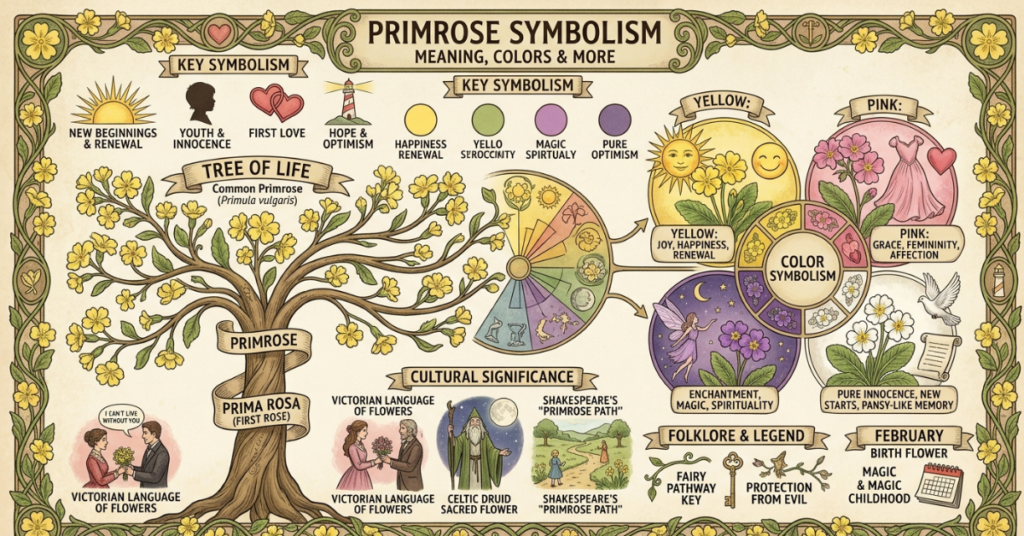
At its core, primrose symbolism meaning revolves around love, youth, innocence, affection, and renewal.
The flower’s early spring appearance plays a major role in these associations. The genus name Primula comes from the Latin primus, meaning “first,” which refers to the plant’s early flowering period. The name primrose also carries the historical idea of a “first rose.”
That connection with the beginning of spring gives the flower a natural link to fresh starts and new emotions. Traditional interpretations commonly connect primroses with:
- Young or new love
- Eternal love and devotion
- Youth and innocence
- Hope and renewal
- Protection
- Affection and tenderness
- New beginnings
Victorian flower symbolism also gave the primrose a strong romantic message. Some traditions associated the flower with young love and intense emotional attachment, including the dramatic sentiment, “I can’t live without you.”
Of course, flower meanings do not follow one universal rulebook. Culture, history, literature, and personal interpretation can all influence symbolism. That is why primrose meanings may differ slightly from one source to another.
Primrose Symbolism and the Language of Flowers
During the Victorian era, flowers often carried messages that people could not easily express aloud. This practice became known as floriography, or the language of flowers.
Within that tradition, a primrose could express strong affection and young love. The message gives the modest-looking flower a surprisingly passionate character.
Folklore adds another interesting layer. In Irish tradition, people sometimes placed primroses near doorways because they were thought to offer protection from fairies. Other European stories also connected the flower with magical or supernatural beliefs.
So, depending on the context, a primrose can suggest both romance and protection. That combination helps explain why the flower has remained symbolically rich for centuries.
Evening Primrose Symbolism
The names may sound almost identical, but evening primrose and common primrose refer to different plants.
Common primrose belongs to the genus Primula. Evening primrose belongs to the genus Oenothera. The common evening primrose, Oenothera biennis, stands out because its yellow flowers usually open in the evening or at night.
That unusual habit gives evening primrose symbolism a different emotional quality. Along with the traditional associations of love and renewal, people can interpret the flower as a symbol of:
- Hope during dark times
- Quiet beauty
- Transformation
- Patience
- Hidden emotions
- Renewal after hardship
Some of these meanings come from modern interpretation rather than historical flower dictionaries. Still, the flower’s nighttime blooming naturally encourages ideas about mystery, resilience, and finding beauty in unexpected moments.
Is Evening Primrose the Same as Primrose?
No. The two plants belong to different genera.
Primrose (Primula vulgaris) is a low-growing perennial that flowers in early spring. Evening primrose (Oenothera biennis) grows much taller and produces yellow flowers that open later in the day.
This distinction becomes especially important when discussing The Hunger Games. In Mockingjay, Katniss recognizes the evening primrose as the flower connected with her sister Primrose.
Primrose Symbolism by Color
Flower color can influence the emotional message people associate with a bloom. Cultivated primroses appear in shades such as yellow, pink, red, white, orange, and purple.
Still, color symbolism does not have one fixed meaning across every culture. Different flower guides sometimes offer slightly different interpretations.
The following meanings represent the most common modern associations.
Red Primrose Symbolism
Red primrose symbolism often centers on passion, attraction, young love, and romantic longing.
Red traditionally carries a strong romantic message, so the color can intensify the primrose’s connection with love. A red primrose may suggest:
- Passionate affection
- Romantic attraction
- Young love
- Longing
- Deep emotional interest
For someone who wants a romantic flower with a softer and less expected look than a classic red rose, the red primrose can make a thoughtful choice.
Pink Primrose Symbolism
Pink primrose symbolism feels softer and more delicate than its red counterpart.
Pink flowers often evoke tenderness, grace, affection, and gentle romance. Because of that, pink primroses can suit a new relationship, a close friendship, or any situation where you want to express warmth without overwhelming intensity.
A pink primrose can represent:
- Tender love
- Grace
- Affection
- Gentleness
- Youthful romance
- Emotional warmth
Its softer appearance also makes it appealing for bouquets, spring arrangements, and sentimental gifts.
Pink Evening Primrose Symbolism
The phrase pink evening primrose symbolism usually refers to the symbolic interpretation of pink-flowered evening primrose varieties.
When you combine the softness of pink with the evening-opening nature of the plant, the symbolism can suggest gentle affection, emotional sensitivity, quiet beauty, and hope during periods of change.
There is no single historical tradition that assigns one official meaning to this exact combination. It works better as a modern symbolic interpretation.
Yellow Primrose Symbolism
Yellow primrose symbolism often reflects happiness, warmth, friendship, optimism, and hope.
Yellow suits the flower especially well because the familiar wild primrose produces bright yellow blooms that appear during the spring season. Its cheerful color naturally reinforces the idea of brighter days ahead.
A yellow primrose can represent:
- Happiness
- Warmth
- Friendship
- Optimism
- Affection
- Hope
- New beginnings
That makes yellow primroses especially suitable for birthdays, spring celebrations, friendship gifts, and moments when you want to encourage someone.
White Primrose Symbolism
White primrose symbolism varies more than some of the other color meanings.
White flowers commonly represent purity, innocence, peace, remembrance, and fresh starts. In some modern floral traditions, people also connect white primroses with grief or mourning.
As a result, a white primrose can suggest:
- Innocence
- Purity
- Remembrance
- Peace
- New beginnings
- Sympathy
Context matters here. A white primrose in a wedding bouquet might highlight innocence and a fresh chapter, while the same flower in a memorial arrangement could express remembrance.
Primrose Symbolism in The Hunger Games
One of the most memorable examples of primrose symbolism in literature appears in The Hunger Games trilogy.
Primrose Everdeen, affectionately called Prim by Katniss, is Katniss’s younger sister. When Prim’s name appears at the Reaping for the 74th Hunger Games, Katniss immediately volunteers to take her place.
That decision reveals how deeply Katniss loves her sister. From that point onward, Prim becomes one of the clearest representations of innocence and compassion in the story.
Prim naturally gravitates toward healing rather than violence. She cares for people and animals, studies medicine, and represents the gentler side of life that the war threatens to destroy.
Her flower name therefore carries more weight than it first appears to.
Why Is Primrose Important in The Hunger Games?
The flower mirrors several important qualities in Prim’s character.
Traditional primrose symbolism includes youth, innocence, and love. Primrose Everdeen embodies those same qualities throughout the story. Her gentleness contrasts sharply with the violence surrounding Katniss.
The flower also becomes closely tied to memory.
Near the end of Mockingjay, Peeta brings plants back to District 12 and grows them near Katniss’s home. At first, Katniss thinks he has brought roses. Roses have painful associations for her because of President Snow.
Then she recognizes the flowers as evening primroses.
That discovery changes the emotional meaning of the scene. Instead of reminding Katniss of Snow and political violence, the flowers remind her of Prim.
The primrose therefore becomes a symbol of:
- Love
- Innocence
- Grief
- Memory
- Healing
- Hope after loss
Primrose vs. Rose in The Hunger Games
The contrast between the two flowers makes the symbolism even more meaningful.
| Flower | Symbolic association |
| Evening primrose | Prim, innocence, memory, love, healing |
| White rose | Snow, intimidation, trauma, control |
| Dandelion | Hope, survival, renewal |
| Katniss flower | Identity, survival, resilience |
The flowers do more than decorate the story. They help readers understand characters, memories, relationships, and emotional turning points.
What Does Primrose Represent After Prim’s Death?
Prim’s death changes the emotional meaning of the flower.
When Peeta plants evening primroses beside Katniss’s home, the flowers give her a living reminder of her sister. Katniss cannot undo what happened, but the flowers help her carry Prim’s memory into a future that still exists.
That makes the primrose more than a symbol of innocence.
It can also represent remembering someone while learning to continue living after loss.
Spring reinforces that idea. Primroses appear as winter gives way to new growth, so they naturally fit themes of survival, renewal, and moving forward.
Primrose Symbolism in Different Traditions
Flower symbolism has developed across many cultures and historical periods. As a result, the primrose does not have one universal definition.
Here are several important associations:
- Victorian flower language: young love and strong emotional attachment.
- European folklore: protection, fairies, and supernatural beliefs.
- Spring symbolism: hope, renewal, and the return of life after winter.
- Literature: youth, beauty, mortality, and the short nature of life.
- Modern floral symbolism: love, affection, friendship, remembrance, and new beginnings.
The surrounding context matters just as much as the flower itself. A primrose in a romantic bouquet may communicate affection, while one in a memorial garden can carry a much more reflective meaning.
Primrose Symbolism for Tattoos
A primrose tattoo can hold a deeply personal meaning. Some people choose the flower simply because they love its appearance, while others use it to represent a specific memory or emotion.
Common symbolic reasons for choosing a primrose tattoo include:
- Remembering a loved one
- Representing childhood or innocence
- Honoring a first love
- Expressing eternal affection
- Celebrating personal growth
- Symbolizing hope after a difficult period
- Marking a new beginning
- Referencing The Hunger Games
Fans of the series may pair a primrose with a mockingjay, arrow, or another meaningful symbol from the books.
Color can shape the design as well. Yellow can give a tattoo a hopeful, cheerful feeling, while pink or white may create a softer and more sentimental appearance.
Is Primrose a Good Flower to Give as a Gift?
Absolutely. Primrose works especially well when you want a gift to carry a little more meaning.
You might choose primroses for:
- A new relationship
- Valentine’s Day
- A close friend
- A birthday
- A spring celebration
- Someone beginning a new chapter
- A sentimental or memorial gift
The color can help you choose the right emotional tone. Red and pink work beautifully for affection, while yellow feels more cheerful and friendly.
Primrose Symbolism at a Glance
| Primrose type or color | Common symbolic meaning |
| Primrose | Eternal love, youth, affection, renewal |
| Evening primrose | Hope, quiet beauty, renewal, transformation |
| Red primrose | Passion, young love, longing |
| Pink primrose | Tenderness, grace, affection |
| Pink evening primrose | Gentle affection, sensitivity, renewal |
| Yellow primrose | Happiness, warmth, friendship, optimism |
| White primrose | Innocence, purity, remembrance, peace |
These meanings represent common symbolic interpretations rather than universal rules.
Frequently Asked Questions About Primrose Symbolism
What is the main meaning of primrose symbolism?
The main primrose symbolism meaning centers on young love, eternal affection, youth, innocence, hope, and renewal. Victorian flower traditions especially connect the flower with young love and emotional attachment.
What does evening primrose symbolize?
Evening primrose can symbolize hope, renewal, quiet beauty, transformation, and resilience. Its habit of opening in the evening also encourages modern interpretations involving mystery and finding beauty during darker moments.
What does a red primrose symbolize?
Red primrose symbolism commonly suggests passion, romantic attraction, young love, and emotional longing.
What does a pink primrose symbolize?
Pink primrose symbolism often represents tenderness, grace, gentle affection, youthful romance, and emotional warmth.
What does a yellow primrose symbolize?
Yellow primrose symbolism commonly connects with happiness, friendship, optimism, warmth, affection, and hope.
What does white primrose symbolize?
White primrose symbolism can represent purity, innocence, peace, remembrance, and new beginnings. Depending on the tradition, it may also carry associations with sympathy or mourning.
What is the primrose symbolism in The Hunger Games?
In The Hunger Games, Primrose represents innocence, compassion, love, and the goodness that Katniss wants to protect. The evening primrose later becomes a powerful symbol of memory and healing after Prim’s death.
Is Primrose Everdeen named after a real flower?
Yes. Primrose Everdeen takes her name from the evening primrose, which Katniss recognizes near the end of Mockingjay.
Is evening primrose the same as common primrose?
No. Common primrose belongs to the genus Primula, while evening primrose belongs to the genus Oenothera. Despite the similar names, they are different plants.
Final Thoughts on Primrose Symbolism
Primrose symbolism brings together several themes that make this flower much more meaningful than its delicate appearance suggests. Its traditional associations include young love, eternal affection, innocence, hope, and renewal.
Color adds another layer. Red can suggest passion, pink often expresses tenderness, yellow brings warmth and optimism, and white can evoke purity or remembrance.
The flower becomes even more meaningful in The Hunger Games. Through Primrose Everdeen, the evening primrose represents innocence, love, loss, memory, and healing. By the end of the story, it also suggests something quietly hopeful: grief can remain part of your life without taking away your ability to move forward.
That is perhaps the most beautiful part of primrose symbolism. A small flower can hold love, memory, and the promise of a new beginning all at once.