
Blue Salvia Meaning
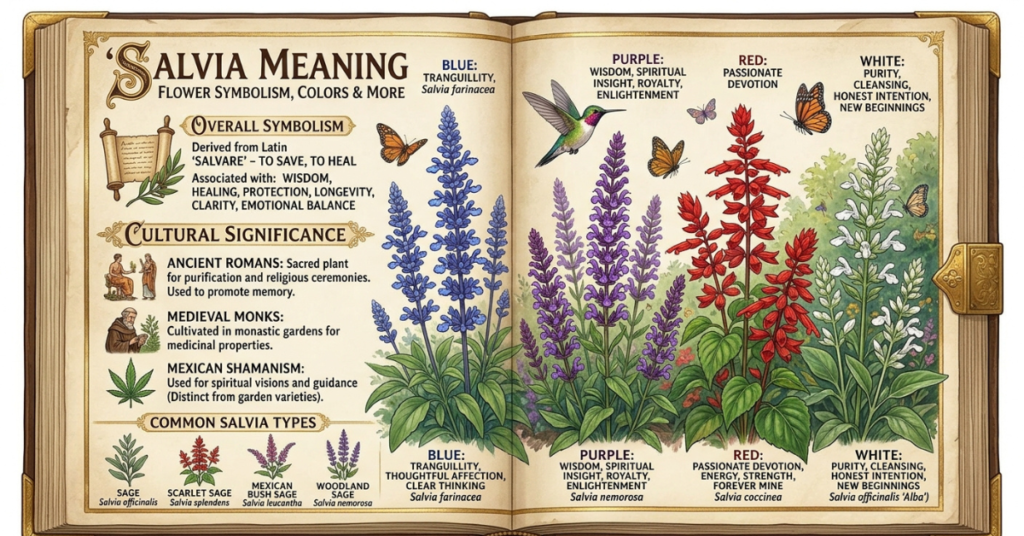
The blue salvia meaning often centers on peace, calmness, trust, wisdom, and serenity. Its cool blue flowers naturally create a relaxed and soothing impression, which makes these symbolic associations feel especially fitting.
Gardeners love blue salvia for more than its symbolism. Many Salvia species produce blue or violet-toned flowers, and their upright flower spikes can add a soft, elegant touch to outdoor spaces.
In flower symbolism, blue salvia can represent:
- Peace
- Calmness
- Trust
- Wisdom
- Spiritual reflection
- Serenity
As a result, blue salvia can make a thoughtful symbolic flower for someone experiencing a major change or simply someone who appreciates quiet, understated beauty.
Blue Salvia Meaning in a Song
If you searched for “blue salvia meaning song,” the answer depends on the specific song and its lyrics. Unlike traditional flower symbolism, music does not give “blue salvia” one universal meaning.
For example, a songwriter might use blue salvia to evoke nature, memories, healing, beauty, nostalgia, or a deeply personal experience. Therefore, you need the song’s context before deciding what the phrase means.
Red Salvia Meaning
The red salvia meaning often draws from the traditional symbolism of the color red. Red flowers tend to evoke passion, energy, courage, love, vitality, and confidence.
Because of these associations, red salvia can feel more energetic and emotionally expressive than blue varieties.
Common symbolic associations include:
- Passion
- Energy
- Courage
- Love
- Vitality
- Confidence
Red salvia also stands out in gardens. For example, Salvia coccinea, commonly called scarlet sage, produces striking red flowers.
Keep in mind, however, that flower-color meanings remain symbolic rather than scientific. Different cultures and traditions may interpret the same color in different ways.
Purple Salvia Meaning
The purple salvia meaning often connects with wisdom, dignity, spirituality, admiration, and mystery.
Purple has long carried associations with royalty, imagination, depth, and spiritual awareness. When you combine those ideas with salvia’s traditional connection to wisdom and health, purple salvia can convey a thoughtful and meaningful message.
Purple salvia may symbolize:
- Wisdom
- Spirituality
- Dignity
- Admiration
- Inner strength
- Mystery
Because several Salvia varieties naturally produce purple flowers, these symbolic associations also fit the plant’s appearance beautifully.
Salvia Meaning in English
In English, salvia functions mainly as a botanical term. It refers to plants belonging to the Salvia genus within the mint family, Lamiaceae.
The word sage, meanwhile, commonly refers to several Salvia plants. In cooking, people usually use “sage” to mean Salvia officinalis, or common sage.
In simple terms:
Salvia = the botanical genus
Sage = a common name used for certain Salvia plants
That distinction explains why a plant label might say “Salvia” while a recipe simply asks for “sage.”
Salvia Meaning in Hindi
The salvia meaning in Hindi usually appears as सैल्विया (Salvia) or साल्विया. In other words, Hindi commonly transliterates the botanical name rather than replacing it with an entirely different word.
Because Salvia contains many different species, one Hindi term does not necessarily describe every plant in the genus. Depending on the species and region, people may use a more specific local name.
For practical purposes:
Salvia in Hindi: सैल्विया / साल्विया
Sage-related meaning: an aromatic herb or plant
Therefore, the exact Hindi name can vary when you refer to a particular Salvia species.
Salvia Meaning in Tamil
The salvia meaning in Tamil can vary because “Salvia” primarily functions as a botanical name rather than an everyday Tamil word.
Tamil references may use a transliteration of “Salvia,” while related terms for sage can describe an aromatic herb used in cooking.
For that reason, the safest interpretation depends on the species you mean. If you’re discussing the botanical genus, keeping the scientific name “Salvia” usually provides the clearest meaning.
Salvia Meaning in Telugu
The salvia meaning in Telugu generally refers to the Salvia plant or sage family. Since the genus contains numerous species, Telugu does not necessarily have one everyday word that accurately describes all of them.
In gardening and botanical contexts, speakers may therefore retain or transliterate the scientific name “Salvia.”
If you mean a particular species, such as common sage or scarlet sage, its Telugu name may differ.
Salvia Meaning in Malayalam
Similarly, the salvia meaning in Malayalam generally refers to the Salvia plant genus or sage-related plants.
However, the exact Malayalam name can depend on the species. In botanical and gardening contexts, people may simply use the scientific name “Salvia.”
This distinction matters because botanical genera do not always have a single equivalent everyday name in every language.
Salvia Meaning Slang
The search term “salvia meaning slang” often appears because people encounter the word in drug-related conversations online.
Strictly speaking, “salvia” does not have one general English slang definition. Instead, some people use the word as shorthand for Salvia divinorum, a particular psychoactive species.
For example, the U.S. Drug Enforcement Administration lists “Salvia,” “Sally-D,” and “Maria Pastora” among names associated with Salvia divinorum.
Therefore, when someone mentions salvia in a drug-related conversation, they may mean Salvia divinorum rather than an ornamental garden plant.
Salvia Meaning as a Drug
This distinction deserves special attention.
Salvia does not automatically mean a drug. The word describes a large botanical genus that includes ornamental plants and culinary herbs.
However, Salvia divinorum is a specific species with psychoactive properties. It can produce powerful changes in perception, including hallucinations, dizziness, impaired coordination, fear, panic, and paranoia.
The compound responsible for its psychoactive effects is salvinorin A. Common culinary sage, on the other hand, is a different plant and should not be confused with Salvia divinorum.
So, the distinction is simple:
Garden salvia ≠ automatically a drug
Salvia officinalis = common culinary sage
Salvia divinorum = a distinct psychoactive species
Understanding this difference can prevent confusion when you search for the salvia meaning drug.
What Does “Gas Station Salvia” Mean?
The phrase “gas station salvia meaning” usually appears in discussions about psychoactive salvia products sold or marketed through convenience stores, smoke shops, or similar retailers.
In that context, “salvia” generally refers to products marketed as containing or relating to Salvia divinorum, rather than an ordinary garden variety.
However, “gas station salvia” is not a botanical term or standardized dictionary definition. Retail products can differ in labeling, ingredients, availability, and legal status depending on the location and time.
For that reason, you should not assume that every product labeled “salvia” contains the same species or a predictable amount of a psychoactive compound.
What Does “Burro e Salvia” Mean?
The Italian phrase “burro e salvia” translates directly to “butter and sage.”
You will usually encounter the expression in Italian cooking. Cooks often combine melted or browned butter with sage and serve the sauce with pasta such as ravioli or tortelli.
The combination works particularly well because rich butter complements sage’s earthy and aromatic flavor.
For example:
ravioli al burro e salvia
simply means ravioli with butter and sage.
Burro e Salvia Meaning in English
The most natural English translations include:
- Butter and sage
- Sage butter
- Butter-and-sage sauce
Unlike some search results might suggest, burro e salvia isn’t slang or a hidden expression. It is simply an Italian culinary phrase.
Why Is Salvia Associated With Health and Healing?
Salvia’s connection with health goes back centuries. The name itself traces to Latin salvus, a word associated with being healthy or safe.
Meanwhile, people have valued sage for culinary and traditional herbal uses for a very long time. That history helps explain why flower symbolism often connects salvia with:
- Health
- Healing
- Longevity
- Wisdom
- Protection
Still, historical use and modern medical evidence are two different things. Traditional beliefs do not automatically prove that a plant can treat a particular health condition.
Therefore, it is important to distinguish cultural or historical symbolism from scientifically established medical benefits.
What Do Different Salvia Colors Symbolize?
Flower-color symbolism can vary between cultures and traditions. Nevertheless, these common interpretations can help you understand the symbolism behind different salvia colors.
Blue salvia
Peace, wisdom, calm, trust, and serenity
Red salvia
Passion, courage, energy, and vitality
Purple salvia
Wisdom, spirituality, dignity, and admiration
Pink salvia
Affection, gentleness, appreciation, and tenderness
White salvia
Purity, remembrance, peace, and clarity
These interpretations can help when you’re researching blue salvia meaning, red salvia meaning, or purple salvia meaning. However, remember that flower symbolism represents cultural interpretation rather than scientific fact.
Final Thoughts on Salvia Meaning
The salvia meaning depends largely on context. In gardening, Salvia refers to a diverse genus of flowering plants. In the kitchen, “sage” usually refers to Salvia officinalis. Meanwhile, flower symbolism connects salvia with wisdom, health, longevity, and esteem.
The word can also point to something completely different. Salvia divinorum is a distinct psychoactive species, while burro e salvia simply means “butter and sage” in Italian cooking.
Ultimately, salvia has botanical, historical, culinary, cultural, and symbolic meanings. When you come across the word in a song, translation, flower arrangement, or online conversation, look at the surrounding context before deciding what it means.
If you enjoy learning about flower meanings, you can also explore the symbolism behind other flowers, herbs, and colorful garden plants.