
Some flowers are beautiful in a familiar way. Others make you stop and wonder whether they are even real. Blue puya belongs firmly in the second category.
Known for its dramatic spikes of metallic-looking turquoise-blue flowers, the blue puya flower is one of the most unusual ornamental plants associated with the bromeliad family. Its intense color, architectural shape, and exotic appearance have made it increasingly popular among plant lovers, botanical garden visitors, and people searching for rare flowering plants.
The plant most commonly connected with this name is Puya berteroniana, sometimes written as blue puya (Puya berteronian) in plant listings and searches. In this guide, we’ll explore the blue puya meaning, appearance, origins, growing requirements, interesting facts, and what to know when looking for blue puya for sale or trying to order blue puya online.
What Is Blue Puya?
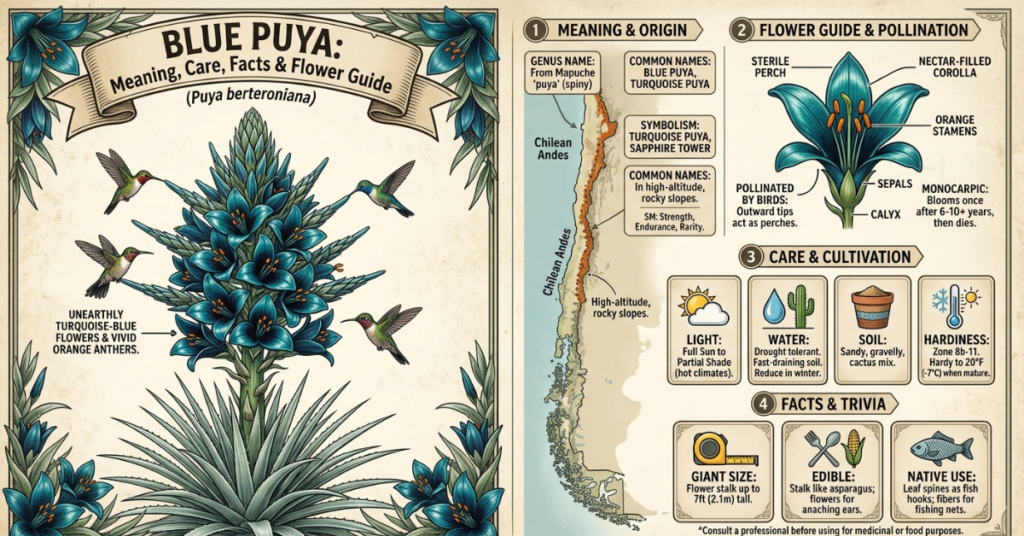
Blue puya is a striking flowering plant from the genus Puya, a group of terrestrial bromeliads native primarily to South America. The species most famously associated with spectacular blue-green flowers is Puya berteroniana.
Unlike the softer, tropical-looking bromeliads many people recognize as houseplants, a mature blue puya plant has a much more dramatic and rugged appearance. It forms a dense rosette of long, narrow leaves, often with sharp spines along their edges.
When the plant flowers, it produces a tall flower spike covered with unusual blossoms. The flowers are generally described as blue, turquoise, teal, or blue-green, depending on the light and stage of bloom.
Blue Puya Quick Facts
- Botanical name: Puya berteroniana
- Plant family: Bromeliaceae
- Common name: Blue puya
- Native region: Chile
- Growth habit: Terrestrial, clump-forming bromeliad
- Flower color: Turquoise-blue to blue-green
- Flower spike: Tall and dramatic
- Foliage: Long, narrow, spiny leaves
- Best known for: Its rare-looking blue flowers and architectural form
Blue Puya Plant: What Does It Look Like?
Before it blooms, the blue puya plant can look surprisingly different from the flower photos that usually attract people’s attention online.
The plant grows as a rosette of tough, elongated leaves. These leaves can be stiff and sharply edged, giving the plant a sculptural appearance. As it matures, it may form offsets and develop into a larger clump.
The real show begins when the flower stalk appears.
The Spectacular Blue Puya Flower
The flowering stem rises above the foliage and carries numerous blossoms. A blue puya flower is especially eye-catching because of its unusual combination of colors and shapes.
The petals can appear:
- Turquoise-blue
- Greenish-blue
- Teal
- Metallic blue-green
The flowers are often contrasted by bright orange or yellow anthers, creating a color combination that looks almost artificial. This contrast is one reason blue puya flowers are so popular in botanical photography and flower illustration.
Depending on growing conditions and lighting, photographs of the same species can look noticeably different. This is worth remembering when searching for blue puya for sale, since edited product photos may exaggerate the intensity of the blue color.
Blue Puya Alpestris vs. Puya Berteroniana
One source of confusion is the search term blue puya alpestris.
Puya alpestris and Puya berteroniana are closely related plants and both belong to the same genus. They can have similarly dramatic blue or blue-green flowers, so their names are sometimes confused in casual gardening discussions and online searches.
However, they are distinct species.
Puya berteroniana
Puya berteroniana is especially famous for its tall flower spikes and vivid turquoise-colored flowers. It is one of the species most often associated with the common name blue puya.
Puya alpestris
Puya alpestris is another Chilean species admired for its striking blue-toned flowers. Depending on the nursery, region, and common naming practices, gardeners may encounter different names used for similar-looking plants.
The simplest advice is to check the botanical name before buying. If you specifically want blue puya (Puya berteroniana), look for that scientific name rather than relying only on a common name.
Where Does Blue Puya Grow Naturally?
Blue puya is associated with Chile, where species in the Puya genus grow in environments that can be dry, rocky, sunny, and challenging.
This background explains much about the plant’s appearance and care needs. Its stiff foliage and tough structure are adaptations that suit relatively harsh conditions better than constantly wet or humid environments.
A blue puya is therefore not a typical delicate tropical houseplant. It is better understood as an unusual terrestrial bromeliad adapted to strong light and well-drained growing conditions.
Blue Puya Meaning and Symbolism
There is no universally established historical flower language for the blue puya meaning in the same way that roses or lilies have long-standing symbolic traditions.
Still, because of its appearance, blue puya can naturally be associated with several symbolic ideas.
Possible Blue Puya Flower Meanings
Uniqueness
The unusual color and dramatic structure make blue puya a natural symbol of individuality.
Strength and resilience
Its tough, spiny foliage suggests endurance and the ability to thrive in challenging conditions.
Mystery
The uncommon blue-green flowers can create an almost otherworldly impression.
Creativity
Because it looks so different from traditional garden flowers, blue puya can represent originality and artistic thinking.
Transformation
The contrast between its rugged foliage and spectacular blooms can symbolize the idea that something extraordinary can emerge from an unexpected place.
So, if someone asks about the blue puya flower meaning, the most appropriate answer is that its symbolism is largely modern and visual rather than based on one fixed traditional interpretation.
How to Grow and Care for a Blue Puya Plant
Growing blue puya successfully requires understanding its basic nature. It generally prefers conditions closer to a sunny, well-drained garden than to a damp indoor tropical environment.
Light Requirements
Blue puya generally performs best with plenty of bright light. Outdoor plants may tolerate substantial sun, particularly when they have gradually adapted to the conditions.
Young plants and plants moved into stronger sunlight should be acclimated carefully to reduce the risk of leaf damage.
Soil Requirements
Excellent drainage is essential.
A suitable growing medium should be loose and free-draining rather than heavy and waterlogged. Gardeners often use gritty or mineral-rich mixes for plants that dislike having constantly wet roots.
A practical mix may include components such as:
- Coarse sand
- Perlite or pumice
- Grit
- Well-draining potting material
The exact formula can vary depending on climate, but the goal is the same: excess water should not remain around the roots for long periods.
Watering Blue Puya
Blue puya should not be treated like a plant that needs constantly moist soil.
Water thoroughly when the growing medium begins to dry, then allow appropriate drying between waterings. The amount and frequency will depend on temperature, sunlight, pot size, soil type, and whether the plant is actively growing.
Overwatering is generally a greater risk than slightly underwatering an established plant.
Temperature and Climate
Blue puya species are associated with Chilean environments, but cold tolerance can vary depending on the species, plant age, and local conditions.
Gardeners in cold climates often grow young plants in containers so they can be protected during severe weather. Before planting outdoors permanently, check the hardiness information for the exact species and your local climate.
Fertilizer
Blue puya does not usually need excessive feeding.
During active growth, a modest amount of balanced fertilizer can support development. Avoid the idea that more fertilizer automatically means faster flowering; excessive feeding can create problems and may encourage foliage growth without improving overall plant health.
How Long Does Blue Puya Take to Flower?
Patience is important.
One of the most common surprises for new growers is that a young blue puya plant may take years to reach flowering maturity. The exact timing depends on the species, growing conditions, climate, and whether the plant was purchased as a seedling or a mature specimen.
This is not a plant to buy if your main goal is immediate flowers.
However, mature blue puya plants can become spectacular focal points. Their dramatic flowering display can make the long wait worthwhile for collectors and botanical gardeners.
Does Blue Puya Die After Flowering?
Like many bromeliads, the life cycle of Puya species can be confusing to first-time growers.
A mature rosette may eventually decline after flowering, but the plant can also produce offsets or additional growth that continues the clump. The exact growth pattern depends on the species and individual plant.
Do not remove offsets too quickly. Allow them to develop sufficiently before separating them, especially if you are trying to establish new plants.
Blue Puya Facts You May Not Know
Looking for interesting blue puya facts? Here are some of the things that make this plant particularly fascinating.
1. It Belongs to the Bromeliad Family
Despite looking very different from many familiar bromeliads, blue puya is part of the Bromeliaceae family.
2. Its Flowers Can Look Almost Metallic
The combination of turquoise petals and contrasting reproductive structures gives the flowers an unusual, jewel-like appearance.
3. The Leaves Can Be Sharp
The edges of the foliage may contain spines, so handling a mature plant requires care. This is definitely not the best plant for placing beside a narrow walkway where people may brush against it.
4. It Can Become a Major Garden Feature
A mature flowering spike can create serious visual impact. Blue puya works particularly well as an architectural or statement plant in suitable climates.
5. Flowering Requires Patience
A small plant may need years of growth before producing its famous flowers.
6. It Is a Popular Subject for Botanical Art
Because the flower shape is so unusual, blue puya drawing searches are popular among botanical artists, illustrators, tattoo designers, and flower enthusiasts.
How to Create a Blue Puya Drawing
The unusual structure of blue puya makes it an excellent subject for botanical illustration.
If you are making a blue puya drawing, focus on three main features:
- The spiky leaf rosette – Start with long, narrow leaves radiating outward.
- The tall flower stalk – Keep the stem upright and slightly tapered.
- The distinctive flowers – Observe the curved petals and contrasting anthers carefully.
For a more realistic botanical drawing, study several reference photographs rather than copying only one heavily edited image. Natural lighting can change how blue or green the flowers appear.
Blue Puya for Sale: What to Check Before Buying
If you’re searching for blue puya for sale, take your time before placing an order.
Rare plants can be sold under confusing common names, and the plant in a product photo may not always match the exact species advertised.
Check These Details Before You Buy
- Confirm the full botanical name.
- Ask whether the plant is Puya berteroniana or another Puya species.
- Check the plant’s current size.
- Ask whether it is seed-grown or an offset.
- Look for information about the plant’s age or maturity.
- Check whether the seller ships legally to your location.
- Read reviews about packaging and plant condition.
- Consider your climate and winter temperatures.
A tiny seedling may cost less, but it may also take a long time to develop into a flowering specimen.
How to Order Blue Puya Online Safely
Searching blue puya order online can produce results from specialist nurseries, seed sellers, plant marketplaces, and collectors.
Before ordering, compare more than just the price.
A Smart Buying Checklist
- Verify the species name.
- Check whether you are buying seeds, a seedling, or a mature plant.
- Read the seller’s description carefully.
- Check shipping restrictions and import requirements.
- Review the return or replacement policy.
- Look at recent customer feedback.
- Avoid sellers making unrealistic claims about instant flowering.
If you are buying seeds, remember that flower color and growth characteristics may not be identical to a particular edited online photograph.
Blue Puya and Prive Revaux Blue Puya Blue Light Readers
The phrase “Prive Revaux Blue Puya blue light readers” may appear in searches alongside the plant name, but it refers to an unrelated product name rather than the botanical blue puya plant.
This is a good example of why search results can sometimes mix completely different topics that happen to share the same words. Someone researching Puya berteroniana should focus on botanical or nursery information, while someone looking for blue-light reading glasses should search within eyewear categories.
The two topics are not related beyond the shared use of the name Blue Puya.
Common Problems When Growing Blue Puya
Yellowing Leaves
Yellowing can have several causes, including aging foliage, excessive moisture, poor drainage, or environmental stress.
Check the soil before watering again. If the growing medium remains wet for long periods, improving drainage may be necessary.
Brown Leaf Tips
Brown tips can result from environmental stress, mineral buildup, inconsistent watering, or damage. Avoid assuming there is only one cause without examining the overall growing conditions.
No Flowers
A young plant may simply not be mature enough. Blue puya is not known for rapid flowering, and insufficient light can also affect growth and flowering potential.
Root Problems
Heavy, poorly drained soil can create unhealthy root conditions. Repotting into a more suitable, free-draining medium may help if excess moisture is the issue.
Is Blue Puya Suitable for Beginners?
Blue puya can be grown by beginners, but it is easier for gardeners who understand the importance of drainage and patience.
It may be a good choice if you:
- Enjoy unusual and rare-looking plants.
- Have access to bright outdoor light.
- Can provide excellent drainage.
- Don’t mind waiting years for flowers.
- Have enough space for a spiny, architectural plant.
It may not be ideal if you want a small, soft-leaved houseplant or an easy flowering plant that produces blooms quickly.
Frequently Asked Questions About Blue Puya
What is blue puya?
Blue puya generally refers to a striking Puya species, most commonly Puya berteroniana, known for its dramatic turquoise-blue or blue-green flowers and spiny foliage.
What is the blue puya flower meaning?
There is no single traditional meaning universally assigned to blue puya. Modern interpretations often connect it with uniqueness, resilience, creativity, mystery, and transformation.
Are blue puya flowers naturally blue?
Yes, the flowers naturally have remarkable blue, turquoise, and blue-green tones. Their appearance can vary depending on lighting, photography, and the stage of bloom.
Is blue puya the same as Puya berteroniana?
Puya berteroniana is one of the species most commonly associated with the common name blue puya. However, common names can vary, so checking the scientific name is always the safest approach.
Is blue puya alpestris the same plant?
No. Puya alpestris and Puya berteroniana are distinct species, although they are related and can have similarly striking blue-toned flowers.
How long does a blue puya plant take to flower?
It can take several years for a blue puya to reach flowering maturity. The timeline depends on the species, age, growing conditions, and climate.
Can I grow blue puya indoors?
A young plant may be grown in a bright location, but mature plants can become large and generally benefit from strong light and suitable outdoor conditions where the climate allows.
Where can I find blue puya for sale?
Specialist plant nurseries, botanical plant sellers, and reputable online nurseries may offer seeds or plants. Always confirm the botanical name and check local shipping or import regulations before ordering.
Are blue puya leaves dangerous?
The leaf edges can be sharp and spiny. Handle the plant carefully and place it away from areas where children, pets, or people could easily brush against the foliage.
Final Thoughts
The blue puya is one of those plants that can make even experienced gardeners look twice. From its rugged, spiny foliage to the extraordinary turquoise tones of the blue puya flower, Puya berteroniana offers something genuinely different from the average ornamental plant.
If you’re interested in a blue puya plant, remember that the biggest requirements are patience, strong light, excellent drainage, and enough room for the plant to mature. When searching for blue puya for sale or planning to order blue puya online, always check the botanical name and find out exactly whether you are buying seeds, a young plant, or a more mature specimen.
Whether you’re drawn to its unusual blue puya meaning, researching blue puya facts, or simply looking for inspiration for a blue puya drawing, this remarkable Chilean bromeliad proves that some of the most unforgettable flowers are also the most unexpected. Explore related guides on rare flowering plants, bromeliads, and drought-tolerant garden design to discover more plants with the same extraordinary visual appeal.